




01. Edit your form online
Type text, add images, blackout confidential details, add comments, highlights and more.

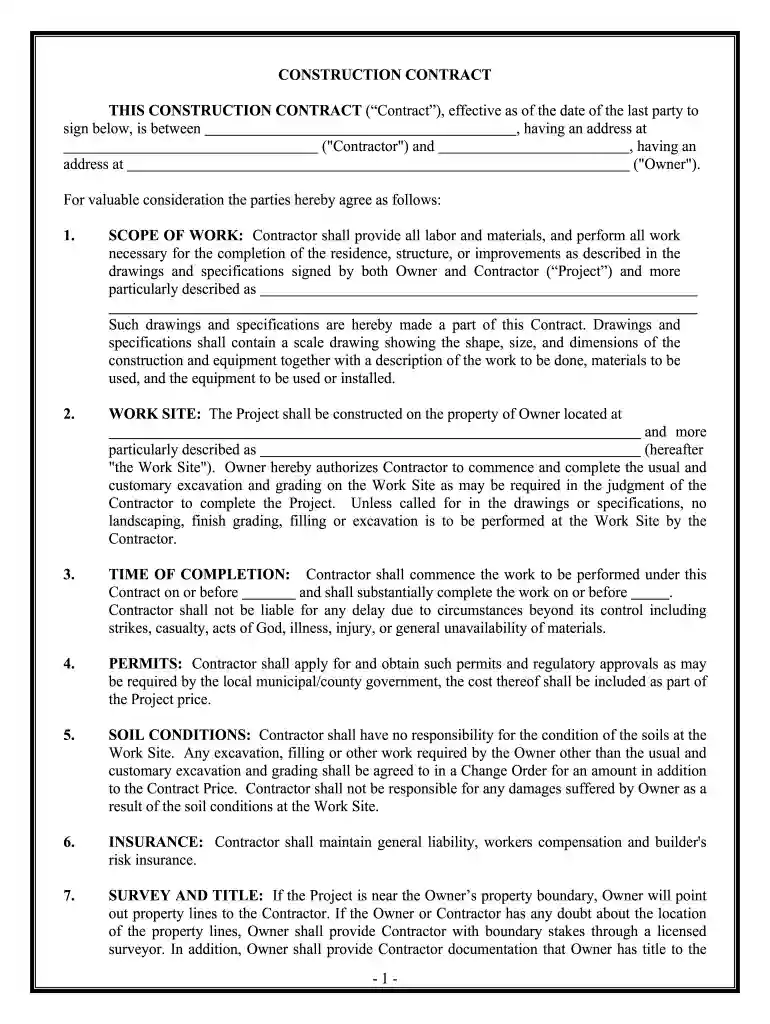
Type text, add images, blackout confidential details, add comments, highlights and more.

Draw your signature, type it, upload its image, or use your mobile device as a signature pad.

Send it via email, link, or fax. You can also download it, export it or print it out.
The Washington Construction Contract Cost Plus or Fixed Fee outlines the terms agreed upon between a contractor and an owner for a construction project. It specifies two potential payment structures: cost plus and fixed fee. In a cost-plus contract, the owner agrees to cover all construction costs plus an additional fee, often as a percentage of total costs, meant to cover the contractor's overhead and profit. In contrast, a fixed-fee contract stipulates a set payment agreed upon before the project begins, regardless of actual costs incurred. These agreements help set clear expectations for both parties and play a critical role in managing project costs and resources.
When using this form, both parties should clearly define the scope, timeline, and terms of payment. It is crucial to:
A residential developer might use a cost-plus contract for a project with potential design changes, while a commercial builder might favor a fixed fee for a straightforward office construction.
Filling out this contract involves several methodical steps to ensure accuracy and mutual understanding.
Understanding key terms is essential for managing and executing construction contracts effectively.
Several critical elements form the backbone of this contract:
Legal compliance is crucial, given Washington's specific construction contracting laws:
In a legal scenario, if a contractor fails to meet the agreed deadlines, the contract could specify penalties or remedies available to the owner, providing legal recourse under Washington state law.
Washington imposes state-specific requirements that must be adhered to:
Other states might have different requirements regarding defect disclosures or consumer rights, underscoring the need for Washington contractors to stay informed about local laws.
While the contract itself doesn't have filing deadlines, absorption of the following timeline considerations is critical:
Strong timeline management mitigates the risks of budget overruns and ensures adherence to deadlines, critical in construction project management.
We've got more versions of the Washington Construction Contract Cost Plus or Fixed Fee form. Select the right Washington Construction Contract Cost Plus or Fixed Fee version from the list and start editing it straight away!
At DocHub, your data security is our priority. We follow HIPAA, SOC2, GDPR, and other standards, so you can work on your documents with confidence.
by JS Ferrell 1962 A cost-plus contract is one in which the contractor agrees to do cer- tain work at cost plus a stated percentage of the cost as profit.
Cost plus fixed fee consultant agreements This type of agreement is likely used when the extent, scope, complexity, character, or duration of the work cannot


