




01. Edit your wind midigation fillable online online
Type text, add images, blackout confidential details, add comments, highlights and more.

Type text, add images, blackout confidential details, add comments, highlights and more.

Draw your signature, type it, upload its image, or use your mobile device as a signature pad.

Send downloadable wind mitigation form via email, link, or fax. You can also download it, export it or print it out.
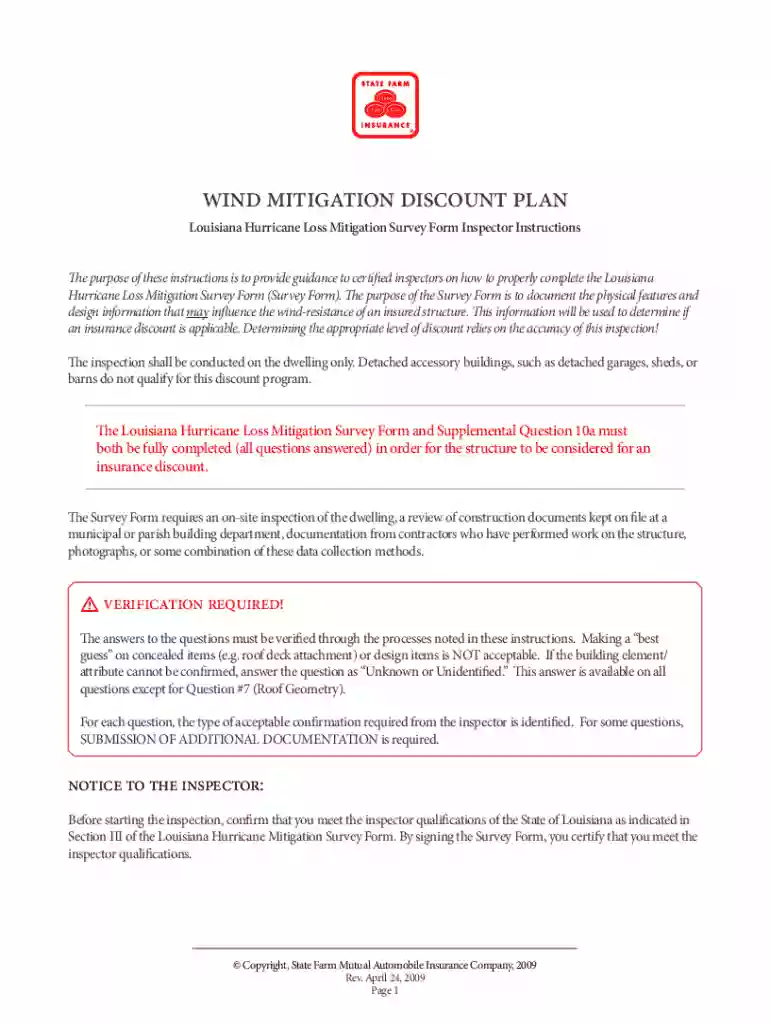
The Louisiana Wind Mitigation Form, also known as the Louisiana Uniform Mitigation Verification Inspection Form, is a document used to assess the wind-resistance features of a property. This form helps determine if a building or structure has adequate mitigation measures in place to withstand high wind events, such as hurricanes. Insurers often require this form to calculate insurance premiums, with potential discounts for properties that meet certain criteria. The form evaluates various aspects, including the roof's design, materials, and construction, as well as other structural elements like windows and doors.
The Louisiana Wind Mitigation Form is utilized primarily by homeowners, inspectors, and insurance companies. Homeowners or their designated inspectors complete the form, outlining the specific wind-resistant features of a property. Once completed, the form is submitted to the homeowner's insurance provider. The insurance company reviews the details to determine whether the property qualifies for discounts or reduced premiums based on its wind-resistant features.
Homeowners in hurricane-prone areas of Louisiana are the primary users of this form, seeking potential discounts on insurance premiums. Additionally, insurance agents and underwriters use the form to evaluate risks associated with insuring a property. Home inspection companies also rely on this form as part of their service offerings, ensuring properties meet necessary standards for wind resistance.


Louisiana mandates specific rules regarding the use and submission of wind mitigation forms. Only certified inspectors should complete the document, ensuring all sections are filled accurately to qualify for potential insurance benefits. While the form itself is standardized, regions within Louisiana might have additional criteria based on local building codes or recent amendments following major hurricanes.
Both digital and paper versions of the Louisiana Wind Mitigation Form are available. Digital submission is often more efficient, allowing easier access, completion, and submission processes. It also simplifies record-keeping and retrieval, ensuring quick communication between inspectors, homeowners, and insurance providers. Meanwhile, paper forms may still be required in situations where digital access is limited or for homeowners preferring physical documentation.
At DocHub, your data security is our priority. We follow HIPAA, SOC2, GDPR, and other standards, so you can work on your documents with confidence.


