
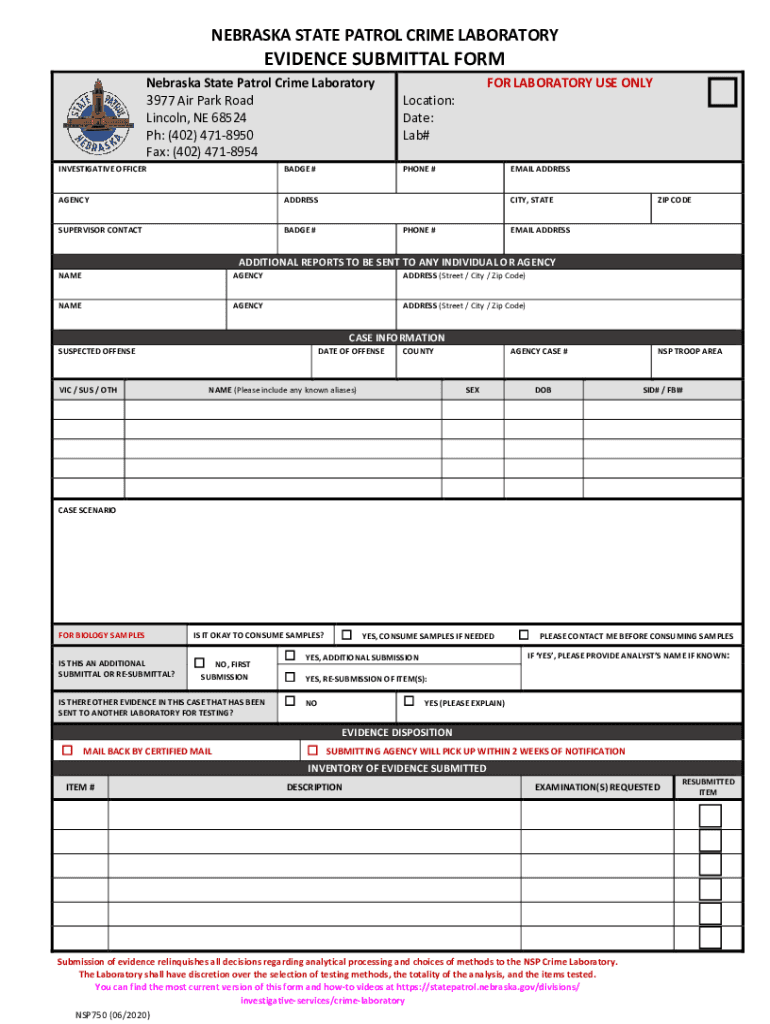







Definition and Purpose of the Nebraska State Patrol Crime Laboratory Evidence Submittal Form
The Nebraska State Patrol Crime Laboratory Evidence Submittal Form is a critical document used in the submission of evidence for criminal investigations. This form is essential for enabling the Nebraska State Patrol Crime Laboratory to receive, process, and analyze evidence pertinent to law enforcement activities. It provides a structured framework for detailing case information, evidence inventory, and chain of custody.
Key Features of the Form
- Investigative Officer Information: The form requires comprehensive details about the officer in charge of the investigation, ensuring accountability and facilitating communication.
- Case Details: Information such as the case number, type of offense, and relevant dates must be clearly noted to provide context for the evidence.
- Evidence Inventory: A detailed list of all items submitted as evidence, crucial for ensuring no items are misplaced or overlooked.
- Chain of Custody: This section maintains a record of each individual who handles the evidence, preserving its integrity for legal proceedings.
How to Use the Nebraska State Patrol Crime Laboratory Evidence Submittal Form
Filling out the Nebraska State Patrol Crime Laboratory Evidence Submittal Form involves several key steps to ensure accuracy and completeness, which are crucial for the evidence to be admissible in legal processes.
- Gather Required Information: Collect all necessary details about the case, including documentation of evidence and officer identification.
- Complete Investigative Officer Section: Provide full details of the officer, including name, badge number, and contact information.
- Detail Case Information: Accurately record the case number, type of crime, and any significant dates or notes that may be relevant to the laboratory's investigation and testing methods.
- List Evidence Items: Itemize each piece of evidence, including descriptions and any identifying marks or serial numbers.
- Track Chain of Custody: Log every transfer of evidence from one individual to another, ensuring each handler dates and signs the submittal form.
How to Obtain the Nebraska State Patrol Crime Laboratory Evidence Submittal Form
Obtaining the Nebraska State Patrol Crime Laboratory Evidence Submittal Form can be done through official law enforcement channels. Typically, individuals seeking the form are already engaged in a law enforcement capacity or their delegates.
- Police Departments: Law enforcement officers can often access this form through their internal systems or by direct request from the administrative departments.
- Direct Contact with the Crime Lab: Departments or authorized personnel may contact the Nebraska State Patrol Crime Laboratory directly to request this form.
Steps to Complete the Nebraska State Patrol Crime Laboratory Evidence Submittal Form
Filling out the form accurately is fundamental to its acceptance and the successful processing of evidence. Follow these step-by-step guidelines:
- Fill Out Officer Information: Start by entering all necessary identification for the investigating officer.
- Include Detailed Case Information: Provide a complete outline of the case specifics, ensuring no data is omitted.
- Inventory Evidence: Carefully document each evidence item, ensuring descriptions are precise.
- Document Chain of Custody: Record each transfer of evidence, securing an unbroken trail of documentation.
- Review for Accuracy: Double-check all entered information for completeness and correctness before submission.
Importance of the Nebraska State Patrol Crime Laboratory Evidence Submittal Form
This form plays a vital role in the criminal justice system. By ensuring that all relevant details are documented and that evidence integrity is maintained, the form helps uphold the judicial standards necessary for fair trials.
- Maintains Evidence Integrity: Proper documentation protects against questions of tampering or mishandling.
- Facilitates Efficient Processing: Clear, complete information aids the laboratory in timely and accurate analysis.
- Supports Legal Proceedings: With accurate chain-of-custody documentation, the legitimacy of the evidence presented in court is safeguarded.
Typical Users of the Nebraska State Patrol Crime Laboratory Evidence Submittal Form
The primary users of this form are those involved in law enforcement and legal proceedings:
- Law Enforcement Officers: Charged with evidence collection, they use this form to ensure organized submission to the laboratory.
- Crime Scene Investigators: Responsible for gathering, preserving, and documenting evidence details.
- Attorneys: Both prosecution and defense may reference the form to verify evidence handling.
- Judiciary: Judges and magistrates may refer to submittal forms during trials to confirm the legitimacy of evidence handling.
Key Elements of the Nebraska State Patrol Crime Laboratory Evidence Submittal Form
Understanding the elements of the form is crucial for its proper use:
- Officer and Agency Information: Accurate input is critical for accountability.
- Comprehensive Case Description: Ensures the laboratory has all contextual information.
- Detailed Evidence Inventory: All items must be itemized to prevent loss or misplacement.
- Accurate Chain of Custody Logs: An integral part of maintaining the legal integrity of the evidence.
Legal Use and Compliance for the Nebraska State Patrol Crime Laboratory Evidence Submittal Form
This form is not just a procedural document but a legal safeguard:
- Evidence Submission Protocols: Adhering to protocol is essential to ensure evidence is admissible in court.
- Legal Admissibility: Properly completed forms ensure that evidence can withstand legal scrutiny.
- Testing and Analysis Discretion: Submission implies consent to laboratory discretion regarding testing methods utilized.
These sections should provide a comprehensive overview of the Nebraska State Patrol Crime Laboratory Evidence Submittal Form, delivering both practical and legal insights while maintaining high utility for users engaged in the criminal justice field.




