Definition and Meaning
The United States Court of Appeals for the Fourth Circuit, often referred to as the Fourth Circuit, is a federal court with appellate jurisdiction over district courts in several states. This includes Maryland, Virginia, West Virginia, North Carolina, and South Carolina. The Fourth Circuit reviews cases decided in the district courts within its jurisdiction to ensure the correct application of law and adherence to procedural standards. These appeals often involve civil rights claims, administrative agency decisions, and constitutional issues.
Appellate Jurisdiction Cases
- Civil cases such as contract disputes and tort claims.
- Criminal cases from district courts.
- Administrative reviews of federal agency decisions.
- Constitutional challenges and civil rights cases.
Role in the Judicial System
- Supervises district court proceedings within the Fourth Circuit.
- Interprets federal laws and the U.S. Constitution.
- Serves as a crucial intermediary between district courts and the U.S. Supreme Court.
Steps to Complete an Appeal
Understanding the formal appeal process involves multiple detailed steps. This section outlines the comprehensive procedure for filing an appeal in the Fourth Circuit.
Preparing the Notice of Appeal
- Determine the Basic Requirements: Ensure the notice includes the case name, docket number, and date of the district court's judgment.
- File Timely: The notice of appeal must be filed within 30 days after the judgment or order being appealed.
- Serve Notice: The appellant must serve the notice to all parties involved and provide a proof of service document.
Compiling the Brief
- Research and Draft Arguments: Present legal and factual arguments related to the trial's record.
- Include Necessary Documents: Attach relevant excerpts from transcripts and pivotal documents.
- Abide by Formatting Rules: Follow the strict guidelines for typeface, margin, and length.
Submission Process
- File with the Court: Submit the appeal and accompanying documents electronically or by mail.
- Serve Opposing Counsel: Ensure opposing parties receive copies to prepare their responses.
- Submit Reply Briefs: File any responsive briefs as per court schedules after the opposing party files their document.
Frequent Users
- Attorneys and Litigants: Lawyers representing individuals, companies, or governmental entities in appellate matters.
- Government Agencies: Appeals involving administrative decisions, such as the Social Security Administration.
- Nonprofit and Advocacy Groups: Pursuing civil rights litigation and policy challenges.
Case Profile
- Appellants range from individuals to multinational corporations.
- Cases often involve significant legal principles that impact society.
Legal Use of the Court
Understanding the legal foundation and use of the Fourth Circuit is essential for effective litigation.
Legal Framework and Authority
- Functionality: Interprets and applies federal law across its jurisdiction.
- Precedential Decisions: Issuing opinions that serve as binding precedents for lower courts.
- Scope of Review: Limited to reviewing procedural and legal errors from district court judgments.
Practical Application
- Remedies: Can affirm, reverse, modify, or remand decisions.
- Jurisdiction: Does not typically entertain new evidence or testimony.
Required Documents
To successfully file an appeal and pursue a case in the Fourth Circuit, specific documents are essential.
Key Documents Needed
- Notice of Appeal: Initiates the appellate process.
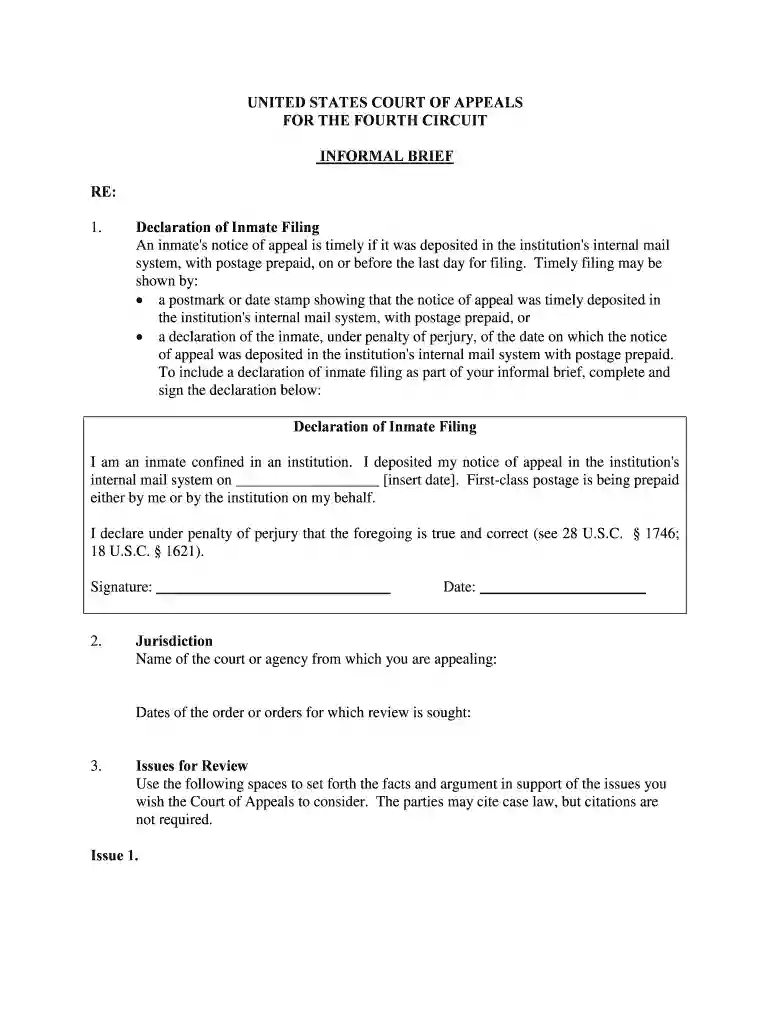
- Informal Brief: Sets forth the arguments and issues for review.
- Certificate of Service: Proof that all parties received necessary documents.
Additional Documentation
- Appendices: Complement the brief with relevant records and rulings.
- Motions for Extension: Filed if additional time is needed to prepare briefs.
Filing Deadlines and Important Dates
Adhering to strict deadlines is crucial in appellate litigation to avoid case dismissal.
Critical Timeline
- Notice of Appeal: File within 30 days from the judgment date.
- Brief Submission: Depending on the case, typically 40 days after the district court record is filed.
- Reply Briefs: Submitted 14 days after the appellee's brief is filed.
Extensions and Exceptions
- Motions for Extension: Permitted if justified and filed within a reasonable time.
- Procedural Adjustments: Certain cases may have extended or reduced deadlines based on judicial discretion.
Key Elements of an Effective Appeal
Drafting a compelling appeal requires focusing on several core components.
Core Components
- Clear Argumentation: Develop a logical and persuasive argument structure.
- Legal Precedents: Reference relevant case laws and statutes supporting the arguments.
- Emphasize Errors: Focus on specific legal and procedural errors made in the district court.
Supporting Tools
- Appendices and Exhibits: Provide thorough documentation to back arguments.
- Citations: Ensure all legal references comply with citation rules for credibility and clarity.
Examples of Using the Fourth Circuit
Understanding practical applications elucidates the role of the Fourth Circuit in the judicial process.
Notable Case Examples
- Civil Rights Litigation: Addressing discrimination claims and constitutional issues.
- Patent and Intellectual Property: Disputes arising from innovative industries challenging district court findings.
- Administrative Appeals: Federal agency decisions, such as environment-related actions, reviewed for compliance.
Real-World Outcomes
- Influence Legislation: Outcomes may influence local and state policies based on rulings.
- Precedent Setting: Court decisions often serve as benchmarks for subsequent similar cases.