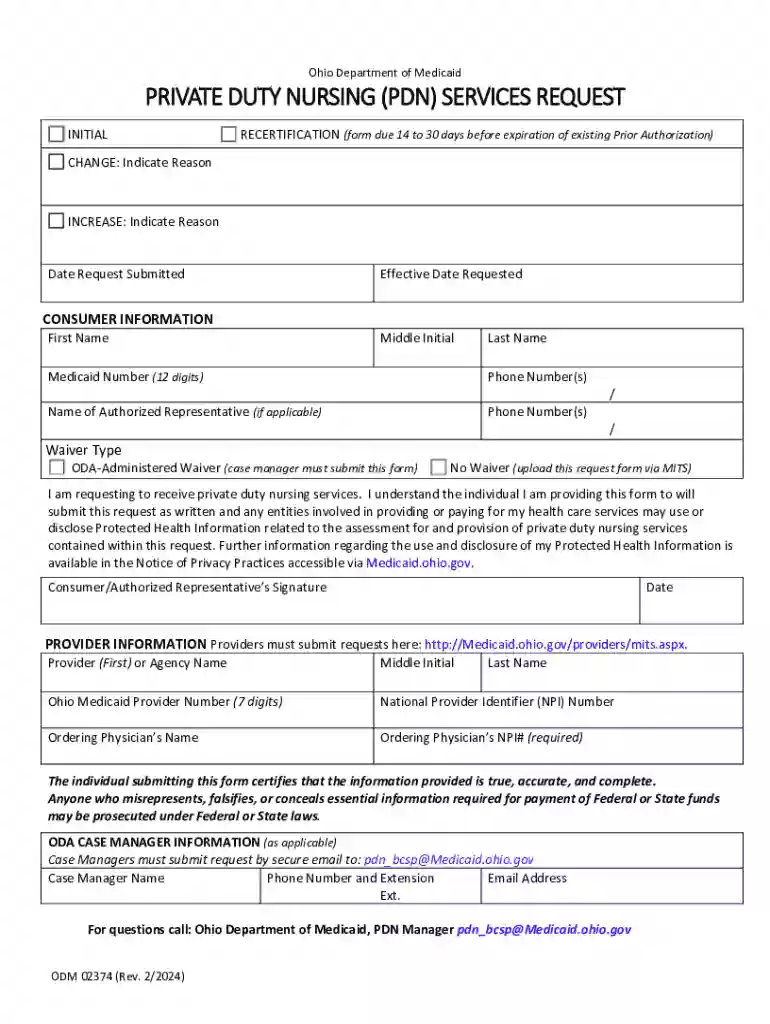
Private Duty Nursing - Ohio Department of Medicaid 2026

Get Form
Private Duty Nursing - Ohio Department of Medicaid Preview on Page 1

Here's how it works

01. Edit your form online
Type text, add images, blackout confidential details, add comments, highlights and more.

02. Sign it in a few clicks
Draw your signature, type it, upload its image, or use your mobile device as a signature pad.

03. Share your form with others
Send it via email, link, or fax. You can also download it, export it or print it out.

Definition and Meaning

The "Private Duty Nursing - Ohio Department of Medicaid" form is a document used by individuals or healthcare providers in Ohio to request Private Duty Nursing (PDN) services covered under the state's Medicaid program. PDN services involve one-on-one nursing care for patients who require continuous, individual attention due to medical complexity. This form facilitates the authorization process for such services, ensuring compliance with Medicaid requirements.

Key Components

  • Consumer Information: This section captures detailed information about the patient receiving the services, including personal identification details and Medicaid ID.
  • Provider Information: Details of the healthcare provider or agency offering the PDN services are recorded here, ensuring that they are verified Medicaid providers.

How to Use the Form

The proper usage of this form is crucial for obtaining PDN services. Here are the detailed steps to ensure efficient use:

  1. Initial Requests: For new PDN services, fill out the consumer and provider information sections thoroughly. Accurate medical and personal data are necessary for eligibility assessment.
  2. Recertification or Changes: This form is also employed for recertifying existing services or making amendments to service details, requiring updated information to be provided.

Common Mistakes to Avoid

  • Incomplete Information: Double-check that all fields are filled, especially mandatory sections like Medicaid ID.
  • Outdated Forms: Always use the latest version of the form to avoid processing delays.

How to Obtain the Form

Obtaining the "Private Duty Nursing - Ohio Department of Medicaid" form is straightforward. It is typically available through the Ohio Department of Medicaid's website or by contacting them directly.

Where to Access

  • Online Access: Visit the official Ohio Department of Medicaid website to download the PDF version of the form.
  • Physical Copies: Request a physical form via mail by contacting the Medicaid office.

Steps to Complete the Form

Completing this form requires careful attention to detail. Follow these steps for a comprehensive completion:

  1. Gather Required Information: Compile necessary personal and medical details beforehand to streamline the process.
  2. Fill Out Consumer and Provider Sections: Enter the required information meticulously, ensuring accuracy to prevent denials.
  3. Attach Supporting Documents: Include medical records or additional forms if required to support the PDN request.

Additional Tips

  • Cross-Verification: Have another individual review the form to catch any mistakes or omissions.
  • Clear Handwriting: If filling out by hand, ensure that handwriting is legible to facilitate processing.

Eligibility Criteria

To be eligible for Private Duty Nursing services under Ohio Medicaid, certain criteria must be met:


  • Medicaid Enrollment: The individual must be enrolled in the Ohio Medicaid program.
  • Medical Necessity: A healthcare provider must certify that continuous nursing care is medically necessary for the individual.
decoration image ratings of Dochub

Exceptions and Considerations

  • Age Requirements: Different criteria may apply based on the patient's age and condition.
  • Recertification Needs: Ongoing eligibility may require periodic recertification.

Key Elements of the Form

Understanding the critical elements of this form is vital for correct completion and processing:

  • Consumer Details: Includes personal information, healthcare needs, and Medicaid identification.
  • Provider Details: Captures information about the nurse or nursing agency, essential for authorization.

Critical Sections to Focus On

  • Medical Necessity Statement: A section where a healthcare provider justifies the need for PDN services.
  • Service Duration and Frequency: Specifies the proposed schedule for nursing services.

State-Specific Rules for Ohio

Ohio has specific regulations governing the use of this form and the provision of PDN services under Medicaid:

  • State Compliance: Services must align with Ohio state laws and Medicaid policies.
  • Provider Requirements: Providers must meet Ohio Medicaid's qualifications to deliver PDN services.

Important Considerations

  • Policy Updates: Stay informed about any changes in state policies that might affect service eligibility or application processes.
  • Paperwork Precision: Ensure all entries align with Ohio's Medicaid standards to prevent processing issues.

Penalties for Non-Compliance

Failure to properly submit or comply with the form's requirements could lead to significant consequences:

  • Denied Services: Incomplete or incorrect forms can result in denial of PDN services.
  • Financial Penalties: Providers may face penalties for non-compliance with Medicaid's service delivery standards.

Remedial Actions

  • Appeal Process: Understand the appeals process if services are denied due to form issues.
  • Corrective Submission: Make necessary corrections promptly to rectify any submission errors.

This structured content provides detailed information and insights into the "Private Duty Nursing - Ohio Department of Medicaid" form, ensuring users understand its importance and the procedures involved.

See more Private Duty Nursing - Ohio Department of Medicaid versions

We've got more versions of the Private Duty Nursing - Ohio Department of Medicaid form. Select the right Private Duty Nursing - Ohio Department of Medicaid version from the list and start editing it straight away!
Versions Form popularity Fillable & printable
2024 4.5 Satisfied (57 Votes)
2014 4.7 Satisfied (40 Votes)
be ready to get more

Complete this form in 5 minutes or less

Get form

Got questions?

We have answers to the most popular questions from our customers. If you can't find an answer to your question, please contact us.
Contact us
Medicare doesnt typically cover caregivers who help you with the activities of daily living unless this type of care is necessary for a short time while you recover from an illness or injury. For instance, it wont pay for services like cleaning, shopping, or laundry, which are typically part of custodial care.
Private duty nurses provide long-term, comprehensive hourly nursing care and are skilled in managing medical equipment and technology. A patient will have a nurse in the home anywhere from 4 to 24 hours per day.
Another popular way to pay for PDN care is through Medicaid, the joint federal and state program that assists lower-income individuals with healthcare. In-home care and skilled nursing are generally covered under Medicaid.
Under Medicares rules, you qualify for home health services if you need intermittent skilled nursing care. Medicare will continue to cover these services as long as they are deemed medically necessary and you meet the criteria for being homebound.
Medicare Part A does not cover most nursing home care. Medicare Part A may help cover some medical services in a nursing home under certain conditions. If you need skilled nursing care, such as changing sterile dressings, Medicare Part A may help cover some costs.

Security and compliance

At DocHub, your data security is our priority. We follow HIPAA, SOC2, GDPR, and other standards, so you can work on your documents with confidence.

Learn more
ccpa2
pci-dss
gdpr-compliance
hipaa
soc-compliance

People also ask

For Medicare to cover in-home nursing services, the care must meet specific criteria. The patient must be homebound, require part-time or intermittent skilled nursing care, and have a physicians certification for these services. Medicare also requires that care be delivered by a Medicare-certified home health agency.
While Medicare covers many aspects of home healthcare, private duty nursing often falls outside its scope. The continuous and long-term nature of private duty nursing exceeds Medicares definition of intermittent care. As a result, families seeking private duty nursing may need to explore alternative funding sources.
While both services offer professional medical care, they cater to distinct patient needs. Private duty nursing focuses on long-term, continuous care for individuals with complex medical needs. Skilled nursing, in contrast, offers short-term, intermittent care that targets recovery or specific health goals.

Related links