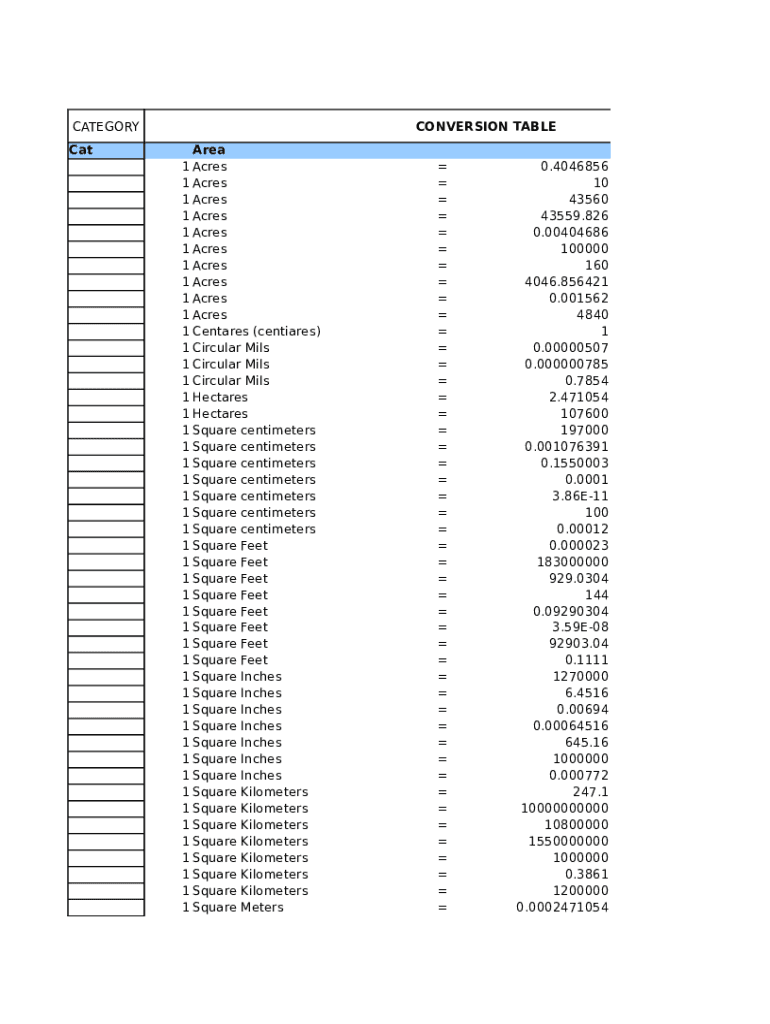






Definition and Meaning of Metric Conversion Table
A metric conversion table is a practical tool that provides users with conversion factors for a wide array of units across different measurement systems. It serves as a reference for converting measurements such as length, area, weight, and temperature from one unit to another, like converting meters to feet or Celsius to Fahrenheit. This table is particularly useful for individuals who work in fields that require frequent and accurate measurement conversions, including science, engineering, and international trade.
How to Use the Metric Conversion Table
Using a metric conversion table involves a few straightforward steps. Here is a typical method:
- Identify the Measurement Type: Determine the category of measurement you need to convert, such as length, weight, or volume.
- Find the Current Unit: Locate the unit you are starting with in the table's first column.
- Select the Target Unit: In the corresponding row, find the unit to which you want to convert your measurement.
- Apply the Conversion Factor: Use the conversion factor provided to convert your measurement. For example, to convert inches to centimeters, multiply the number of inches by 2.54.
This process helps ensure that conversions are accurate, minimizing errors in calculations that rely on exact measurements.
Important Terms Related to Metric Conversion Table
Understanding the terminology associated with metric conversion tables is vital:
- Conversion Factor: The numerical value used in converting a measurement from one unit to another.
- SI Units: The International System of Units, the standard metric system adopted globally.
- Imperial Units: Units commonly used in the United States, such as inches and pounds.
- Derived Units: Units that are combinations of base SI units, such as newtons (force).
These terms form the basis of effectively using a metric conversion table.
Key Elements of the Metric Conversion Table
A comprehensive metric conversion table contains several key components:
- Unit Types: Categories include length, area, volume, weight, temperature, and more.
- Listings for Both Metric and Imperial Units: Includes a variety of units from both the metric system and other non-metric systems.
- Conversion Instructions: Guidance on how to convert between units within the table.
- Notes on Accuracy: Information regarding the precision of the conversions, important for scientific calculations.
These elements ensure users can perform conversions with confidence.
Examples of Using the Metric Conversion Table
Practical examples can illustrate the table’s utility:
- Cooking: Converting ingredients from grams to ounces.
- Travel: Adjusting speed from kilometers per hour to miles per hour.
- Temperature Adjustments: Converting weather forecasts from Celsius to Fahrenheit.
Such examples demonstrate the daily applicability of metric conversion tables across diverse scenarios.
Software Compatibility
Metric conversion tables are often integrated into popular software solutions, enhancing their utility:
- Spreadsheet Applications: Programs like Microsoft Excel and Google Sheets frequently include functionality for metric conversions.
- Engineering Software: Tools like AutoCAD have built-in support for unit conversions that use metric conversion tables.
- Calculator Apps: Many digital calculators provide quick access to conversion factors through embedded conversion tables.
This compatibility simplifies the process of managing units in digital formats.
Digital vs. Paper Versions
Both digital and paper versions of metric conversion tables offer distinct benefits:
- Digital Versions: Often more accessible and can be easily updated. They are interactive and can perform automatic calculations.
- Paper Versions: Useful in fieldwork where digital devices may not be practical. They don't require power or an internet connection.
Each format can be selected based on the user's specific needs and environment.
Business Types that Benefit Most from Metric Conversion Table
Various business sectors regularly rely on metric conversion tables:
- Manufacturing: Essential for creating products that meet international standards.
- Logistics and Shipping: Facilitates the conversion of weights and dimensions from one system to another.
- Healthcare: Frequent conversions between units like milliliters and fluid ounces are necessary.
These industries benefit from the precision and convenience provided by metric conversion tables.