




01. Edit your 632 2021 online
Type text, add images, blackout confidential details, add comments, highlights and more.

Type text, add images, blackout confidential details, add comments, highlights and more.

Draw your signature, type it, upload its image, or use your mobile device as a signature pad.

Send it via email, link, or fax. You can also download it, export it or print it out.
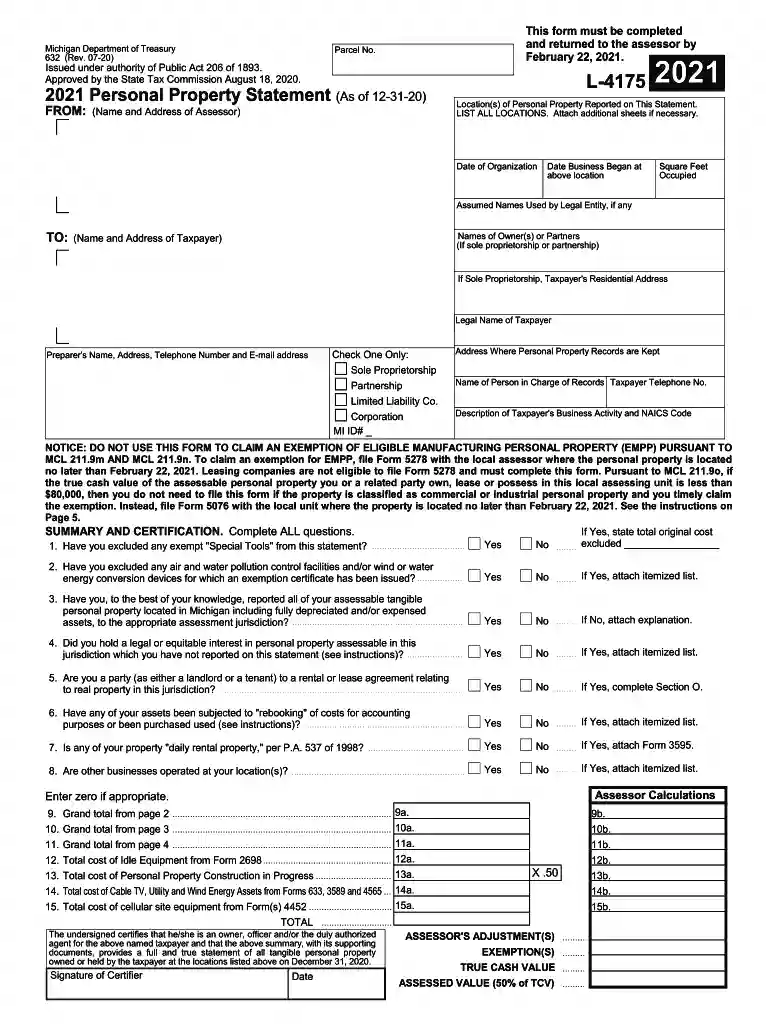
Form 632, also known as the 2021 Personal Property Statement, is a legally mandated document issued by the Michigan Department of Treasury. It requires individuals and entities to report all assessable tangible personal property owned or possessed as of December 31, 2020. The form plays a crucial role in calculating property taxes in Michigan and includes details such as business activities, property locations, and any claimed exemptions. Proper submission ensures compliance with state tax regulations, helping stakeholders avoid penalties and facilitating accurate local tax assessments.
To effectively use Form 632, start by gathering detailed records of all tangible personal property as of December 31, 2020. Then, categorize these properties according to the sections outlined within the form, including manufacturing equipment, office furniture, and other assets. Use the provided sections to report property details accurately, ensuring that all relevant exemptions are appropriately claimed. Review the form thoroughly before submission to ensure completeness and accuracy, mitigating the risk of errors that could lead to audits or fines.
Form 632 can be obtained directly from the Michigan Department of Treasury's official website. It's also available at local assessor's offices throughout Michigan. For those who prefer digital interaction, downloading the form from the department’s website ensures access to the latest version. Always verify the version year to confirm relevance, as using outdated forms may result in processing delays.
Understanding these elements helps to ensure precise entry and reporting, which assists in avoiding future disputes or reassessments.
The legal use of Form 632 is governed by Michigan's property tax laws. Every year, it enables the state to assess tax liabilities accurately by collecting comprehensive data on owned tangible personal properties. The form ensures that property taxes are computed based on up-to-date and precise valuations, forming a critical element of legal compliance for businesses and individuals owning such assets.
Completing Form 632 necessitates having various supporting documents on hand, including:
These documents are critical in ensuring all information recorded on the form is accurate and verifiable.
Form 632 must be filed with the appropriate local tax assessor by February 22, 2021. Missing the deadline can result in late penalties and potential audits. It's important to not only submit the form on time but also ensure it is complete and accurate, as these factors collectively influence the acceptance process and potential tax assessments and rebates.
We've got more versions of the 632 2021 form. Select the right 632 2021 version from the list and start editing it straight away!
At DocHub, your data security is our priority. We follow HIPAA, SOC2, GDPR, and other standards, so you can work on your documents with confidence.
Bill 632 (2021-2022 Session) North Carolina Momnibus Act. 2021-2022 Session. To Com On Rules and Operations of the Senate on 4/7/2021. SOCIAL SERVICES; TASK
Defines social determinants of maternal health as nonclinical factors impacting maternal health outcomes, including economic, neighborhood, social and community


