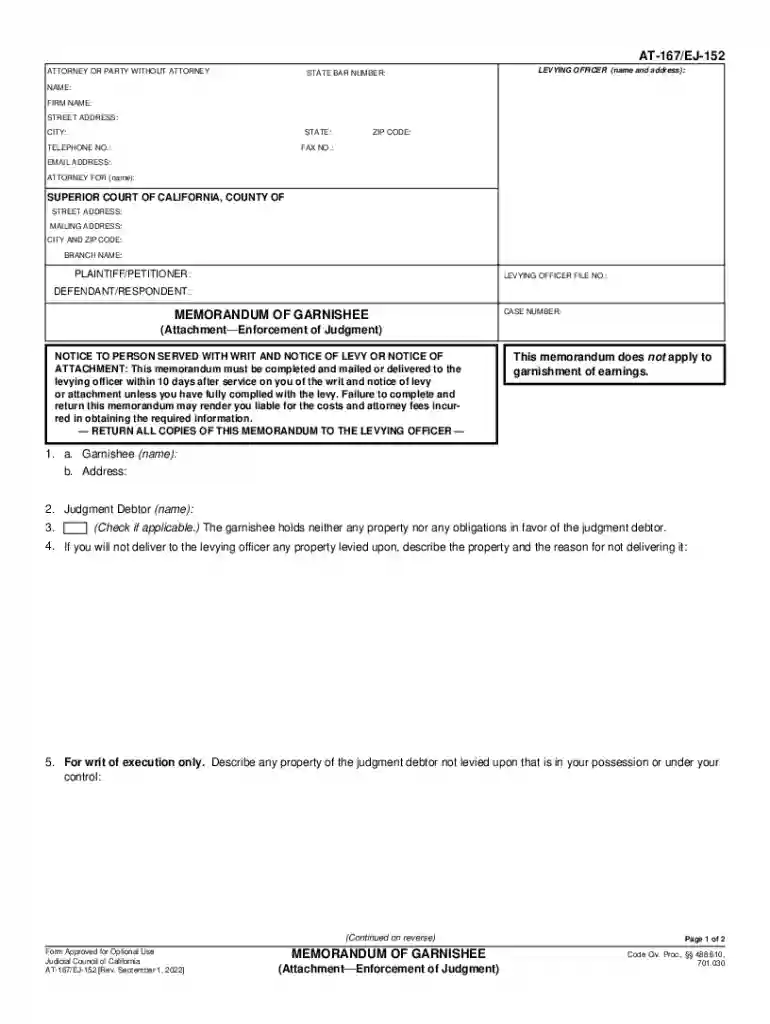
AT-167 MEMORANDUM OF GARNISHEE(AttachmentEnforcement of Judgment) Judicial Council forms 2026

Get Form
memorandum of garnishee Preview on Page 1

Here's how it works

01. Edit your memorandum of garnishee online
Type text, add images, blackout confidential details, add comments, highlights and more.

02. Sign it in a few clicks
Draw your signature, type it, upload its image, or use your mobile device as a signature pad.

03. Share your form with others
Send it via email, link, or fax. You can also download it, export it or print it out.

Definition & Meaning of the AT-167 Memorandum of Garnishee

The AT-167/EJ-152 Memorandum of Garnishee is a critical legal form employed in the state of California. This form is part of the judicial process for the enforcement of judgments, specifically targeting garnishees. A garnishee is an individual or entity that holds property or debts that belong to a judgment debtor. This document necessitates their response concerning any assets or obligations they possess that relate to the debtor in question.

Importance of the Form

  • Legal Obligation: Garnishees are legally required to complete and return this form, outlining their relationship with the judgment debtor financially.
  • Information Disclosure: It assists in disclosing any potential assets or income streams that can be seized or redirected to satisfy an outstanding judgment.

How to Use the AT-167 Memorandum of Garnishee

Utilizing this form involves a structured process to ensure accurate and complete submission. Here's how it should be approached:

  1. Identify the Garnishee's Role: Specifically understand if you hold any property or debts related to the judgment debtor.
  2. Complete the Form: Provide detailed information about any assets or obligations you have concerning the debtor.
  3. Submit the Form: Send the completed memorandum back to the levying officer within ten days of receiving it, as mandated.

Practical Steps

  • Review Legal Obligations: Thoroughly understand your responsibilities under law.
  • Gather Financial Information: Ensure all relevant details about debts or assets held are ready for inclusion.

Steps to Complete the AT-167 Memorandum of Garnishee

Accurate completion of the form involves several crucial steps:

  1. Personal and Case Information: Fill in the necessary sections detailing the identities of both the garnishee and the judgment debtor.
  2. Assets and Debts Details: Clearly state the specifics of any property or monetary obligations.
  3. Certification: Affix your signature to certify the accuracy of the provided information.

Important Tips

  • Check for Accuracy: Double-check every detail to prevent delays or legal complications.
  • Consult Legal Advice: If unsure, it’s beneficial to consult with a legal professional versed in judgment enforcement.

Who Typically Uses the AT-167 Memorandum of Garnishee

The use of the AT-167 is primarily within judicial and legal domains for parties associated with judgment enforcement:


  • Judges and Legal Officers: Oversee the process ensuring legal protocols are maintained.
  • Garnishees: Individuals or entities tasked with declaring assets related to debtors.
  • Creditors: Utilize the form to facilitate the collection of debts owed by judgment debtors.
decoration image ratings of Dochub

Real-World Scenarios

  • A business holding unfulfilled contracts with a debtor may be required to disclose this status.
  • An employer having wage attachments for judgment garnishment will complete this form for clarity on the available wages.

Key Elements of the AT-167 Memorandum of Garnishee

The form comprises several vital components that require detailed attention:

  • Identification of Parties: Includes spaces for names, addresses, and case numbers.
  • Asset Declaration: Sections for full disclosure of any property or financial obligations pertaining to the debtor.
  • Return Instructions: Details on how and when to submit the form to comply with legal timelines.

Legal Use of the AT-167 Memorandum of Garnishee

The legal framework surrounding the AT-167 demands adherence to procedures designed to achieve a fair debt collection process:

  • Compliance with State Laws: Ensures the garnishee’s operation aligns with California’s judgments and garnishments statutes.
  • Transparency and Accountability: Aids in maintaining clear communication between all parties involved in the legal proceedings.

Common Legal Missteps

  • Incomplete Information: Submission without full details can lead to legal repercussions.
  • Late Submission: Failing to return the form on time may result in penalties.

State-Specific Rules for the AT-167 Memorandum of Garnishee

California establishes unique regulations that dictate the use and implementation of the AT-167 form:

  • Deadline Adherence: The ten-day window for return is strict and enforced.
  • Detailed Property Reporting: Requires exhaustive breakdown of assets and financial responsibilities linked to the debtor.

Important Terms Related to the AT-167 Memorandum of Garnishee

Understanding the terminology within the AT-167 is fundamental for accurate completion:

  • Garnishee: The individual or institution holding the debtor’s assets.
  • Judgment Debtor: The person or entity that owes a debt subject to garnishment.
  • Levying Officer: The officer tasked with facilitating the garnishment process, often a sheriff or similar authority.

Vocabulary Application

  • Comprehension of terms like "debt obligation" or "levy" is crucial for the effective handling of the form.

Examples of Using the AT-167 Memorandum of Garnishee

Examples help elucidate the practical application of the form:

  • Business Transactions: A firm required to disclose pending payments to a debtor company for service contracts.
  • Wage Attachments: Employers obliged to specify ongoing wage garnishments for employee debts.

Case Study: Wage Garnishment

A retail chain identifies funds owed to an employee subject to garnishment and completes the AT-167 to declare amounts automatically deducted from wages, ensuring compliance with the judgment order.

This comprehensive guidance aims to demystify the use of the AT-167, ensuring users understand how to navigate and comply with its demands effectively.

See more AT-167 MEMORANDUM OF GARNISHEE(AttachmentEnforcement of Judgment) Judicial Council forms versions

We've got more versions of the AT-167 MEMORANDUM OF GARNISHEE(AttachmentEnforcement of Judgment) Judicial Council forms form. Select the right AT-167 MEMORANDUM OF GARNISHEE(AttachmentEnforcement of Judgment) Judicial Council forms version from the list and start editing it straight away!
Versions Form popularity Fillable & printable
2022 4.4 Satisfied (38 Votes)
2013 4.8 Satisfied (268 Votes)
be ready to get more

Complete this form in 5 minutes or less

Get form

Got questions?

We have answers to the most popular questions from our customers. If you can't find an answer to your question, please contact us.
Contact us
A memorandum is a short message used for sharing important information within a business. Effective memos should be clear, organized, and answer all potential questions from the readers. Use a clear format with a subject line, purpose, and specific actions to ensure memos are easily understood.
Filled out by the garnishee claimed to have personal property or money of the judgment debtor to tell the sheriff and court if they are turning over property or money and why it is not being turned over.
Q: Is an Affidavit of Memorandum the same as a lien? A: No, an Affidavit of Memorandum is not the same as a lien. While both documents establish a financial interest or claim on a property, a lien is actually a legal claim that provides the claimant with the right to foreclose on the property to satisfy the debt.
The bench memorandum is a document written by a law clerk for an appellate judge, which the judge uses in preparing for oral arguments. A trial judge may ask his clerk to write a bench memo in advance of a motions hearing; however, writing bench memos at the trial court level is less common.

Security and compliance

At DocHub, your data security is our priority. We follow HIPAA, SOC2, GDPR, and other standards, so you can work on your documents with confidence.

Learn more
ccpa2
pci-dss
gdpr-compliance
hipaa
soc-compliance
be ready to get more

Complete this form in 5 minutes or less

Get form