




01. Edit your arizona voter registration form online
Type text, add images, blackout confidential details, add comments, highlights and more.

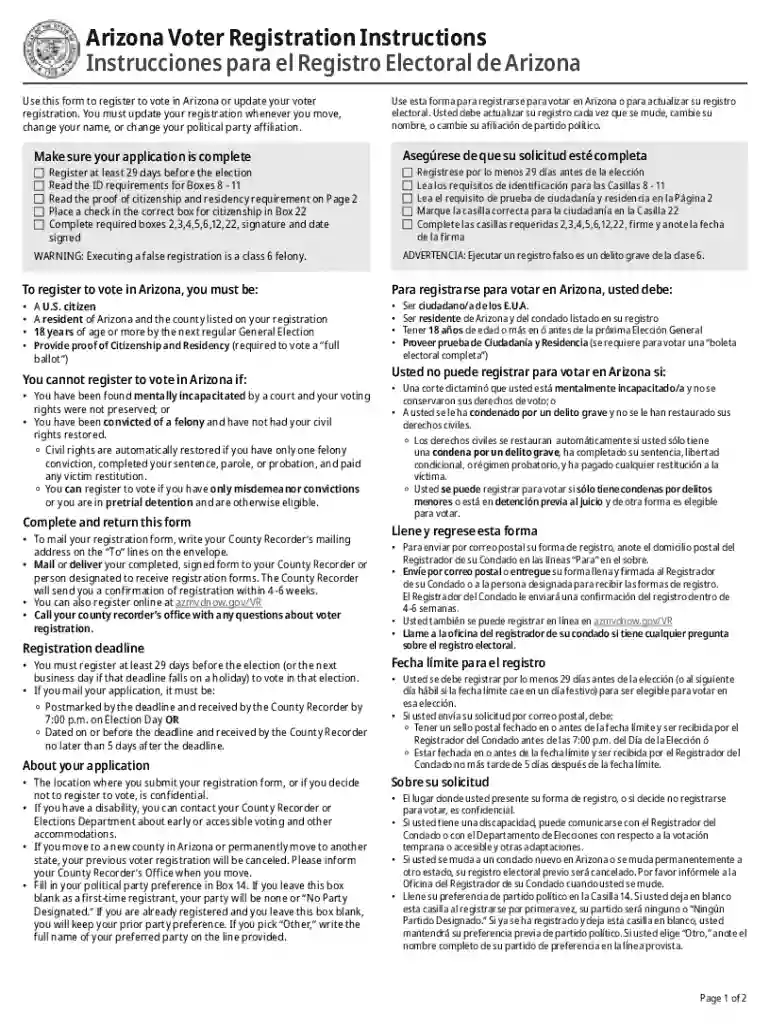
Type text, add images, blackout confidential details, add comments, highlights and more.

Draw your signature, type it, upload its image, or use your mobile device as a signature pad.

Send az sos voter registration via email, link, or fax. You can also download it, export it or print it out.
The "voter registration form standard" is a critical document utilized across various states in the United States to facilitate the process of registering citizens to vote. This standardized form ensures that all relevant information is collected efficiently, allowing for the verification of eligibility in accordance with state laws. It typically collects essential details such as the applicant’s name, address, date of birth, and party affiliation. The purpose of this form is to maintain an updated voter roll, which is crucial for organizing and executing elections. By standardizing the voter registration form, states aim to simplify the registration process and ensure uniformity across jurisdictions.
Provide Personal Information: Fill in your full legal name, residential address, and date of birth. This information is essential for verifying your identity and eligibility to vote.
Indicate Citizenship and Age: Confirm that you are a U.S. citizen and meet the minimum age requirement of eighteen years by the time of the next election. Some states may allow pre-registration at a younger age.
Choose a Political Party, If Desired: While optional, declaring a party affiliation can be important if you wish to participate in that party’s primary elections. Some states may restrict primary voting to registered party members.
Provide Contact Information: Include a phone number and email address, which may be used for election-related communications and notifications.
Sign and Date the Form: Your signature is a critical component, as it certifies that the information provided is true and that you meet the legal requirements to vote. An unsigned form will not be processed.
Submit the Form: Follow state-specific guidelines regarding submission methods—these may include mailing the form, submitting it online, or delivering it in person to the designated election office.
The standardized voter registration form can typically be obtained through multiple channels:
To use the voter registration form standard, individuals must meet certain eligibility criteria:


Each state has specific rules and deadlines related to the voter registration process:
Individuals may submit their voter registration forms using various methods:
We've got more versions of the arizona voter registration form form. Select the right arizona voter registration form version from the list and start editing it straight away!
At DocHub, your data security is our priority. We follow HIPAA, SOC2, GDPR, and other standards, so you can work on your documents with confidence.
The National Mail Voter Registration Form can be used to register U.S. citizens to vote, to update registration information due to a change of name,
The National Voter Registration Form can be used to register U.S. citizens to vote, to update registration information due to a change of name, make a change of
Oct 5, 2022 In every state except North Dakota, eligible voters must register. Some states do this automatically. Others require that residents file formsRead more


