



01. Edit your texas driver safety course online
Type text, add images, blackout confidential details, add comments, highlights and more.

Type text, add images, blackout confidential details, add comments, highlights and more.

Draw your signature, type it, upload its image, or use your mobile device as a signature pad.

Send tx driver safety course via email, link, or fax. You can also download it, export it or print it out.
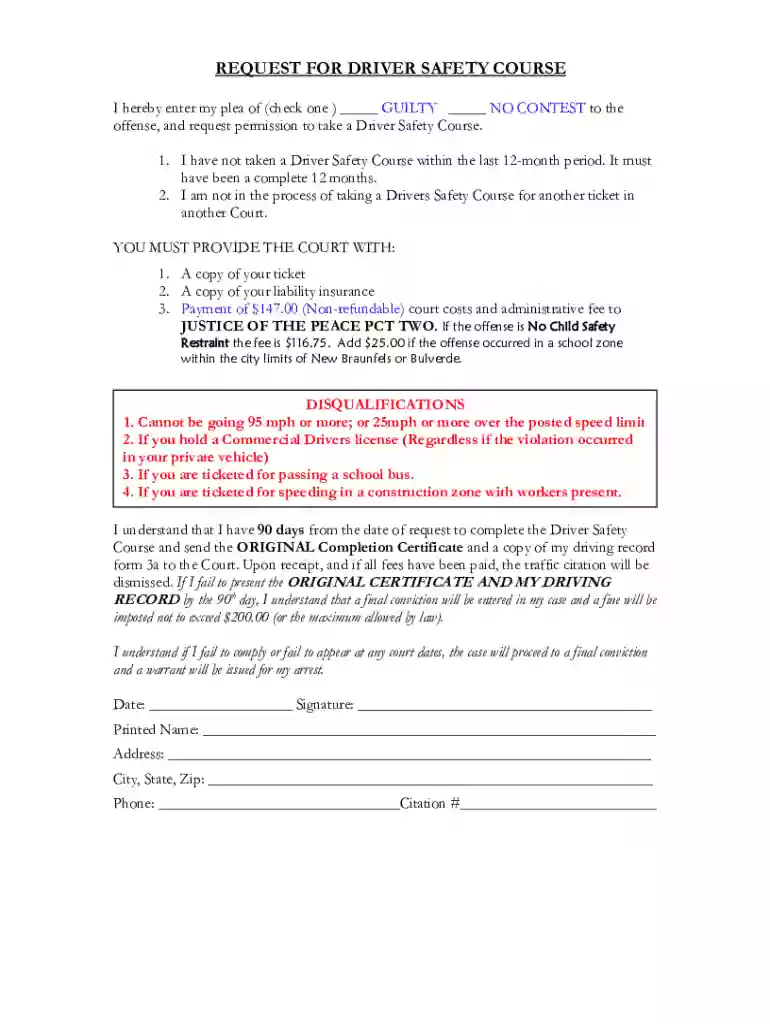
The "Defendant's Request For Driving Safety Course" is a formal application used by individuals who have pleaded guilty or no contest to a traffic offense, seeking permission to enroll in a driver safety course. The primary goal of this request is to have the traffic citation dismissed upon successful completion of the course. By opting for this route, defendants can potentially mitigate points on their driving record, reduce fines, and avoid insurance premium hikes. Eligibility for this form and subsequent course completion generally depend on specific criteria set by state laws and the nature of the offense.
To effectively utilize the Defendant's Request For Driving Safety Course form, you must first verify your eligibility based on the nature of your traffic offense and local regulations. Typically, these forms are provided by traffic courts or the Department of Motor Vehicles (DMV). Once obtained, complete all required sections, ensuring accuracy and full disclosure of necessary personal and case-related information. Some jurisdictions require additional documentation, such as a copy of the traffic citation, proof of insurance, and a valid driver's license. Submit the form within stipulated timeframes, often before any scheduled court dates, to initiate the approval process.
Eligibility Confirmation: Verify that your traffic offense qualifies for resolution through a driving safety course. Note any disqualifying factors such as prior offenses within a set period.
Obtain the Form: Access the request form via the court or DMV website. Some courts provide the form directly upon request at the courthouse.
Complete the Form: Fill in personal details, traffic citation number, and any other required information. Ensure all data is correct to avoid processing delays.
Attach Required Documents: Include copies of driving license, insurance details, and potentially the court notice or citation.
Submit the Form: Deliver the form and attachments to the appropriate authority either in person, by mail, or through online submission if available.
Await Approval: After submission, wait for confirmation of approval from the court, which may include further instructions.
Course Completion: Upon approval, enroll in a court-approved driving safety course, complete it within the provided timeframe, and procure certification of completion.
Submit Certification: Submit proof of course completion to the required authority within the specified period to ensure citation dismissal.
This form is predominantly used by drivers in the United States who have received a traffic citation and seek to mitigate potential negative impacts. Common users include individuals with minor traffic violations such as speeding or failure to stop. This option is especially beneficial for first-time offenders and those looking to avoid increased insurance premiums. Frequent road users, including delivery drivers, sales representatives, and commuters, may also find this course advantageous in maintaining a clean driving record.


Eligibility to file a Defendant's Request For Driving Safety Course largely depends on the state and specific circumstances of the traffic violation. Typically, eligibility criteria include:
First-Time Offenders: Individuals who have not taken a driving safety course for other citations within a set time frame, usually twelve months.
Non-Serious Violations: Only certain non-serious infractions, like minor speeding or signal violations, qualify.
Time Restrictions: The request usually must be filed promptly, often before a court appearance or within a specific number of days following the citation.
No Commercial Licenses: Holders of commercial driver’s licenses (CDL) may be ineligible regardless of vehicle type at the time of the offense.

The request form operates within the legal framework established by state transportation laws. It serves as a formal agreement between the defendant and the court to complete a driver safety course in lieu of penalties, potentially aiding in the maintenance of a clean driving record. Its legal standing requires compliance with all specified terms, such as timely completion of the course and submission of proof. Non-compliance may result in reinstatement of charges or additional penalties. This process demonstrates the legal balance between punishment and educational reform for minor traffic infractions.
Traffic Citation: The official notice issued by law enforcement detailing the alleged traffic law infringement.
Defendant: The individual named in the traffic citation who is seeking to file the request form.
Dismissal: The legal act of nullifying the traffic citation and associated penalties upon successful completion of a driving safety course.
Non-Contest Plea: A plea that does not admit guilt but accepts the court’s punishment, often pivotal in course eligibility.
Insurance Reduction: A probable outcome of course completion where insurance premiums may not rise due to citation dismissal.
When preparing to submit the Defendant's Request For Driving Safety Course, gather the following documents:
Ensure these documents are updated and accurately reflect your current status. Attach these to your request form to facilitate efficient processing and approval.
Failure to adhere to the terms of the Defendant's Request For Driving Safety Course can lead to several consequences:
Complying with all specified deadlines and requirements is crucial to avoid these adverse outcomes and successfully leverage the benefits offered by the driving safety course.
We've got more versions of the texas driver safety course form. Select the right texas driver safety course version from the list and start editing it straight away!
At DocHub, your data security is our priority. We follow HIPAA, SOC2, GDPR, and other standards, so you can work on your documents with confidence.


