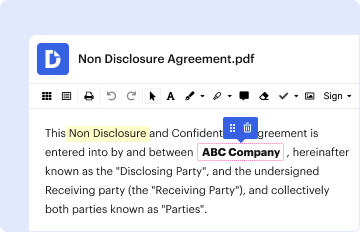
Type text, add images, blackout confidential details, add comments, highlights and more.
02. Sign it in a few clicks
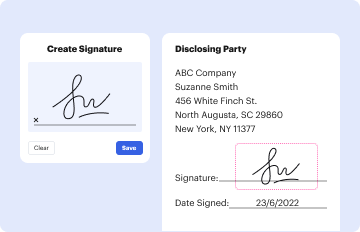
Draw your signature, type it, upload its image, or use your mobile device as a signature pad.
03. Share your form with others
Send it via email, link, or fax. You can also download it, export it or print it out.
How to use or fill out MI-1041, 2003 Michigan Fiduciary Income Tax Return with our platform
Ease of Setup
DocHub User Ratings on G2
Ease of Use
DocHub User Ratings on G2
Click ‘Get Form’ to open the MI-1041 in the editor.
Begin with Part 1: Name and Identification. Fill in the name of the estate or trust, Federal Employer Identification Number (FEIN), and details about the fiduciary.
Proceed to Part 2: Income and Adjustments. Enter federal taxable income from U.S. 1041, line 22, and any adjustments as required.
In Part 3: Credits and Payments, input any applicable credits such as city income tax credit or public contributions.
Finally, complete Part 4: Balance Due or Refund. Calculate if there is a tax due or an overpayment refund.
Start using our platform today for free to simplify your MI-1041 form completion!
Fill out MI-1041, 2003 Michigan Fiduciary Income Tax Return 2003 Michigan Fiduciary Income Tax Return online It's free
Form 706 ensures that estate taxes are adequately assessed for larger estates, while Form 1041 helps report the estates income during the settlement process. By understanding these differences, executors and administrators can better manage estate obligations.
What is a 1041 fiduciary tax return?
The fiduciary of a domestic decedents estate, trust, or bankruptcy estate files Form 1041 to report: The income, deductions, gains, losses, etc. of the estate or trust. The income that is either accumulated or held for future distribution or distributed currently to the beneficiaries.
What is the form for fiduciary income tax return in Michigan?
Form 1041 is an income tax return, the same as an individual or business would file but for a decedents estate or a trust. The return reports income, capital gains, deductions, and losses, but subject to somewhat different rules than those that apply to living individuals.
What is the tax form for fiduciary relationship?
Form 56 is used to notify the IRS of the creation or termination of a fiduciary relationship under section 6903 and provide the qualification for the fiduciary relationship under section 6036.
Is a 1041 a fiduciary tax return?
The IRS requires the filing of an income tax return for trusts and estates on Form 1041formerly known as the fiduciary income tax return. This is because trusts and estates must pay income tax on their income just like you report your own income on a personal tax return each year.
Related Searches
1041 MichiganMI 1041 Schedule NRPay michigan fiduciary tax onlineMichigan Income Tax returnMichigan 1040X FormHow to determine residency of a trustState of Michigan non Resident Tax Form1040 Michigan
Fiduciary income tax is a tax imposed on the income earned by certain types of legal entities, such as trusts and estates, while they hold and manage assets on behalf of beneficiaries.
Where to file a 1041 tax return?
Mailing addresses for Form 1041 And you are not enclosing a check or money orderAnd you are enclosing a check or money order Internal Revenue Service P.O. Box 409101 Ogden, UT 84409 Internal Revenue Service P.O. Box 409101 Ogden, UT 844092 more rows
What is a K1 1041 tax form?
IRS Schedule K-1 (Form 1041) Beneficiarys Share of Income, Deductions, Credits, etc. is used to report a beneficiarys share of income, deductions, and credits from a trust or estate. The fiduciary must file Schedule K-1 with the IRS for each beneficiary and provide each beneficiary with a copy.
Related links
All Funds List
To be used to record income received from Funds in Trust, held outside the University. Federal Income Tax Expense, To record federal income tax. General
Jan 1, 2003 Deferred income taxes reflect the differences between assets and liabilities recognized for financial reporting purposes and amounts recognized.
Cookie consent notice
This site uses cookies to enhance site navigation and personalize your experience.
By using this site you agree to our use of cookies as described in our Privacy Notice.
You can modify your selections by visiting our Cookie and Advertising Notice.