




01. Edit your af form 475 online
Type text, add images, blackout confidential details, add comments, highlights and more.

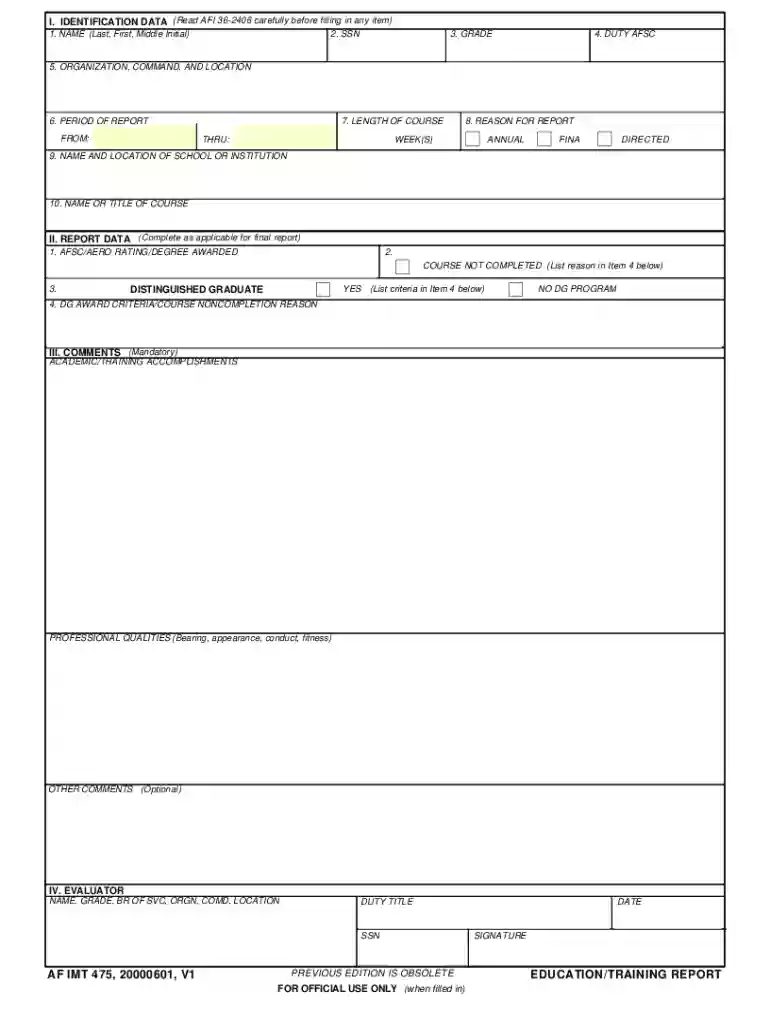
Type text, add images, blackout confidential details, add comments, highlights and more.

Draw your signature, type it, upload its image, or use your mobile device as a signature pad.

Send af 475 via email, link, or fax. You can also download it, export it or print it out.
The AF Form 475, commonly referred to as the Air Force Training Report, serves as a crucial document for recording a member's training accomplishments within the U.S. Air Force. This standardized form enables evaluators to provide a comprehensive assessment of an individual's professional development and performance during specific training periods.
The form is structured to capture essential information about the member, including:
Essentially, the AF Form 475 ensures a systematic and documented approach to training evaluations, which plays a significant role in personnel management and development within the Air Force.
Filling out the AF Form 475 requires careful attention to detail. Each section of the form is vital for accurately reflecting the training experience and contributions of the individual being evaluated.
Personal Information: Accurately fill in your name, rank, service number, and duty title. This ensures identification and proper tracking through Air Force systems.
Training Details: Complete sections detailing the specific training programs attended, including:
Evaluator Comments: The evaluator is expected to provide insights based on observations throughout the training period, focusing on:
Review for Accuracy: Before submitting the form, double-check all entries to ensure there are no errors. Accurate data is critical in maintaining the integrity of records.
Submission: Submit the completed AF Form 475 to the designated personnel office as dictated by unit regulations.
This structured process helps in ensuring that the member's accomplishments are adequately recognized and documented.
The AF Form 475 is vital for several reasons, particularly in the context of personnel evaluations and career progression within the U.S. Air Force.
By precisely documenting training experiences, the AF Form 475 aids in strategic talent management within the service.
The AF Form 475 includes specific elements that are essential for capturing a complete picture of a member's training experience.
Incorporating all these elements ensures that the AF Form 475 conveys comprehensive and accurate information necessary for evaluations.
The AF Form 475 has undergone various updates to streamline its use and ensure compliance with current training and evaluation standards within the Air Force.
These variants not only enhance usability but also reflect the Air Force's commitment to improving its processes.
The use of AF Form 475 is governed by specific legal and regulatory frameworks that ensure compliance throughout its usage.
Understanding these legal aspects helps ensure proper use of the AF Form 475 and promotes accountability within the evaluation process.
At DocHub, your data security is our priority. We follow HIPAA, SOC2, GDPR, and other standards, so you can work on your documents with confidence.
Mar 26, 2026 All applicants must fully complete SECTION IV of the NGB FORM 34-1. Any YES answers to the questions (except 9 17) require a fullRead more
The 475 Field Communicator includes a color LCD touch screen, a Lithium Ion battery. (Power Module), a SH3 processor, memory components, and integralRead more


