







Understanding the Legislative Process: How a Bill Becomes a Law Flowchart
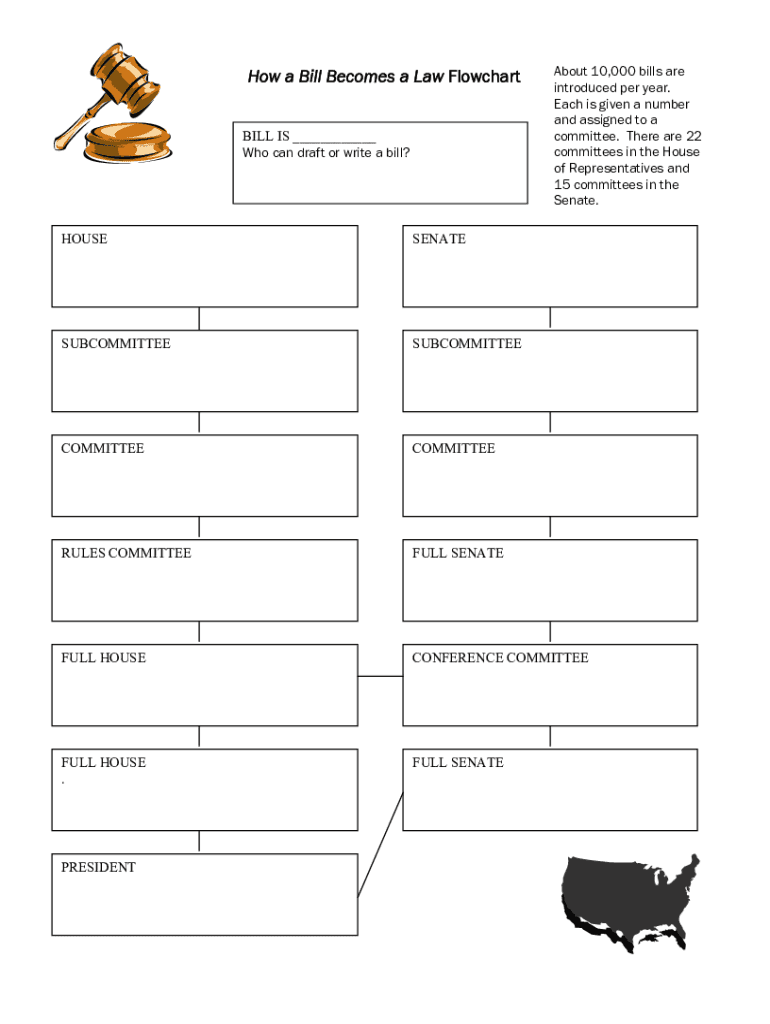
The journey of a bill becoming a law in the United States is a complex and structured process. This flowchart, which visually represents each step, is instrumental in understanding the various stages a bill goes through, from its inception to final approval. The importance of this flowchart lies in its ability to clarify the legislative process, making it accessible to students, educators, and anyone interested in civics.
Key Steps in the Process of How a Bill Becomes a Law
-
Drafting the Bill
The process begins with the drafting of a bill. This can be initiated by a member of Congress, an organization, or the President. The draft must then be introduced in either the House of Representatives or the Senate. Each chamber has specific rules about who can introduce a bill, and this stage is where the bill is assigned a unique identifier. -
Committee Review and Markup
Once introduced, the bill is sent to a relevant committee. Committees play a vital role in the legislative process by reviewing, amending, and debating the bill. A subcommittee may also be involved in a more detailed examination. After discussions and amendments are made during markup sessions, the committee votes on whether to send the bill back to the main chamber for consideration. -
Debate and Voting
After passing through committee, the bill is brought to the floor for debate. Members of the chamber discuss its merits and may propose further amendments. Following the debate, a vote is taken. A simple majority is required for the bill to proceed to the other chamber, where the process is repeated. -
Conference Committee
If both chambers pass different versions of the bill, a Conference Committee is formed to reconcile these differences. The committee drafts a final version that integrates the necessary revisions agreed upon by members of both chambers. This compromise is crucial, as it enables the bill to be accepted in a form that is agreeable to both the House and Senate. -
Presidential Action
The reconciled bill is then sent to the President, who can sign it into law, veto it, or let it become law without a signature (if he takes no action within ten days). In the case of a veto, Congress may override it with a two-thirds majority vote in both chambers. -
Becoming Law
Upon the President’s approval or upon overcoming a veto, the bill is officially enacted and becomes law. At this point, it is assigned a public law number, and details are made available to the public.
Who Benefits from the Flowchart?
-
Students and Educators
The flowchart serves as an essential educational tool, helping students grasp the complexities of the legislative process in a straightforward manner. -
Civic Educators
Understanding how a bill becomes law enhances civic education, allowing educators to teach about governmental processes accurately. -
Research Professionals
Researchers and professionals analyzing legislative changes can use the flowchart for a clearer understanding of procedural nuances and timelines.
Important Terminology Related to Legislative Processes
- Bill: A proposal for new legislation that is introduced for consideration.
- Committee: A group of lawmakers assigned to review and modify legislation.
- Veto: The President's power to reject a bill passed by Congress.
- Public Law Number: The identifier assigned to a bill once it has been enacted into law.
Variations and Alternative Representations
The "how a bill becomes a law flowchart" can come in various forms depending on the intended audience and detail level. Some may include:
- Detailed Flowcharts: Incorporating all steps with additional context about committee actions and voting rules.
- Simplified Charts: Focusing on key steps for younger audiences or casual learners.
- Interactive Versions: Online tools that allow users to click on steps for more information.
Conclusion: The Legislative Flowchart as a Learning Tool
The flowchart illustrating how a bill becomes law is not only an academic tool but a practical guide to understanding governance. Each step of the process encapsulated in the flowchart plays a vital role in ensuring that legislation is carefully considered and developed, thus reflecting the principles of democracy and public representation.




