
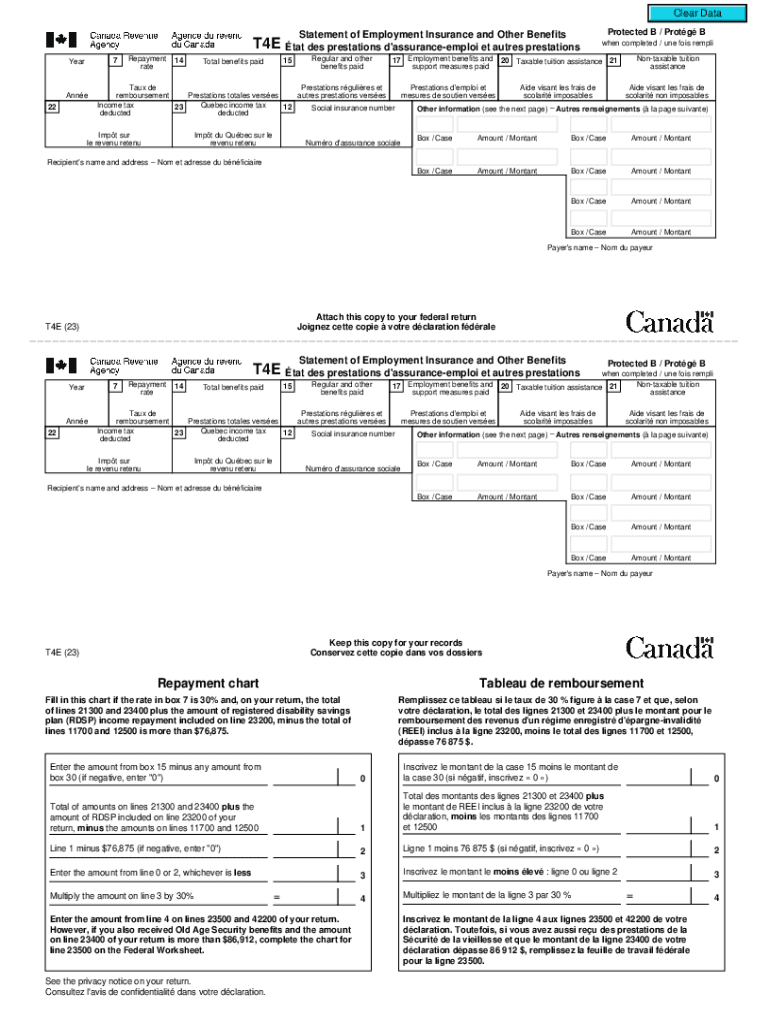







Definition and Meaning of Canada T4E
The Canada T4E 2 is a tax form that serves as a record of the Employment Insurance (EI) benefits received by an individual during the tax year. It outlines total benefits paid, repayment rates, and various taxable and non-taxable amounts. The T4E slip is essential for completing annual income tax returns, as it provides the information needed to report income accurately to the Canada Revenue Agency (CRA). This form includes specific boxes identifying different types of benefits and deductions applicable to the recipient, as well as instructions tailored for residents of Quebec regarding repayments.
How to Use the Canada T4E 2
Utilizing the Canada T4E 2 form effectively requires understanding its structure. The slip comprises multiple sections, each designated for distinct types of information. Recipients should:
- Identify Data: Locate your total benefits paid in the designated box. This figure is crucial for tax reporting.
- Report Conditions: Review specific notations regarding repayment amounts if applicable. It is essential to report this on your tax return to avoid penalties.
- Deductions and Tax Liabilities: Note any taxable and non-taxable figures, as these affect your overall tax obligations.
When filling out your tax return, ensure that the amounts correspond directly to those listed on your T4E slip, as discrepancies may lead to complications with the CRA.
Steps to Complete the Canada T4E 2
Completing the Canada T4E 2 form involves several steps:
- Gather Your Information: Collect your T4E slip and any other relevant documents that illustrate your financial situation.
- Fill Out the Form: Input the total benefits received during the specified tax year in the appropriate box on your tax return.
- Double-Check for Errors: Review your entries meticulously to confirm accuracy before submission.
- Consider Additional Contributions: If you have repayments indicated, ensure to include them in your tax calculations.
- Submit Your Tax Return: File your return by the designated deadline, ensuring to attach the T4E slip if required.
By following these steps, you will streamline the tax preparation process and help ensure compliance with tax obligations.
Important Terms Related to Canada T4E
Understanding the terminology associated with the Canada T4E 2 is vital for proper navigation of tax documentation. Here are some key terms:
- Employment Insurance (EI): A program that provides temporary financial assistance to unemployed individuals.
- Taxable Amounts: Portions of your benefits that are subject to taxation and must be reported as income.
- Non-Taxable Amounts: Benefits that do not require reporting as income, providing relief from taxation.
- Repayment Rate: The percentage of benefits that must be repaid based on individual earnings during the benefit period.
Familiarity with these terms will aid in comprehensive comprehension of the T4E slip and its implications for your tax return.
Who Typically Uses the Canada T4E
The Canada T4E form is primarily utilized by individuals who have received Employment Insurance benefits. This includes:
- Unemployed Workers: Those who have been laid off or are seeking employment.
- Individuals on Parental Leave: Parents taking time off work to care for a newborn or adopted child.
- Participants in Training Programs: Individuals involved in training programs, who may receive benefits during their retraining phase.
Users of the T4E slip are typically required to file their income tax returns, as the amounts reported will impact their overall tax responsibilities.


Filing Deadlines and Important Dates
Filing deadlines associated with the Canada T4E 2 are crucial for compliance. Important dates to remember include:
- Tax Year Deadline: The annual deadline for submitting tax returns is April 30 for most individuals.
- Late Fees: If you fail to file by the deadline, the CRA may impose penalties, including interest on any outstanding taxes owed.
- Reminders for Repayment: If applicable, ensure any repayment amounts are considered in your tax calculations by the filing deadline.
Awareness of these dates helps taxpayers avoid penalties and ensures timely submission of their financial documents.
Digital vs. Paper Version of Canada T4E
The Canada T4E 2 can be obtained and completed in both digital and paper formats. Each method has distinct advantages:
-
Digital Version:
- Can be accessed quickly from online platforms, including the CRA website.
- Allows for electronic submission, simplifying the filing process.
- Offers easy storage and retrieval of past documents.
-
Paper Version:
- May be necessary for individuals who prefer physical documentation.
- Requires manual entry, which increases the risk of errors if not carefully completed.
Choosing between digital and paper formats depends largely on the user's preferences and access to technology.
Examples of Using the Canada T4E 2
Practical application scenarios for the Canada T4E slip include:
- Income Reporting: When filing taxes, individuals who received EI benefits will detail the total amount from their T4E slip on their returns.
- Audit Trail: A tax professional may utilize the T4E to verify income during audits, reinforcing the importance of accurate reporting.
- Repayment Strategy: Individuals who received overpayments may adjust future tax filings based on the repayment amounts noted on the T4E slip.
These examples illustrate the diverse ways the T4E form is utilized within tax reporting and compliance practices.




