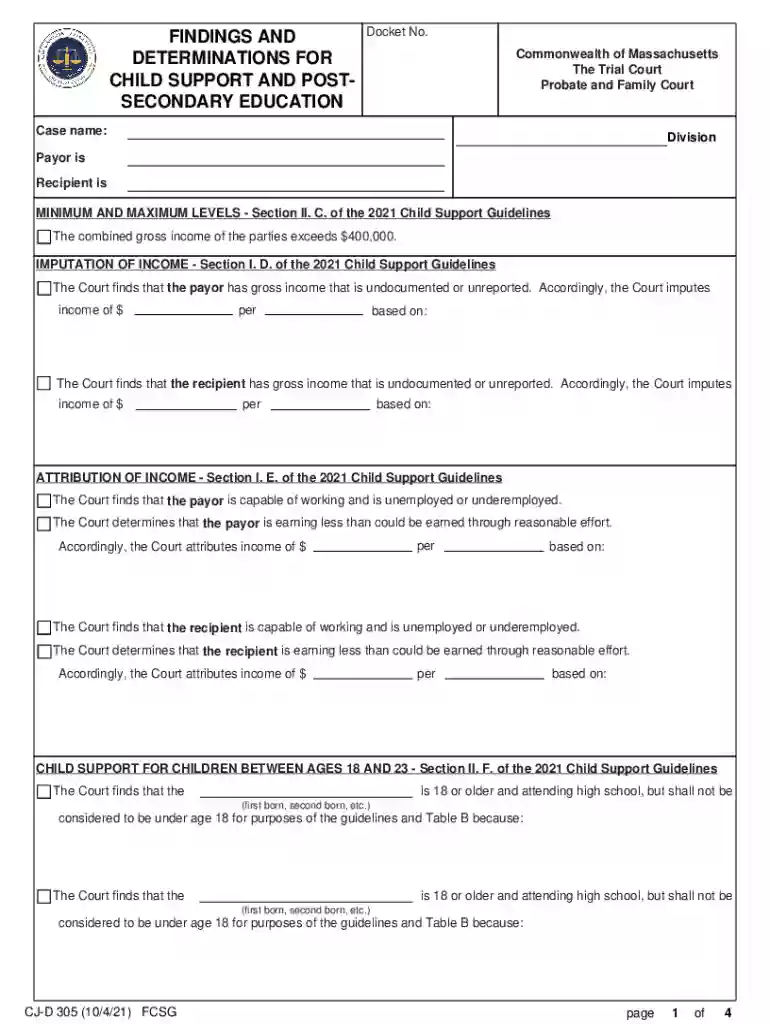
Findings and Determinations for Child Support and Post-Secondary 2026

Get Form
cjd 305 Preview on Page 1

Here's how it works

01. Edit your cjd 305 online
Type text, add images, blackout confidential details, add comments, highlights and more.

02. Sign it in a few clicks
Draw your signature, type it, upload its image, or use your mobile device as a signature pad.

03. Share your form with others
Send cjd305 via email, link, or fax. You can also download it, export it or print it out.

How to use or fill out Findings and Determinations for Child Support and Post-Secondary

Form edit decoration
9.5
Ease of Setup
DocHub User Ratings on G2
9.0
Ease of Use
DocHub User Ratings on G2
  1. Click ‘Get Form’ to open it in the editor.
  2. Begin by entering the Docket Number and Case Name at the top of the form. This information is crucial for identifying your case.
  3. In Section II, provide details regarding the payor and recipient. Fill in their names and any relevant income information as required.
  4. For Sections on Imputation and Attribution of Income, carefully assess each party's employment status. Input any imputed income amounts based on your findings.
  5. Complete the section regarding Child Support for children aged 18 to 23, specifying if they are attending high school and providing necessary justifications.
  6. In the Contribution to Post-Secondary Education section, indicate financial capabilities of both parties concerning educational costs.
  7. Review health care coverage details, ensuring you accurately reflect any additional costs that may affect child support calculations.
  8. Finally, address any deviations from standard guidelines in Section IV, explaining circumstances that justify adjustments to support amounts.

Start using our platform today to efficiently complete your Findings and Determinations for Child Support and Post-Secondary form!

See more Findings and Determinations for Child Support and Post-Secondary versions

We've got more versions of the Findings and Determinations for Child Support and Post-Secondary form. Select the right Findings and Determinations for Child Support and Post-Secondary version from the list and start editing it straight away!
Versions Form popularity Fillable & printable
2021 4.5 Satisfied (59 Votes)
2013 4 Satisfied (35 Votes)
be ready to get more

Complete this form in 5 minutes or less

Get form

Got questions?

We have answers to the most popular questions from our customers. If you can't find an answer to your question, please contact us.
Contact us
What are the main factors that affect the amount of a child support payment? The gross monthly income of each parent. The cost of daycare for the child(ren) each month. The cost of medical insurance for the child(ren) The living arrangements of the child(ren) (for example how many nights they spend at each parents house)
If the check must be payable to the custodial parent, please include the SDU as the co-payee. For example, please make the check payable to [custodial parent] and/or [the state SDU]. Sending payments electronically to state SDUs is another way to ensure payments arrive quickly and safely.
Although overnight visits are one factor, the court also must consider other factors such as income, who pays for health care, who pays for child care, and how many dependents each parent is financially responsible for.
For periods commencing on or after 1 January 2023, if the parties combined income is over $206,310 the maximum amount of child support to be shared between the parties for children aged 12 years and under is: $25,169 for 1 child; $39,198 for 2 children; $49,515 for 3 children.
On average, a typical child support monthly payment is about $400-500 in California, but it can vary greatly.

Security and compliance

At DocHub, your data security is our priority. We follow HIPAA, SOC2, GDPR, and other standards, so you can work on your documents with confidence.

Learn more
ccpa2
pci-dss
gdpr-compliance
hipaa
soc-compliance
be ready to get more

Complete this form in 5 minutes or less

Get form

People also ask

The amount that can be withheld from your wages is limited by the Federal Consumer Credit Protection Act. Here are the limits: 50 percent of disposable income if an obligated parent has a second family. 60 percent if there is no second family.
Expenses that extend beyond those typical areas are generally considered extraordinary or special under California law. Such expenses may include the following: Tutoring for a child who needs additional help for particular classes. Treatment for a disease or prolonged illness.

Related links