BylawsSTS - Society of Thoracic Surgeons 2026

Get Form
BylawsSTS - Society of Thoracic Surgeons Preview on Page 1

Here's how it works

01. Edit your form online
Type text, add images, blackout confidential details, add comments, highlights and more.

02. Sign it in a few clicks
Draw your signature, type it, upload its image, or use your mobile device as a signature pad.

03. Share your form with others
Send it via email, link, or fax. You can also download it, export it or print it out.

How to use or fill out BylawsSTS - Society of Thoracic Surgeons with our platform

Form edit decoration
9.5
Ease of Setup
DocHub User Ratings on G2
9.0
Ease of Use
DocHub User Ratings on G2
  1. Click ‘Get Form’ to open the BylawsSTS application in the editor.
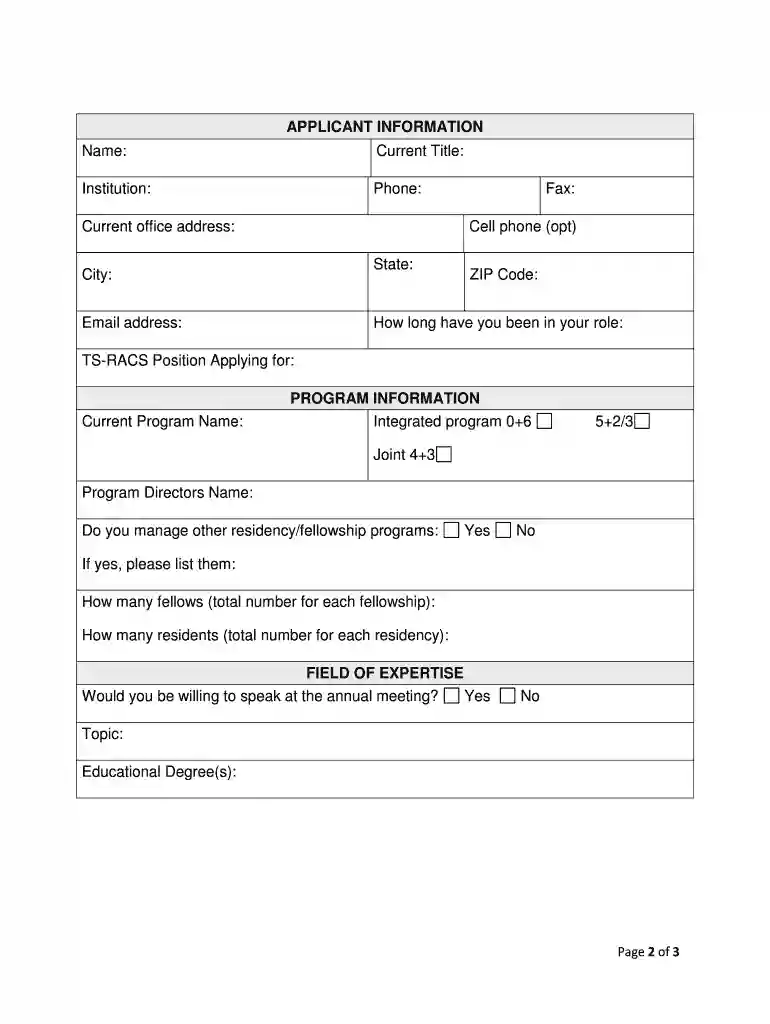
  2. Begin by filling out your personal information in the 'Applicant Information' section. Include your name, current title, institution, and contact details.
  3. In the 'Program Information' section, indicate your program type and provide the Program Director's name. Specify if you manage other residency or fellowship programs.
  4. Next, address the 'Field of Expertise' section. Indicate your willingness to speak at the annual meeting and list any relevant topics.
  5. Complete the 'Topics of Interest' section by suggesting topics for future meetings.
  6. Finally, review all entered information for accuracy. Your typed signature is sufficient; enter it in the designated field along with the date.
  7. Submit your completed application packet electronically as instructed.

Start using our platform today to streamline your application process for free!

See more BylawsSTS - Society of Thoracic Surgeons versions

We've got more versions of the BylawsSTS - Society of Thoracic Surgeons form. Select the right BylawsSTS - Society of Thoracic Surgeons version from the list and start editing it straight away!
Versions Form popularity Fillable & printable
2018 4.8 Satisfied (137 Votes)
be ready to get more

Complete this form in 5 minutes or less

Get form

Got questions?

We have answers to the most popular questions from our customers. If you can't find an answer to your question, please contact us.
Contact us
The STS score is a risk stratification model that is composed of up to 30 variables that predict short- and long-term mortality and morbidity after cardiac surgery, ranging from demographic features to structural properties of the heart and biochemistry.
What are Top 10 Highest Paying Cities for Thoracic Surgeon Jobs CityAnnual SalaryMonthly Pay Berkeley, CA $377,713 $31,476 Sitka, AK $371,617 $30,968 San Francisco, CA $363,441 $30,286 Santa Clara, CA $362,288 $30,1906 more rows
The number of cardiothoracic surgeons per 100,000 people in the US decreased by 12% from 2010 to 2018 (from 0.50 to 0.44; P . 001). Figure 1.
The STS star rating system is one of the most sophisticated and highly regarded overall measures of quality in health care, rating the benchmarked outcomes of cardiothoracic surgery programs across the United States and Canada.
STS ACSD Operative Risk Calculator This next-generation Risk Calculator can be used to assess risk of operative mortality, major morbidity, and short-term outcomes after the vast majority of adult cardiac surgeries.

Security and compliance

At DocHub, your data security is our priority. We follow HIPAA, SOC2, GDPR, and other standards, so you can work on your documents with confidence.

Learn more
ccpa2
pci-dss
gdpr-compliance
hipaa
soc-compliance
be ready to get more

Complete this form in 5 minutes or less

Get form

People also ask

The overall composite score is created by rolling up the domain scores into a single number. In addition to receiving a numeric score, participants are assigned to rating categories designated by one star (below average performance), two stars (average performance), or three stars (above average performance).
The STS score is a validated risk-prediction model for open surgery based on data from the STS National Adult Cardiac Surgery Database. In general, an STS predicted risk of surgical mortality of 4%-8% is considered intermediate risk and 8% or greater is considered high risk.

Related links