- courts state co 2026

Get Form
- courts state co Preview on Page 1

Here's how it works

01. Edit your form online
Type text, add images, blackout confidential details, add comments, highlights and more.
02. Sign it in a few clicks
Draw your signature, type it, upload its image, or use your mobile device as a signature pad.
03. Share your form with others
Send it via email, link, or fax. You can also download it, export it or print it out.

How to use or fill out - courts state co with our platform

Form edit decoration
9.5
Ease of Setup
DocHub User Ratings on G2
9.0
Ease of Use
DocHub User Ratings on G2
  1. Click ‘Get Form’ to open it in the editor.
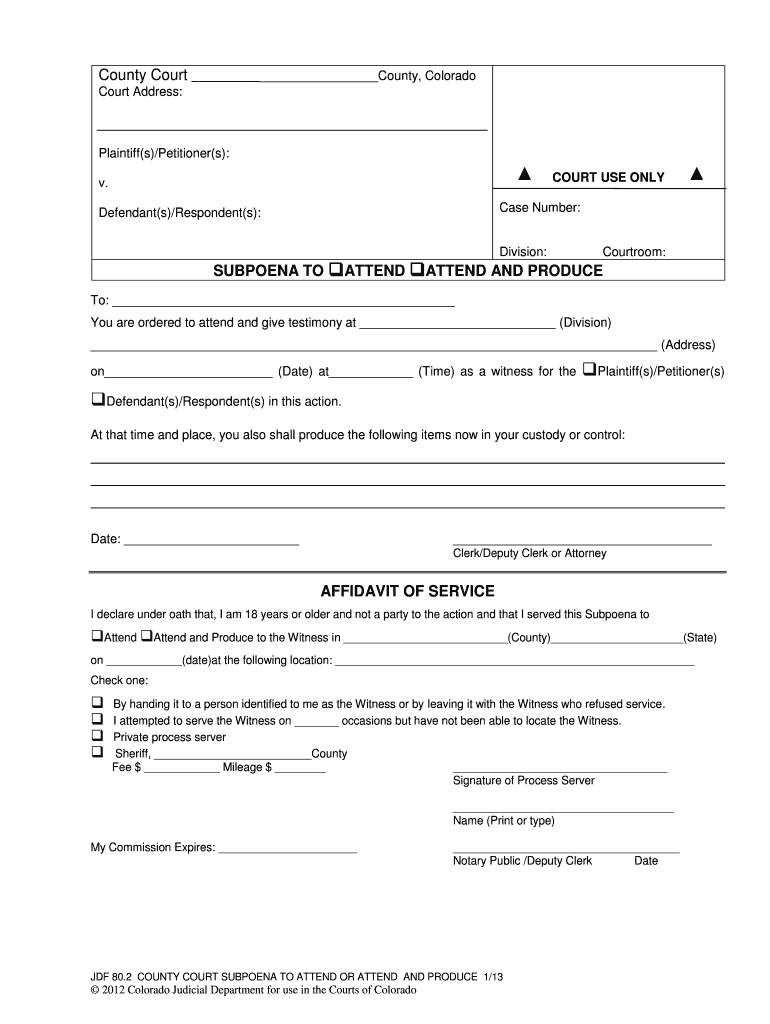
  2. Begin by entering the Court Address at the top of the form. This is essential for identifying where the subpoena is being issued.
  3. Fill in the Plaintiff(s)/Petitioner(s) and Defendant(s)/Respondent(s) sections with the relevant names involved in the case.
  4. Input the Case Number, Division, and Courtroom details to ensure proper identification of your case.
  5. Select whether you are issuing a subpoena to attend or to attend and produce by checking the appropriate box.
  6. Complete the witness information section, including their name, address, date, and time they are required to appear.
  7. In the Affidavit of Service section, provide details about how and when you served the subpoena to the witness.
  8. Finally, ensure that all signatures are completed where indicated, including those of any process servers or notaries if applicable.

Start using our platform today for free to streamline your document editing and form completion!

See more - courts state co versions

We've got more versions of the - courts state co form. Select the right - courts state co version from the list and start editing it straight away!
Versions Form popularity Fillable & printable
2013 4.8 Satisfied (133 Votes)
be ready to get more

Complete this form in 5 minutes or less

Get form

Got questions?

We have answers to the most popular questions from our customers. If you can't find an answer to your question, please contact us.
Contact us
The Colorado court system consists of the Supreme Court, an intermediate Court of Appeals, district courts and county courts.
The Colorado Supreme Court is the states court of last resort. Its decisions are binding on all other Colorado state courts. The Supreme Court is composed of seven justices who serve ten-year terms.
District Courts These are courts of general jurisdiction in Colorados 23 judicial districts. They handle criminal, civil, domestic relations, juvenile, probate, and mental health cases. County Courts These are courts of limited jurisdiction in each of Colorados 64 counties.
District courts have authority to handle many types of cases, including dissolution of marriage (divorce), civil claims in any amount, juvenile matters, probate (estates), mental health, and criminal matters. You may appeal a district court decision to the Colorado Court of Appeals and/or to the Colorado Supreme Court.
There can be an overlap between the case-types, as some offences can be heard in either court. But as a general rule the more serious offences will proceed to the District court while the less serious ones will stay in the Local court.

Security and compliance

At DocHub, your data security is our priority. We follow HIPAA, SOC2, GDPR, and other standards, so you can work on your documents with confidence.

Learn more
ccpa2
pci-dss
gdpr-compliance
hipaa
soc-compliance
be ready to get more

Complete this form in 5 minutes or less

Get form

People also ask

The Colorado Open Records Act CORA requires that most public records be available to the public. A public record includes most writings made, maintained, or kept by our office. However, there are some exceptions concerning records made available under CORA.
California has 2 types of state courts, trial courts (also called superior courts) and appellate courts, made up of the Courts of Appeal and the California Supreme Court.
Colorados three-tiered judicial system Colorado state courts, like federal courts, have three tiers: trial courts, the state court of appeals, and the state supreme court. Cases start in trial courts and are reviewed by the state court of appeals.

Related links