Registry law family 2026

Get Form
florida father registry Preview on Page 1

Here's how it works

01. Edit your florida father registry online
Type text, add images, blackout confidential details, add comments, highlights and more.

02. Sign it in a few clicks
Draw your signature, type it, upload its image, or use your mobile device as a signature pad.

03. Share your form with others
Send florida putative father registry form via email, link, or fax. You can also download it, export it or print it out.

How to use or fill out registry law family with our platform

Form edit decoration
9.5
Ease of Setup
DocHub User Ratings on G2
9.0
Ease of Use
DocHub User Ratings on G2
  1. Click ‘Get Form’ to open the registry law family document in the editor.
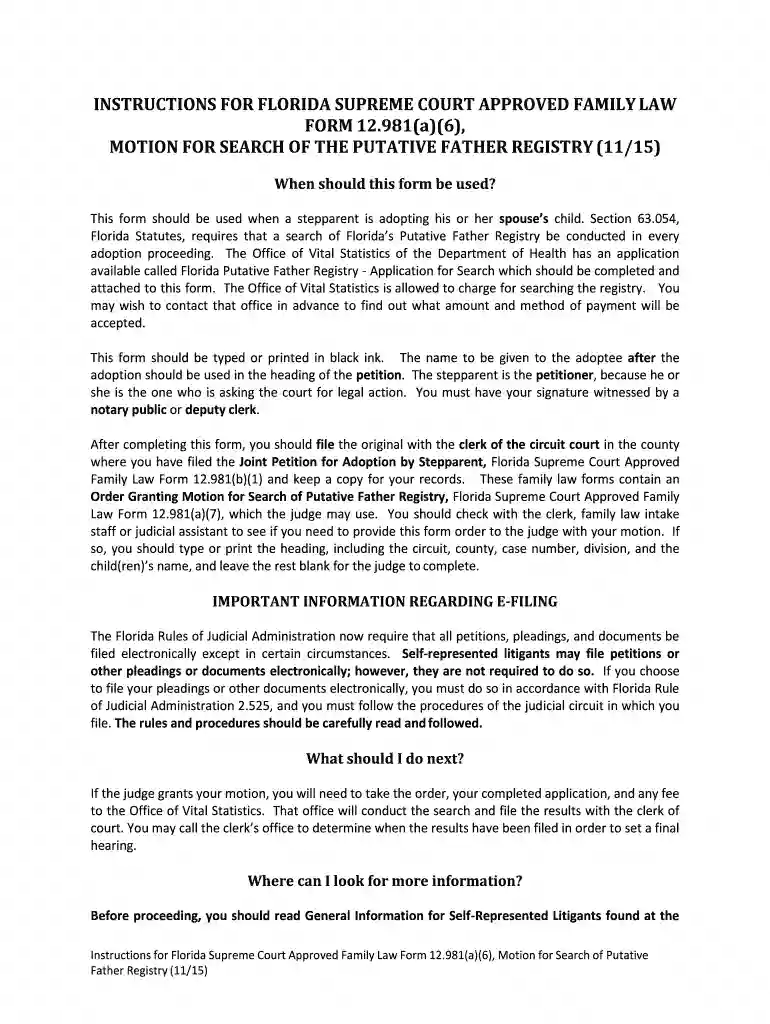
  2. Begin by entering the case details at the top of the form, including the judicial circuit, county, case number, and division. Ensure accuracy as this information is crucial for processing your motion.
  3. In the section labeled 'Petitioner,' input your full legal name as you will be recognized in court. This identifies you as the individual requesting the search of the Putative Father Registry.
  4. Complete the body of the motion by stating that this action is for adoption by a stepparent and referencing Section 63.054 of Florida Statutes. This establishes the legal basis for your request.
  5. Attach the completed Florida Putative Father Registry - Application for Search to your motion. This is essential for initiating the search process.
  6. Sign and date your motion at the bottom, ensuring that your signature is witnessed by a notary public or deputy clerk to validate your submission.
  7. Finally, file the original document with the clerk of court in your county and keep a copy for your records. If required, check if you need to provide additional forms to the judge.

Start using our platform today to streamline your document editing and filing process!

See more registry law family versions

We've got more versions of the registry law family form. Select the right registry law family version from the list and start editing it straight away!
Versions Form popularity Fillable & printable
2015 4.8 Satisfied (122 Votes)
be ready to get more

Complete this form in 5 minutes or less

Get form

Got questions?

We have answers to the most popular questions from our customers. If you can't find an answer to your question, please contact us.
Contact us
Under Family First, states, territories and tribes with approved Title IV-E plans have the option to use these funds for prevention services that would allow candidates for foster care to stay with their parents or relatives. States are then reimbursed for prevention services for up to 12 months.
What is family law in Malaysia? Family law in Malaysia is a set of laws that cover the legal issues among families in Malaysia. There are 4 main legal issues which are marriage divorce, domestic violence, adoption, and guardianship of infants.
A family register (also known in several variations, such as household register and family album, and, when discussing non-anglophone countries, the native-language names of the registers such as koseki in Japan ,Familienbuch in Germany ,and hukou in China ) is a civil registry used in many countries to track
Family Law-I deals with laws governing marriage and matrimonial remedies of nullity, restitution of conjugal rights, judicial separation and divorce, and ancillary remedies of maintenance, legitimacy, adoption, custody and guardianship of children and distribution of spousal property.
law. n. 1) any system of regulations to govern the conduct of the people of a community, society or nation, in response to the need for regularity, consistency and justice based upon collective human experience.

People also ask

(1) The term immediate family member means, with respect to a person (A) the husband or wife of the person; (B) the natural or adoptive parent, child, or sibling of the person; (C) the stepparent, stepchild, stepbrother, or stepsister of the person; (D) the father-, mother-, daughter-, son-, brother-, or sister-in-
Disrespectful Language: Avoid insults, sarcasm, or any derogatory remarks. Personal Attacks: Never make personal comments about the judges character or past decisions, such as ``You always rule against people like me. Interrupting: Speaking over the judge or interrupting them can be seen as disrespectful.

Related links