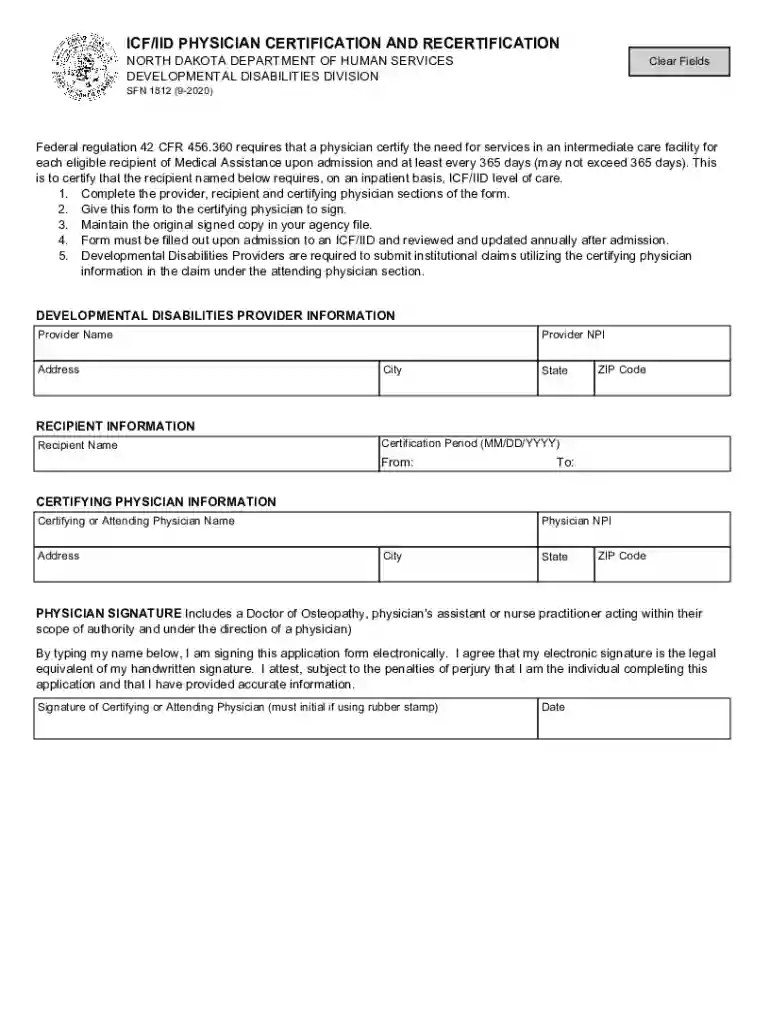
Definition and Meaning
Physician certification and recertification is a formal process ensuring that medical evaluations align with required standards for providing care within specific settings, like intermediate care facilities for individuals with intellectual disabilities (ICF/IID) in North Dakota. The process mandates that a physician must verify the necessity for services upon admission and at least annually thereafter. This certification is pivotal as it directly impacts the approval for care and resource allocation within the healthcare system.
Practical Examples
- Case of Admission: When a resident is admitted into an ICF/IID, a physician completes the certification to confirm the level of care required, assuring that it is suitable for the individual's health status.
- Annual Review: Each year, the physician reassesses the individual's needs, recertifying that ongoing services are necessary, adapting recommendations to any changes in health or condition.
Steps to Complete the Certification and Recertification Process
Completing the physician certification and recertification involves a structured process to ensure accuracy and compliance with guidelines.
- Initial Assessment: Conduct a comprehensive medical examination of the individual upon entry into the care facility.
- Documentation: Fill out certification forms specifying the individual’s health care needs.
- Regular Reviews: Follow up with yearly assessments, evaluating any changes in health status.
- Record Maintenance: Keep a meticulous record of all evaluations and certifications for compliance audits and continuous care planning.
Important Considerations
- Completeness: Ensure no sections are left incomplete to avoid delays in care provision.
- Timeliness: Certifications need to be timely to prevent gaps in the individual's care coverage.
Key Elements of the Certification Form
The certification form focuses on several critical aspects that a physician must address for each patient evaluation.
- Patient Information: Includes personal and medical history data.
- Health Assessment: Details regarding the patient's current health status and any diagnosed conditions.
- Recommended Services: Specific services required to meet the patient’s health needs.
- Certification Statement: Assurance from the physician that the services prescribed are medically necessary.
Detailed Breakdowns
- Health Assessment Details: Expand on conditions affecting care needs, providing a comprehensive overview.
- Service Recommendations: Match health needs with appropriate facility resources to support living conditions.
Legal Use of Certification in North Dakota
North Dakota enforces specific regulations regarding physician certification. Physicians must adhere to state guidelines to validate the certification process.
Compliance Requirements
- State Laws: Ensure conformity with North Dakota’s laws on health services for individuals with intellectual disabilities.
- Duty of Care: Physicians are legally obliged to prioritize accuracy and truthfulness in their certifications.
How to Obtain Physician Certification
Obtaining physician certification involves understanding the various resources and contacts that facilitate this multi-step process.
- Locating Certified Physicians: Engage with networks of certified healthcare providers authorized for these certifications.
- Scheduling Assessments: Set appointments for initial and recurring evaluations necessary for certification.
Efficient Access Tips
- Facility Assistance: Utilize care facility resources to streamline the certification scheduling process.
- Continual Communication: Maintain clear communication between patients, families, and healthcare providers during evaluations.
Important Terms Related to Certification and Recertification
Understanding the terminology associated with physician certification aids clarity in the documentation and procedural requirements.
- Intermediate Care Facility (ICF): A healthcare facility providing specialized care for individuals with intellectual disabilities.
- Recertification: The systematic re-evaluation required to continue receiving or updating services.
Key Term Descriptions
- Care Plan Review: Periodic assessment to ensure the medical care plan is still appropriate.
- Medical Necessity: A criteria standard determining the essential nature of services provided.
State-Specific Rules for Certification
In North Dakota, specific rules govern the physician certification process ensuring its adaptation to cater to local health service systems and infrastructure.
Compliance Strategies
- State Mandates: Tailor certification practices to meet North Dakota’s specific legal and healthcare requirements.
- Update Frequency: Stick to the mandated cycle, usually annually, for regular re-evaluation.
Examples of Certification Utilization
Certifications validate and support various administrative and logistic needs in care facilities.
Typical Scenarios
- Intake Evaluations: Used during initial facility admissions to establish care needs baseline.
- Insurance Approvals: Provide requisite documentation for insurers to authorize coverage for services.
Penalties for Non-Compliance
Failing to comply with certification requirements can lead to significant consequences. Regular adherence to these procedures is critical to avoid sanctions.
Possible Penalties
- Regulatory Action: Non-compliance might result in penalties from state health offices or loss of institutional accreditation.
- Service Disruptions: Missed certifications can delay or interrupt essential services for patients, impacting care quality.