2013 3805v form-2026

Get Form
2013 nol Preview on Page 1

Here's how it works

01. Edit your 2013 nol online
Type text, add images, blackout confidential details, add comments, highlights and more.

02. Sign it in a few clicks
Draw your signature, type it, upload its image, or use your mobile device as a signature pad.

03. Share your form with others
Send it via email, link, or fax. You can also download it, export it or print it out.

How to use or fill out 2013 3805v form with our platform

Form edit decoration
9.5
Ease of Setup
DocHub User Ratings on G2
9.0
Ease of Use
DocHub User Ratings on G2
  1. Click ‘Get Form’ to open the 2013 3805v form in the editor.
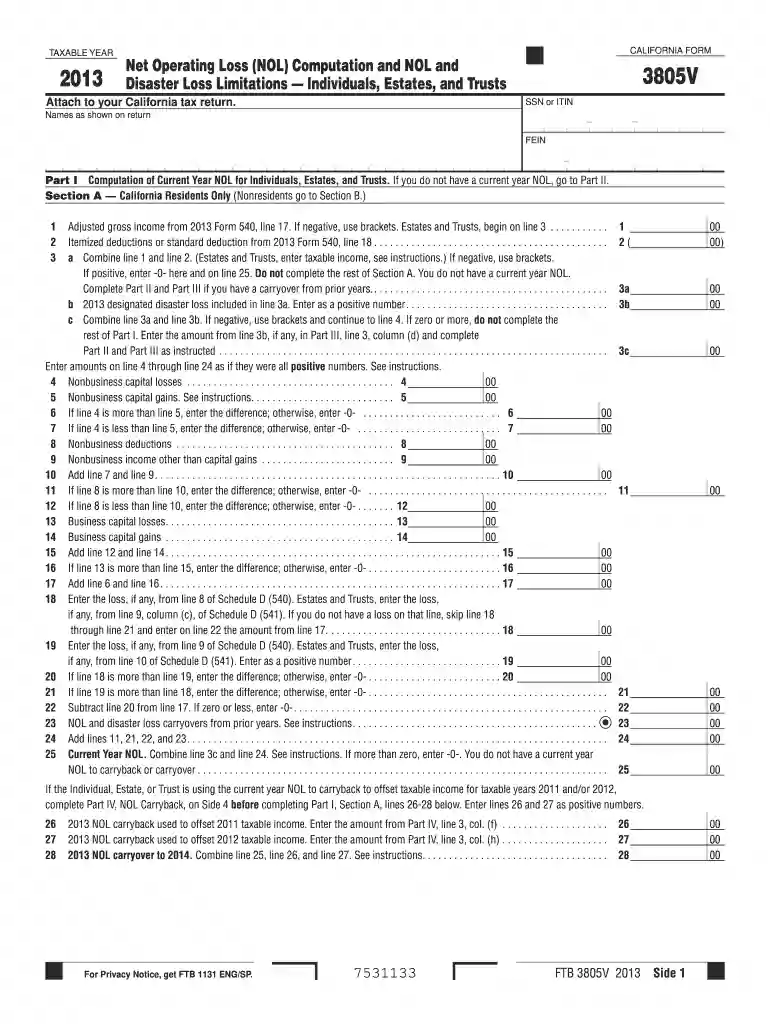
  2. Begin with Part I, Section A for California residents. Enter your adjusted gross income from line 17 of your 2013 Form 540 on line 1. If this amount is negative, use brackets.
  3. On line 2, input your itemized deductions or standard deduction from line 18 of your Form 540. Ensure accuracy as this will affect your NOL calculation.
  4. Combine lines 1 and 2 on line 3a. If the result is negative, use brackets and proceed to Part II. If positive, enter -0- on line 3a and complete Parts II and III if you have carryovers.
  5. For nonresidents, switch to Section B and follow similar steps by entering amounts earned from California sources in the respective columns.
  6. Review all entries for accuracy before saving or submitting your completed form through our platform.

Start filling out your form online for free today!

See more 2013 3805v form versions

We've got more versions of the 2013 3805v form form. Select the right 2013 3805v form version from the list and start editing it straight away!
Versions Form popularity Fillable & printable
2022 4.5 Satisfied (46 Votes)
2021 4.5 Satisfied (46 Votes)
2020 4.8 Satisfied (64 Votes)
2019 4.2 Satisfied (59 Votes)
2018 4.3 Satisfied (121 Votes)
2017 4.1 Satisfied (48 Votes)
2016 4.4 Satisfied (2761 Votes)
2015 4 Satisfied (48 Votes)
2014 4 Satisfied (24 Votes)
2013 4.1 Satisfied (73 Votes)
2012 4 Satisfied (27 Votes)
be ready to get more

Complete this form in 5 minutes or less

Get form

Got questions?

We have answers to the most popular questions from our customers. If you can't find an answer to your question, please contact us.
Contact us
The carryover period for suspended losses was extended by: One year for losses incurred in taxable years beginning on or after January 1, 2021, and before January 1, 2022. Two years for losses incurred in taxable years beginning on or after January 1, 2020, and before January 1, 2021.
Most notably, the state continued to allow taxpayers to take full advantage of the net operating loss (NOL) deduction and ignore 80% of taxable income limitation. In the latest round of budget proposals, taxpayers may see changes to the NOL deduction for the upcoming tax year.
California Suspension of NOL Deduction Changes Tax Planning for Businesses. Californias business climate recently worsened when the state enacted legislation suspending the net operating loss deduction for tax years beginning on or after January 1, 2024, and before January 1, 2027.
Enter loss from Schedule D (540NR), line 8 as a positive number. Enter the smaller of line 1 or line 5. Subtract line 7 from line 6. This is your capital loss carryover to 2023.
For taxable years 2024 through 2026, California suspended the NOL deduction.

People also ask

NOLs can be carried forward indefinitely but are limited to offsetting 80% of taxable income. The 2017 Tax Cuts and Jobs Act (TCJA) and the 2020 Coronavirus Aid, Relief, and Economic Security Act (CARES) led to significant changes in NOL rules. NOLs are recorded as deferred tax assets, affecting future tax liabilities.
You can apply your net capital loss against a taxable capital gain from another year to reduce it either carry it back to any of the past 3 years, or carry it forward to use in a future year.
In general, your NOL deduction for tax years beginning after December 31, 2020, cannot exceed the sum of: (1) the NOLs carried to the year from tax years beginning before January 1, 2018; plus, (2) the lesser of: (a) the NOLs carried to the year from tax years beginning after December 31, 2017, or (b) 80% of the excess

Related links