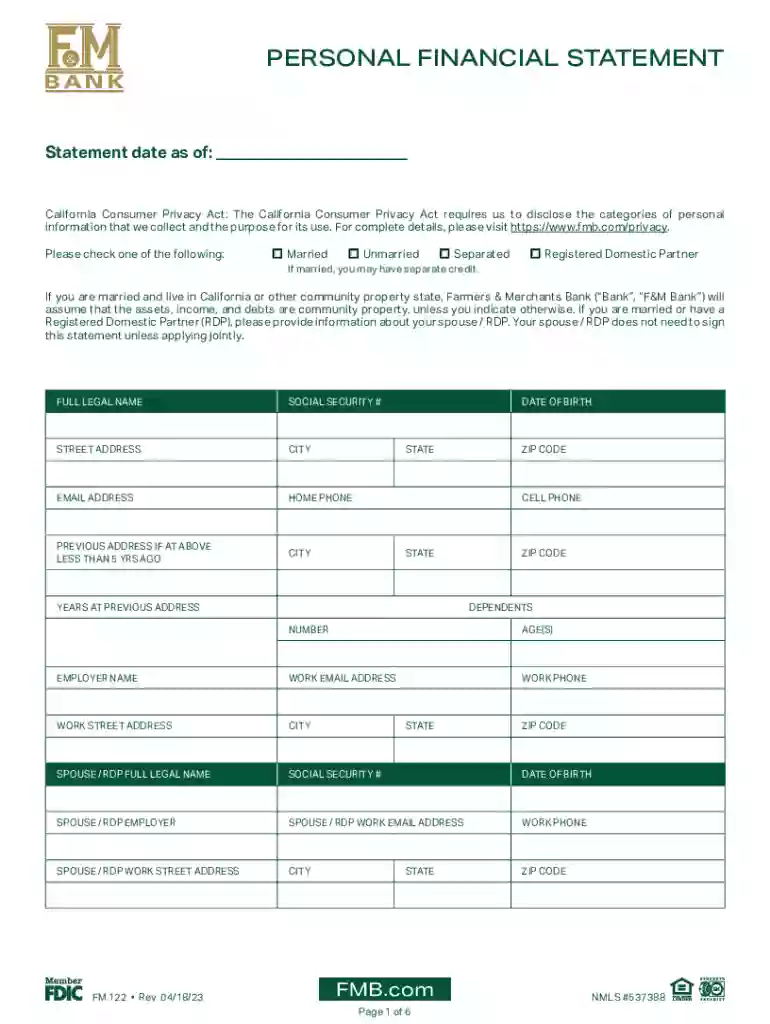
CALIFORNIA CONSUMER PRIVACY STATEMENT 2026

Get Form
CALIFORNIA CONSUMER PRIVACY STATEMENT Preview on Page 1

Here's how it works

01. Edit your form online
Type text, add images, blackout confidential details, add comments, highlights and more.

02. Sign it in a few clicks
Draw your signature, type it, upload its image, or use your mobile device as a signature pad.

03. Share your form with others
Send it via email, link, or fax. You can also download it, export it or print it out.

How to use or fill out CALIFORNIA CONSUMER PRIVACY STATEMENT with our platform

Form edit decoration
9.5
Ease of Setup
DocHub User Ratings on G2
9.0
Ease of Use
DocHub User Ratings on G2
  1. Click ‘Get Form’ to open the CALIFORNIA CONSUMER PRIVACY STATEMENT in the editor.
  2. Begin by filling out your personal information, including your full legal name, social security number, and contact details. Ensure accuracy as this information is crucial for compliance.
  3. Indicate your marital status by checking the appropriate box. If married or in a registered domestic partnership, provide details about your spouse or partner.
  4. Proceed to the Assets and Liabilities section. Enter amounts for each asset and liability category accurately. Use the provided schedules for detailed entries on investments and real estate.
  5. Complete the Income & Expenses section by detailing your annual income sources and expenses. This will help in assessing your financial situation.
  6. Answer all questions regarding legal matters truthfully. Attach additional sheets if necessary for comprehensive responses.
  7. Review all entered information carefully before signing to affirm its accuracy. Utilize our platform’s features to ensure everything is complete.

Start using our platform today to fill out your CALIFORNIA CONSUMER PRIVACY STATEMENT easily and for free!

See more CALIFORNIA CONSUMER PRIVACY STATEMENT versions

We've got more versions of the CALIFORNIA CONSUMER PRIVACY STATEMENT form. Select the right CALIFORNIA CONSUMER PRIVACY STATEMENT version from the list and start editing it straight away!
Versions Form popularity Fillable & printable
2023 4.3 Satisfied (25 Votes)
2013 4.8 Satisfied (183 Votes)
be ready to get more

Complete this form in 5 minutes or less

Get form

Got questions?

We have answers to the most popular questions from our customers. If you can't find an answer to your question, please contact us.
Contact us
Yes, the CCPA exempts certain industries regulated by federal laws, such as healthcare entities covered by HIPAA, financial institutions under the GLBA, and consumer reporting agencies under the FCRA. Insurance institutions regulated by Californias IIPPA are also exempt.
All for-profit companies that process data from users in California and that meet certain thresholds need to comply with the CCPA. These organizations either: collect or process information from at least 100,000 individuals or households, or. have an annual gross revenue over USD 26,625,000 from the year prior, or.
Buy, sell, or share the personal information of 100,000 or more consumers or households. Derive 50% or more of your annual revenue from selling or sharing consumers personal information. Businesses that meet certain thresholds must comply with the CCPA.
The California Consumer Privacy Act (CCPA) provides consumers with the right to opt-out meaning, the right to tell a business to stop selling their personal information.
The CCPA relies on the opt-out principle, which means that you can process personal data without permission until a user opts out of the processing. The CCPA opt-out right is the right of every California consumer to opt out of the selling or sharing of their personal information.

Security and compliance

At DocHub, your data security is our priority. We follow HIPAA, SOC2, GDPR, and other standards, so you can work on your documents with confidence.

Learn more
ccpa2
pci-dss
gdpr-compliance
hipaa
soc-compliance
be ready to get more

Complete this form in 5 minutes or less

Get form

People also ask

A CCPA privacy policy must provide details about your personal information handling and privacy practices, including: categories of personal information collected in the last 12 months. categories of sources from where personal information is collected. specific purposes for which personal information is used.
The CPRA builds on the protections provided by the CCPA, but it introduces new requirements for businesses. Here are a few key differences: The CPRA has a broader scope than the CCPA. The CPRA adds new categories of sensitive personal information, such as health data and precise geolocation.
The California Consumer Privacy Act (CCPA) is among the strictest privacy laws globally, empowering California residents with control over their personal information. Consequently, many law firms must prioritize data privacy. If your firm meets the CCPAs criteria, compliance is mandatory.

Related links