




01. Edit your cot observation notes online
Type text, add images, blackout confidential details, add comments, highlights and more.

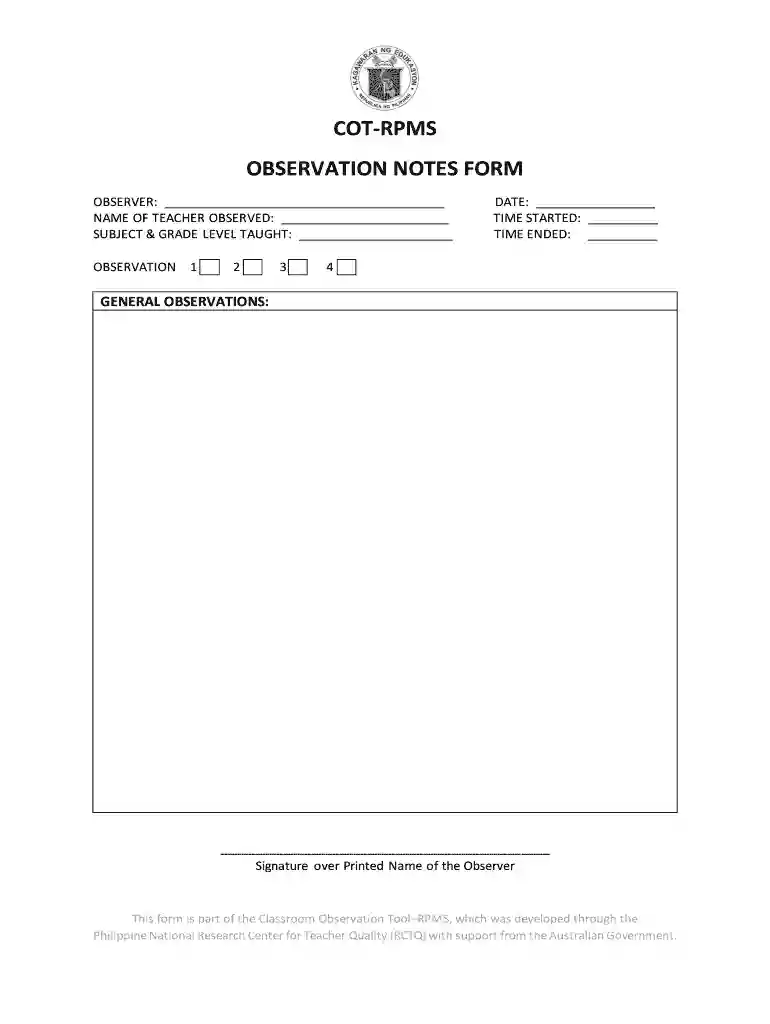
Type text, add images, blackout confidential details, add comments, highlights and more.

Draw your signature, type it, upload its image, or use your mobile device as a signature pad.

Send observation notes for cot via email, link, or fax. You can also download it, export it or print it out.
The COT form, or Classroom Observation Tool form, is a structured document used primarily for educators and evaluators to assess teaching performance during classroom observations. This form is designed to facilitate a comprehensive evaluation by providing specific criteria and indicators that help observers gather pertinent data about teaching practices, student engagement, and classroom management. It typically includes sections for recording the observer's details, the teacher's information, dates and times of observation, as well as space for qualitative and quantitative comments.
Understanding the definition and importance of the COT form is crucial for any educator involved in performance assessment, as it enhances the quality of feedback provided to teachers and leads to improved teaching practices.
Completing the COT form effectively requires systematic preparation and execution to ensure thorough and accurate assessments. Here are the significant steps involved:
Prepare in Advance: Familiarize yourself with the COT form and specific terminology utilized in the observation criteria. This preparation aids in making precise and relevant observations during classroom visits.
Schedule the Observation: Coordinate with the teacher to set an appropriate date and time for the classroom observation. Ensure that both parties understand the goals of the evaluation process.
Conduct the Observation: During the observation, take detailed notes based on the predetermined criteria laid out in the COT form. Focus on various aspects, such as student engagement, teaching strategies, and classroom management.
Complete the Form Post-Observation: After the observation, fill out the COT form while your observations are still fresh. Include both quantitative ratings and qualitative comments. Be sure to provide actionable feedback.
Review and Analyze: Before finalizing the form, review the recorded observations for clarity and comprehensiveness. Ensure the feedback aligns with the observed teaching practices.
Submit for Review: Once completed, submit the COT form according to institutional guidelines, ensuring it reaches the appropriate evaluator or administration personnel.
Following these steps helps maximize the benefits of classroom observations, ultimately contributing to enhanced teaching and learning experiences.
Understanding key terminology associated with the COT form is essential for educators and evaluators. Below are some important terms that frequently appear in the context of classroom observations:
Formative Assessment: A method used to evaluate student learning through observations and feedback, aiming to improve teaching strategies and learning outcomes.
Peer Review: A process where colleagues observe one another’s teaching practices to provide constructive feedback and support professional growth.
Rubric: A scoring tool that outlines expectations and criteria for performance, typically used to assess multiple facets of teaching effectiveness during observations.
Observation Indicators: Specific behaviors or actions observed in the classroom that are aligned with evaluative criteria, such as student participation and lesson delivery.
By familiarizing oneself with these terms, educators can engage more fully in the observation process and ensure clarity in assessments.
The COT form is primarily used by various stakeholders in the educational sector, each with specific purposes for its use:
Teacher Evaluators: Administrators and instructional coaches utilize the form to assess teaching effectiveness, providing structured feedback to educators aiming for professional development.
Teachers Engaged in Self-Reflection: Educators may use the COT form for self-observation purposes, allowing them to critically assess their own teaching practices and identify areas for growth.
Peer Observers: Colleagues conducting peer observations find the COT form valuable for offering consistent feedback and encouragement, fostering a collaborative professional culture.
School Administrators: Principals and other educational leaders may incorporate the COT form into broader evaluation systems to ensure that teaching quality aligns with institutional standards and goals.
By understanding the varied users of the COT form, schools can foster a culture of continuous improvement and professional learning.


The legal context surrounding the COT form emphasizes adherence to educational standards and regulations that govern classroom observations. Important considerations include:
Confidentiality: Observations must be kept confidential, with any feedback shared only with relevant parties to protect teacher rights and ensure a professional evaluation process.
Compliance with School Policies: The use of the COT form must align with district or state education department regulations, ensuring that evaluations uphold professional standards.
Due Process: Teachers have the right to understand how evaluations impact their employment status, including having access to observation results and the opportunity to appeal unfavorable evaluations.
Understanding the legal implications ensures that stakeholders respect educators’ rights while promoting accountability and continuous improvement within educational institutions.
Utilizing the COT form in various scenarios can illustrate its effectiveness in classroom observation. Here are several examples:
New Teacher Evaluation: A school administrator observes a first-year teacher using the COT form to assess their lesson delivery, classroom management, and student engagement techniques. The feedback provided post-observation can guide the teacher’s development through targeted professional development programs.
Peer Observation Collaboration: Two experienced colleagues engage in a peer observation where one teacher uses the COT form to evaluate the other's teaching strategies. This collaborative effort allows both parties to reflect on their practices and discuss the gathered data during follow-up meetings.
Self-Assessment: A veteran teacher decides to use the COT form for self-observation as part of their goal to enhance student interactive learning. By applying the form, they can identify strengths and areas for improvement, leading to a more engaging classroom environment.
By applying the COT form in these diverse contexts, educators can leverage structured feedback to refine their practices, ultimately benefiting both teachers and students.
Classroom observation indicators serve as critical benchmarks for evaluating teaching effectiveness. Included within the COT form, these indicators provide clear metrics for performance assessment:
Student Engagement: Indicators that assess the level of student participation during lessons, measuring how effectively the teacher invites interaction and maintains interest.
Instructional Clarity: Evaluates how clearly the teacher presents the material and whether students comprehend the lesson goals and objectives.
Classroom Management: Analyzes the teacher’s ability to maintain a productive learning environment, including behaviors such as transitioning smoothly between activities and addressing off-task behavior.
Use of Teaching Strategies: Examines the variety and effectiveness of instructional strategies used, including differentiation techniques tailored to meet diverse student needs.
By employing these indicators, observers can provide consistent and focused evaluations, ultimately contributing to meaningful professional development for educators.
Submitting the COT form may necessitate various supporting documents to ensure comprehensive evaluation and professional development. Typically, the following items might be required:
Pre-Observation Planning Documents: Details regarding the lesson plan that will be executed during the observation help observers understand the context and objectives for the session.
Previous Evaluation Reports: Access to prior observation results can offer valuable context for current evaluations, highlighting patterns and offering insights into teacher growth over time.
Feedback from Students: Collecting student evaluations or feedback can provide additional perspectives, enriching the evaluation and supporting the insights derived from the COT form.
By understanding the auxiliary documentation needed for effective COT form submission, educators can ensure a thorough and holistic evaluation process.
We've got more versions of the cot observation notes form. Select the right cot observation notes version from the list and start editing it straight away!
At DocHub, your data security is our priority. We follow HIPAA, SOC2, GDPR, and other standards, so you can work on your documents with confidence.
This form is required to request assistance on Investigations, litigation, and Open Records (ORR). The completed form can be sent toRead more
A series of forms, evaluations and guidelines for teachers and leaders to use in their Culture of Thinking classrooms and schools.Read more
Concurrently, format and protocol tuning ensures that models follow unified inputoutput protocols, producing CoT-style reasoning followed by concise answers.Read more


