







Definition & Meaning
The "BIGGS LABORATORY, WADSWORTH CENTER NEW YORK STATE DEPARTMENT" refers to a critical component within the New York State Department of Health that focuses on laboratory evaluations and testing procedures. This division supports public health efforts by ensuring high standards in laboratory testing across New York State. Its functions encompass testing and analysis to aid in disease prevention and public health protection initiatives. The Center is instrumental in maintaining the integrity and quality of laboratory operations in the state.
Subsections:
- Public Health Role: This laboratory's work supports public health by testing a variety of specimens to identify pathogens, monitor outbreaks, and ensure community safety. Its role in public health is foundational, providing the necessary data to guide health policies and responses.
- Laboratory Standards: It ensures that all laboratory activities comply with established standards and regulations, which involve rigorous assessments and evaluations to maintain accuracy and reliability.
How to Use the BIGGS LABORATORY, WADSWORTH CENTER NEW YORK STATE DEPARTMENT
The use of the BIGGS LABORATORY involves submitting specimens for testing following specific guidelines set by the state department. Laboratories wanting to utilize Biggs services must comply with submission protocols and testing requirements.
Steps:
- Collect Specimen: Ensure the specimen is collected accurately following the proper safety and contamination protocols.
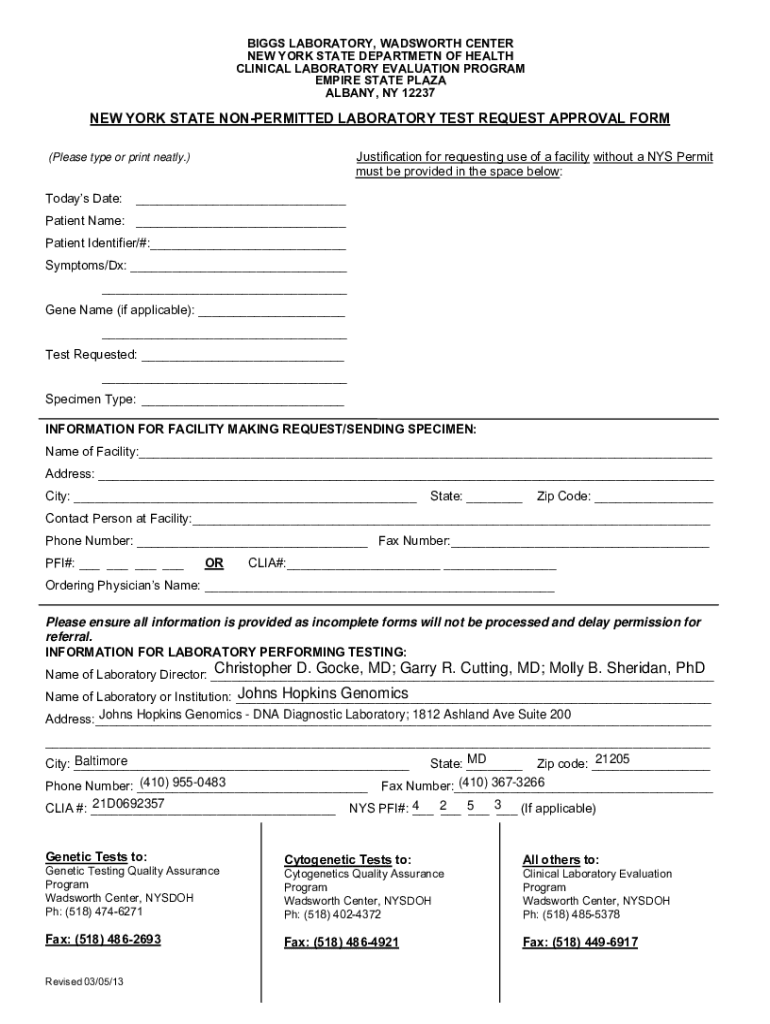
- Documentation: Complete all necessary forms, detailing patient information and testing requirements.
- Submission: Submit the specimen to Biggs Laboratory with the appropriate documentation for processing.
- Follow-up: Verify receipt and await results, maintaining communication with the laboratory for any inquiries or clarifications.
Practical Example:
A healthcare provider suspecting a disease outbreak might collect samples and send them to Biggs for analysis. This ensures accurate detection and timely intervention.
Steps to Complete the BIGGS LABORATORY, WADSWORTH CENTER NEW YORK STATE DEPARTMENT
Completing the forms correctly is critical for the laboratory's seamless processing of specimens.
Procedure:
- Fill Out Request Form: Carefully input all required information in the specimen request form.
- Justification: Note any specific reasons for the submission, such as continuity of care or specimen integrity.
- Cross-check Information: Ensure all relevant patient and specimen data are accurate and complete.
- Submit for Approval: Forward the forms alongside the specimen for laboratory approval and processing.
Edge Cases:
- Incomplete Information: Any missing or incorrect details can delay the processing time. It’s crucial to double-check all data and consult the laboratory's guidelines if needed.
Legal Use of the BIGGS LABORATORY, WADSWORTH CENTER NEW YORK STATE DEPARTMENT
The laboratory must be used legally and in accordance with state regulations. Any misuse of its services can result in penalties.
Legal Obligations:
- Compliance: Users must adhere to state regulations and guidelines when submitting specimens.
- Accuracy: Misrepresentation of testing purposes or results can lead to legal action against the submitting entity.
State-Specific Rules for the BIGGS LABORATORY, WADSWORTH CENTER NEW YORK STATE DEPARTMENT
Different states might have varying stipulations, but New York State has specific rules and regulations governing laboratory use and specimen submission to maintain consistency and reliability in testing.
Key Differences:
- Testing Regulations: Only permitted labs can submit specimens unless justified for special reasons.
- Documentation Standards: Strict requirements exist for documentation that must accompany all submissions.
Required Documents
Ensuring all required documents accompany any submission to the laboratory is crucial for processing efficiency.
Document Checklist:
- Specimen Submission Form: Primary document detailing specimen and patient information.
- Justification for Submission: Explanation for any specimen submitted from non-permitted labs.
- Practitioner Information: Detailed information about the submitting practitioner or entity.
Form Submission Methods (Online / Mail / In-Person)
Submitting forms and specimens to Biggs Laboratory is possible through several avenues, offering flexibility to submitters.
Methods:
- Online: Quick and efficient if systems are available.
- Mail: Traditional method ensuring documentation can be physically tracked.
- In-Person: Useful for urgent submissions requiring immediate attention.
Practical Consideration:
Practices should ensure they select the submission method that best suits their timeline and needs while aligning with Biggs’ capacities and protocols.
Important Terms Related to BIGGS LABORATORY, WADSWORTH CENTER NEW YORK STATE DEPARTMENT
Understanding key terminology can demystify many procedures associated with using the laboratory services.
Glossary:
- CLEP: Clinical Laboratory Evaluation Program responsible for overseeing laboratory competence.
- Specimen Integrity: Ensuring a specimen’s quality and condition are maintained during transit.
- Permitted Laboratory: Laboratories authorized to submit specimens without additional justification.
By covering these crucial sections, users gain a comprehensive understanding of the BIGGS LABORATORY, WADSWORTH CENTER NEW YORK STATE DEPARTMENT, enabling them to effectively engage with its services and adhere to best practices and regulatory requirements.




