





Definition and Meaning
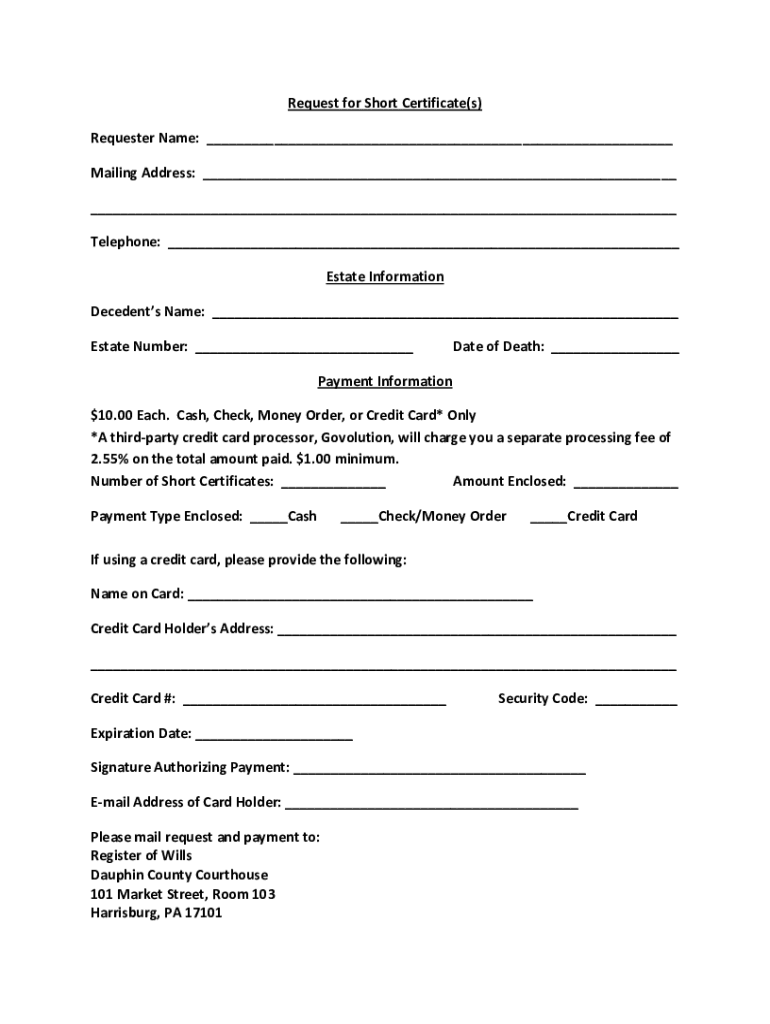
The Hudson County Surrogate's Court Information Sheet is a crucial document used in the probate process, primarily when handling estates. It captures essential information about the decedent's estate, including the deceased person's details and the executor’s or administrator’s requests, such as obtaining short certificates. This form serves as a structured way to communicate the necessary details to the court, ensuring that the estate is processed smoothly and in accordance with legal requirements.
Key Elements Included in the Form
- Decedent's Information: Includes the full legal name, date of death, and estate number.
- Requester's Details: Information about the person submitting the form, which is typically the executor or administrator of the estate.
- Short Certificate Requests: Specifies the number of short certificates needed and the applicable fee of $10.00 per certificate.
- Payment Information: Section for detailing the payment method, such as cash, check, money order, or credit card.
Steps to Complete the Hudson County Surrogate's Court Information Sheet
- Gather Required Information: Ensure you have the decedent’s full name, date of death, and estate number, alongside your personal details as the requester.
- Complete Decedent's Section: Fill out all fields related to the decedent accurately to avoid processing delays.
- Request and Payment Details: Indicate the number of short certificates needed and select the preferred payment method.
- Review the Form: Double-check all entered data for accuracy and completeness.
- Submit the Form: Follow the specified submission method, whether it is in-person, via mail, or online, as per the court’s accepted procedures.
Tips for Accurate Completion
- Double-check the estate number with any official communications received.
- Ensure that your contact information is current, as the court may need to reach you for any clarifications.
- Verify payment method compatibility with the court’s systems or guidelines.
How to Obtain the Hudson County Surrogate's Court Information Sheet
Methods for Access
- In-Person: Visit the Hudson County Surrogate’s Court to pick up a copy.
- Online: Download directly from the Hudson County website, if available.
- Request by Mail: Contact the court to have a form mailed to your address.
Where to Find More Information
Access additional resources and guidance on filling out the form through the Hudson County Surrogate’s Court or their official website, providing both contact information and procedural guides.
State-Specific Rules for the Hudson County Surrogate's Court Information Sheet
Working exclusively within Hudson County, this form aligns with New Jersey probate laws, which could vary slightly from those in other states. Specific requirements might include stricter documentation verification or particular submission procedures unique to New Jersey’s judiciary system.
New Jersey Law Compliance
- Ensure that all signatures are from authorized individuals.
- Be aware of the deadlines and procedural nuances specific to New Jersey probate filings.
Important Terms Related to the Hudson County Surrogate's Court Information Sheet
- Probate: The legal process of administering a deceased person's estate.
- Executor: The individual appointed to administer the last will and testament.
- Short Certificate: A legal document proving the executor's authority to act on behalf of the estate.
Clarifications and Usage
- Use probate terms consistently, aligning with New Jersey’s probate code for clarity in legal dealings.
- Understand the context and implications of each term to ensure compliance and proper form utilization.
Why Use the Hudson County Surrogate's Court Information Sheet
This information sheet facilitates a smooth probate process, reducing the likelihood of administrative delays by providing the court with all required data in a standardized format. Executors can efficiently manage estate-related tasks, like obtaining necessary legal documents, transferring assets, and closing the estate according to legal mandates.
Benefits of Proper Form Usage
- Streamlined estate processing.
- Legal compliance assurance.
- Clear communication with court officials.
Examples of Using the Hudson County Surrogate's Court Information Sheet
Real-World Scenarios
- Scenario 1: An executor needs several short certificates to close bank accounts and transfer assets. The form's completion enables them to quickly acquire the necessary documents from the court.
- Scenario 2: A family member is handling the estate but resides out of New Jersey. They use the form to coordinate and request all assets’ documentation efficiently in advance to minimize their travel.
Form Submission Methods
Available Channels
- Online Submission: Upload the completed form through a designated portal, if offered by Hudson County.
- Mail Submission: Send to the court's address following proper mailing instructions.
- In-Person Drop-off: Submit directly to the court's office for immediate processing and any clarifications.
Considerations for Each Method
- Verify any additional documentation required at submission.
- Check for confirmation that the form was received and processed if submitting by mail or online.
Required Documents
Supporting Materials
- Death Certificate: Official copy to verify the decedent’s information.
- Legal Proof of Executor Status: Existing documentation providing executor authority.
- Identification: Personal identification for the individual completing the form.
Ensuring Document Validity
- Confirm that all supporting documents are up-to-date and issued by recognized authorities.
- Keep copies of all submitted documents for personal records and legal reference.
Eligibility Criteria


Who Can Use the Form
Typically used by estate executors, administrators, or legal representatives, this form is essential for those responsible for settling the estate of the deceased. Aligning these roles with legal probate guidelines helps ensure a smooth and conflict-free process.
Compliance and Authorization
- Ensure you have the legal standing and necessary authorization to act as the executor.
- Confirm that all eligibility criteria for handling estates in New Jersey are met before form submission.