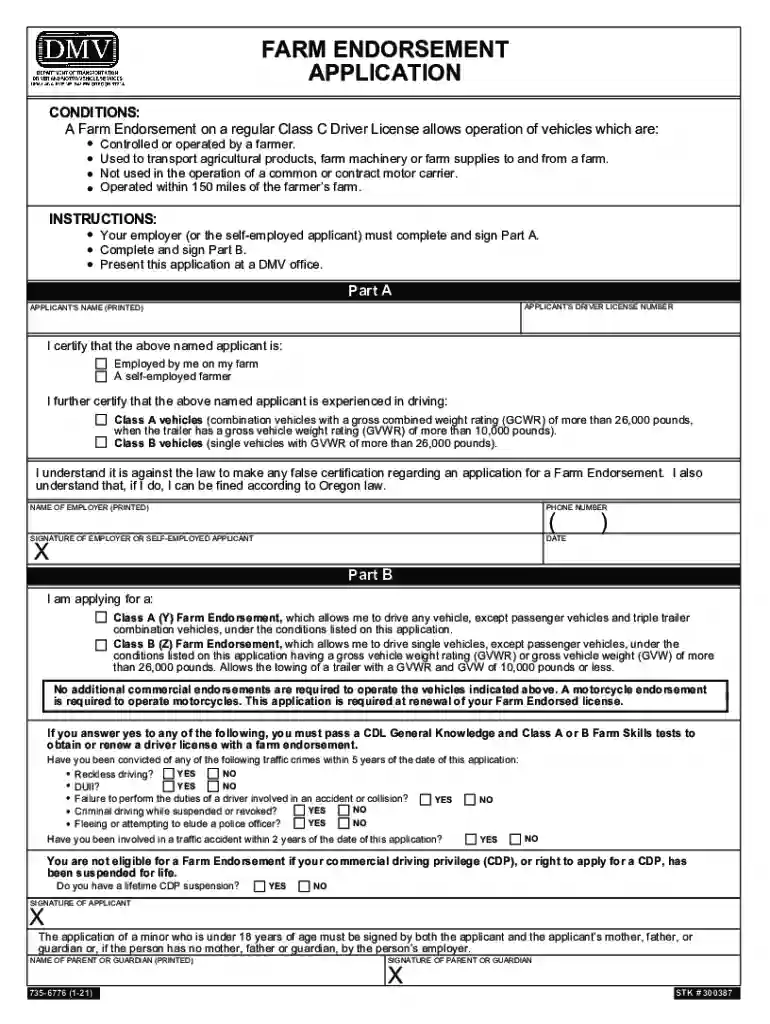
A Farm Endorsement on a regular Class C Driver License allows operation of vehicles which are: 2026

Get Form
A Farm Endorsement on a regular Class C Driver License allows operation of vehicles which are: Preview on Page 1

Here's how it works

01. Edit your form online
Type text, add images, blackout confidential details, add comments, highlights and more.

02. Sign it in a few clicks
Draw your signature, type it, upload its image, or use your mobile device as a signature pad.

03. Share your form with others
Send it via email, link, or fax. You can also download it, export it or print it out.

Definition & Meaning

A Farm Endorsement on a regular Class C Driver License authorizes the operation of specific vehicles used for agricultural purposes within a defined geographical radius. This endorsement allows the holder to legally operate vehicles such as farm trucks and tractors for tasks directly related to farming activities. The purpose of this endorsement is to facilitate agricultural operations by allowing farmers to transport goods and equipment without the need for a commercial driver's license, which is typically more restrictive and costly.

The endorsement is critical for ensuring that agricultural producers can efficiently manage their operations by providing legal access to larger vehicles required for transporting livestock, produce, and machinery.

How to Use a Farm Endorsement

Operating vehicles under a Farm Endorsement involves several specific scenarios:

  • Transport of Equipment: Farmers can use large vehicles to transport equipment between farms and fields.
  • Moving Goods: It permits the transport of farm goods, like crops and livestock, to markets or processing facilities.
  • Distance Limitation: Usage is restricted within a 150-mile radius from the farm, ensuring operations remain local to the farm's location.

Farmers must adhere to all state and federal regulations regarding vehicle operation and safety while using this endorsement to maintain compliance and avoid penalties.

How to Obtain a Farm Endorsement

To receive a Farm Endorsement, applicants must follow a set process:

  1. Eligibility Verification: Ensure all criteria, such as residency and age, are met.
  2. Application Submission: Submit a completed application along with necessary identification documents to the Department of Motor Vehicles (DMV) or equivalent state agency.
  3. Certification: For self-employed applicants, certification of farming operations is required. Employed applicants need verification from their employers.
  4. Testing: Some states might require passing specific knowledge tests related to farm vehicle operations.

After following these steps, the application will be reviewed, and the DMV will issue the endorsement if all requirements are satisfied.

Steps to Complete the Application

Applying for the Farm Endorsement involves several logical steps designed to ensure compliance and readiness:

  • Compile Necessary Documents:

    • Proof of identity and residency.
    • Evidence of farming operation (e.g., tax documents or employer certification).
  • Visit DMV Office: Applicants typically need to visit their local DMV office to submit their documents in person unless an online submission is available.

  • Complete Required Testing: Some locations require tests to ensure applicants understand the legal and operational aspects of using endorsed vehicles.

Who Typically Uses the Farm Endorsement

This endorsement is primarily used by:

  • Farm Owners: Individuals who manage and operate farm businesses.
  • Farm Employees: Workers who are responsible for transporting farm produce or equipment.
  • Family Members: Often includes family members engaged in the farming business who need to operate large vehicles.

People in these roles benefit from the flexibility and reduced regulatory burden the endorsement provides.


decoration image ratings of Dochub

Legal Use of the Farm Endorsement

The Farm Endorsement is subject to several legal guidelines:

  • Agricultural Use Only: Vehicles operated under this endorsement must be used strictly for agricultural purposes. Any non-farming usage is subject to standard vehicle regulations and possibly different licensing requirements.

  • State Regulations: Regulations can vary by state, and it's essential for holders to be familiar with the specific laws applicable in their location.

  • Insurance Compliance: Despite the relaxed licensing requirements, standard insurance for farm vehicles is obligatory to protect from liabilities or damages during operation.

State-Specific Rules

Farm Endorsement regulations vary notably across different states:

  • Varied Distance Limits: Some states may impose different radius limits or permit broader operational scope under certain conditions.
  • Application Fees: Processing fees for the endorsement can differ.
  • Testing Requirements: Knowledge or road tests may be mandatory in some states but waived in others.

It's crucial for applicants to review their state-specific rules by consulting with the DMV or their equivalent office to ensure they're meeting all required guidelines.

Examples of Using a Farm Endorsement

To illustrate the practical application:

  • Seasonal Harvest Transport: Farmers use trucks to move large amounts of produce to nearby collection centers during harvest season.
  • Livestock Markets: Farmers may transport animals to market or auction houses within the local area using larger, agriculture-endorsed vehicles.

These examples underscore the critical role this endorsement plays in facilitating daily and seasonal agricultural operations, highlighting its utility for farming communities.

See more A Farm Endorsement on a regular Class C Driver License allows operation of vehicles which are: versions

We've got more versions of the A Farm Endorsement on a regular Class C Driver License allows operation of vehicles which are: form. Select the right A Farm Endorsement on a regular Class C Driver License allows operation of vehicles which are: version from the list and start editing it straight away!
Versions Form popularity Fillable & printable
2022 4.8 Satisfied (161 Votes)
2021 4.6 Satisfied (113 Votes)
2019 4.2 Satisfied (41 Votes)
2018 4.3 Satisfied (166 Votes)
2013 4 Satisfied (28 Votes)
be ready to get more

Complete this form in 5 minutes or less

Get form

Got questions?

We have answers to the most popular questions from our customers. If you can't find an answer to your question, please contact us.
Contact us
(a) A vehicle or combination of vehicles registered in this state, which (i) displays a covered farm vehicle designation issued by the commissioner, (ii) is operated by the owner or operator of a farm or ranch, or an employee or family member of an owner or operator of a farm or ranch, (iii) is used to transport
Class C drivers can operate any vehicle with a GVWR under 26,001 pounds or tow a trailer that weighs less than 10,001 pounds. Example vehicles: Passenger vans, small hazmat trucks, and shuttle buses.
A Class C commercial drivers license (CDL) is the type of drivers license needed to drive commercial motor vehicles or a combination of vehicles that dont meet the requirements for Class A or Class B licenses, including both intrastate and interstate transportation.
With a Basic Class C License: a 2-axle vehicle with a GVWR of 26,000 pounds or less. a 3-axle vehicle weighing 6,000 pounds gross or less. a motorized scooter.
Endorsements for Class C Licenses These endorsements allow you to drive specialized vehicles such as school buses or vehicles carrying hazardous materials, provided you pass the necessary exams and background checks.

Security and compliance

At DocHub, your data security is our priority. We follow HIPAA, SOC2, GDPR, and other standards, so you can work on your documents with confidence.

Learn more
ccpa2
pci-dss
gdpr-compliance
hipaa
soc-compliance

People also ask

A Class C CDL is another one of the different types of California commercial drivers licenses. This particular license is required for drivers operating automobiles designed to transport 16 or more passengers (including the driver) or hazardous materials requiring placards.

Related links