




01. Edit your form online
Type text, add images, blackout confidential details, add comments, highlights and more.

Type text, add images, blackout confidential details, add comments, highlights and more.

Draw your signature, type it, upload its image, or use your mobile device as a signature pad.

Send it via email, link, or fax. You can also download it, export it or print it out.
The term "form online" refers to a digital format of documents used for collecting, submitting, and processing various types of information via the internet. This could encompass applications, registrations, surveys, tax filings, or any standardized documents traditionally filled out on paper. The online format allows users to easily access and complete forms using electronic devices such as computers or smartphones. This conversion to a digital medium often includes interactive fields for user input, automation to streamline data handling, and integration options with other software platforms, enhancing both accessibility and user experience.
Utilizing an online form starts with locating the appropriate platform that hosts the form you need. Begin by accessing the website of the organization or service requiring the form. Many institutions provide direct links to their forms on their homepage or under sections labeled "Forms" or "Documents." Once accessed, follow these steps:
Read Instructions Carefully: Before starting, review any guidelines provided for completing the form. These instructions can aid in understanding specific fields that require attention.
Input Data Accurately: Use the interactive fields to input the necessary information, ensuring that all required fields are completed. Online forms usually alert users if required fields are left blank.
Save Progress if Possible: Some platforms allow you to save your work and return later, which can be useful if you need more time to gather information.
Review for Errors: Before submission, review all data for accuracy. Correct any mistakes to avoid delays in processing.
Submit and Confirm: Once complete, submit the form through the platform. Many systems will provide confirmation once successfully submitted, which might include a reference number that should be saved for tracking purposes.
Completing an online form involves a series of straightforward steps designed to guide users through the process efficiently:
Access the Form: Begin by visiting the appropriate website hosting the form you need.
Open the Form Page: Click on the link or button that opens the electronic form.
Fill Out the Fields: Use your keyboard to enter the necessary information into each field. Common fields might include name, address, date of birth, and specific details pertinent to the form's purpose.
Attach Required Documents: Some forms may require additional documentation. Attach electronic copies where necessary using the upload feature commonly provided on the form page.
Review and Edit: Ensure all information is correct. Most platforms allow for editing before final submission.
Submit Form: Finalize the process by clicking the "Submit" button. You may receive an email confirmation that includes a summary of your submission.
Shifting to online forms presents several advantages:
Convenience and Accessibility: Users can complete forms from any location with internet access, at any time, removing the need for physical presence or mailing delays.
Efficiency and Speed: Automated features reduce the time taken to fill out forms, process data, and receive responses.
Cost Effective: Eliminating paper reduces costs associated with printing, postage, and storage.
Environmental Impact: Digital forms support environmentally friendly practices by decreasing paper usage.
Security: Encryption and secure servers protect sensitive information more effectively than paper forms can offer.
A broad spectrum of individuals and organizations use online forms. These include:
Individuals: Private citizens submit tax forms, apply for licenses, enroll in courses, and register for events.
Businesses: Companies use online forms to onboard employees, manage customer feedback, and handle order processing.
Educational Institutions: Schools use digital forms for admissions, enrollment processes, and feedback.
Government Agencies: Authorities provide services such as tax filings, benefits applications, and licenses through digital form submissions.
An online form often includes these critical elements to enhance usability and functionality:
Interactive Fields: Allow users to input data directly online without requiring physical writing.
Dropdowns and Checkboxes: Simplify the selection of options and reduce input errors.
Signature Fields: Utilize electronic signature options to authenticate forms legally.
Automated Calculations: Instantly compute totals or validate data entries based on user input.
Submission Confirmation: Provides users with acknowledgment and a reference number upon successful submission, ensuring tracking and accountability.
The legal use of electronic forms has gained recognition, particularly under laws like the Electronic Signatures in Global and National Commerce Act (ESIGN) in the U.S. This legislation supports the validity and legality of electronic transactions, giving online forms the same weight as paper documents when complying with certain regulatory standards. Legal concerns addressed by online forms include:
Authenticity and Integrity: Ensuring that the identities of signatories can be verified and that the document remains unchanged post-signature.
Data Protection: Compliance with data protection standards (like GDPR or CCPA), ensuring user information is handled securely.
Online forms are often designed to be compatible with various software and CMS (Content Management Systems). Compatibility implications include:
Integration with Office Suites: Compatibility with software like Microsoft Office or Google Workspace allows users to export or import data adeptly.
Tax Software Compatibility: Solutions like TurboTax or QuickBooks integrate with tax forms to streamline financial operations.
Web Browsers: Forms are typically accessible through major web browsers such as Chrome, Firefox, Safari, and Edge, ensuring broad accessibility across devices and systems.
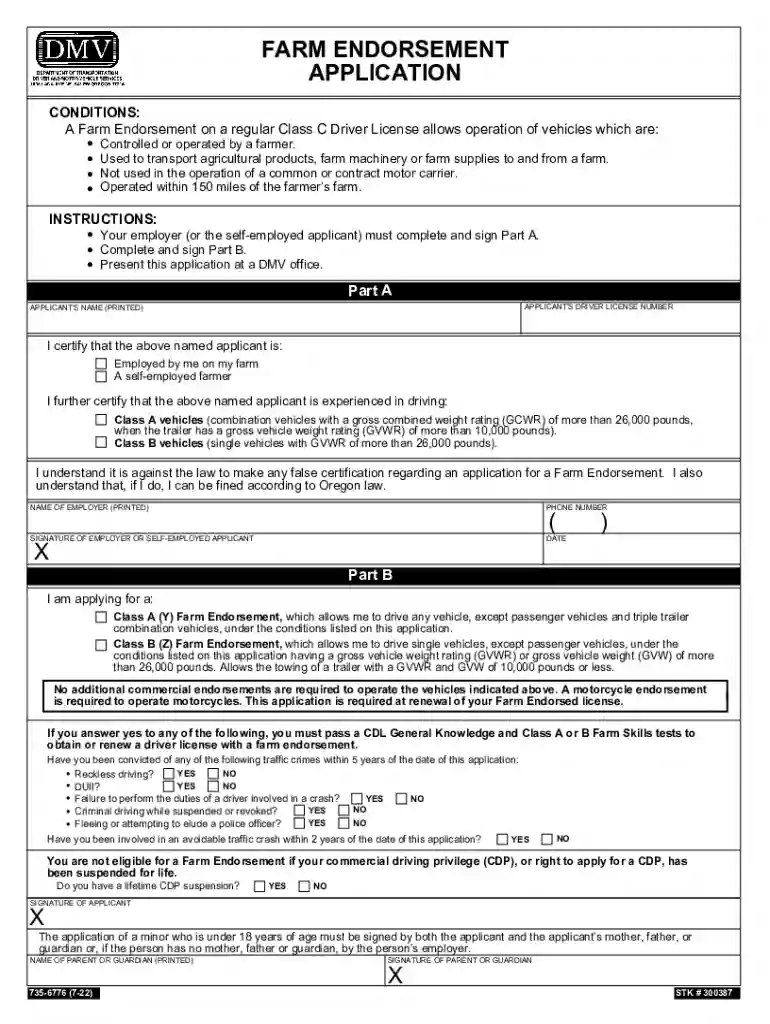
We've got more versions of the Oregon Farm Endorsement Application form. Select the right Oregon Farm Endorsement Application version from the list and start editing it straight away!
At DocHub, your data security is our priority. We follow HIPAA, SOC2, GDPR, and other standards, so you can work on your documents with confidence.
The Youth Tractor Safety Certification course is a 22-hour program that meets the requirements of the Oregon Department of Agriculture.Read more
that the least likely application to be endorsed for ISM is to identify areas of high concentration. (i.e., hot spots). Several states have regulations andRead more
Fill out the application (Form 735-6776);; Make an appointment at a DMV office;; Present proof of physical address and identity;; Pay the testing and licensingRead more


