Definition and Meaning
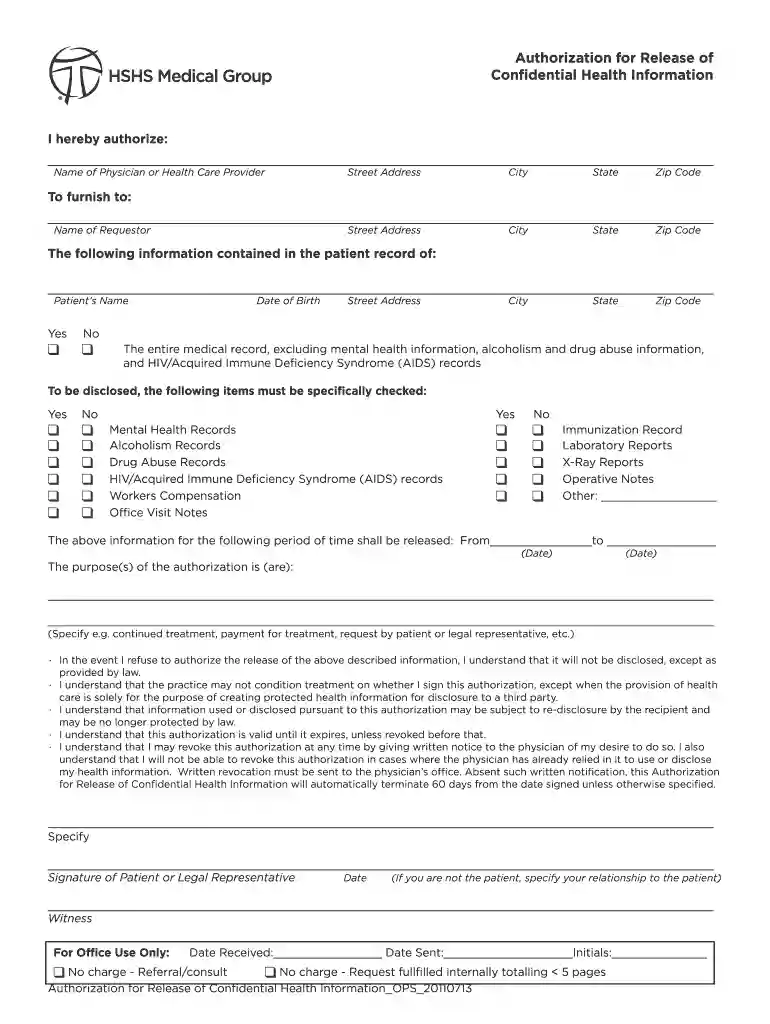
The "Request for Medical CareOPS20101220 - HSHS Medical" is a formal document designed to facilitate the disclosure of a patient's medical records from a specified healthcare provider to an authorized requestor. This form plays a critical role in ensuring the secure and authorized transfer of sensitive health information. As such, it serves as a bridge between healthcare providers and entities that need this information, ensuring compliance with legal and medical standards for data privacy and patient confidentiality.
Key Elements of the Form
- Healthcare Provider Information: Identifies the entity responsible for handling and releasing the medical records.
- Patient Details: Includes necessary identification information about the patient whose records are being requested.
- Requested Information: Outlines the specific types of medical records being requested.
- Authorization Validity: Defines the time frame during which the authorization to release information is valid.
- Purpose of Release: States the reason or purposes for which the medical information is being disclosed.
How to Use the Request for Medical CareOPS20101220 - HSHS Medical
Steps to Complete the Form
- Fill Patient Information: Begin with entering the patient's full name, date of birth, and any identifying number like a patient ID.
- Specify the Healthcare Provider: Clearly indicate the institution or specific healthcare provider from which the records are being requested.
- Detail the Information Needed: List the exact types of records or information required, such as lab reports, prescriptions, or hospitalization details.
- Include Authorization Details: State the authorization period, indicating the start and end dates of this validity.
- Purpose of Request: Provide a detailed explanation of why these records are needed, such as for legal proceedings or further medical treatment.
Practical Example
- A patient named John Doe requires his medical records for ongoing treatment at a new healthcare facility. He fills in his details, specifies the needed documents such as recent blood tests, and explains that the purpose is continuity of care.
How to Obtain the Request for Medical CareOPS20101220 - HSHS Medical
Methods of Acquisition
- Directly from Healthcare Provider: Forms can often be obtained directly from the administrative office of the concerned healthcare facility.
- Online Portals: Many institutions offer downloadable versions through their official websites for ease of access.
- Mail Requests: By contacting the healthcare provider, patients can request for the form to be sent via mail.
Real-World Scenario
- An online portal of HSHS Medical provides downloadable forms. A requestor, needing immediate access, downloads and prints the form to expedite the process.
Why Request for Medical CareOPS20101220 - HSHS Medical is Necessary
Benefits and Applications
- Continuity of Care: Ensures that new healthcare providers have access to complete medical histories for informed decision-making.
- Legal Assurance: Provides a legally recognized method of obtaining medical information, protecting both requestor and provider.
- Patient Rights: Upholds a patient’s right to access their own medical information, promoting transparency in healthcare.
Use Cases
- Changing Physicians: For patients transitioning between healthcare providers, this form is essential for transferring comprehensive medical histories.
- Second Opinions: Patients seeking additional medical evaluations can use this form to share their complete medical records with other specialists.
Primary Users
- Patients: Individuals seeking their own medical records to manage health proactively.
- Healthcare Facilities: Institutions needing past records for continuity of care or legal reasons.
- Legal Professionals: Attorneys may require complete medical documentation for use in health-related litigation.
Examples
- A legal team asks for the form to collect evidence for a medical malpractice case.
- A new doctor requests it to verify a patient’s treatment history before making diagnostic decisions.
Key Elements of the Request for Medical CareOPS20101220 - HSHS Medical
Main Sections
- Authorization Statement: The legal declaration by the patient authorizing the release of information.
- Signature and Date: Verifies consent from the patient or their legal representative, with the date of consent.
- Recipient Details: Information on where or to whom the records should be sent ensures accuracy in transmission.
Potential Edge Cases
- Unauthorized Signatures: If a signature is questioned, additional documentation proving authorization may be required.
Legal Use of the Request for Medical CareOPS20101220 - HSHS Medical
Compliance and Regulations
- HIPAA Guidelines: This form must comply with the Health Insurance Portability and Accountability Act, safeguarding the patient's privacy and data security.
- State Laws: Legal requirements can vary by state, affecting how and when the form can be used.
Legal Scenarios
- Access Disputes: A patient disputes denial of their records, using this form to demonstrate their right under HIPAA.
State-Specific Rules for Request for Medical CareOPS20101220 - HSHS Medical
Variations Across States
- Time Frames: Different states may have specific windows within which records must be provided once requested.
- Consent Requirements: Some states may have stricter guidelines about who can authorize a medical records release.
State Example
- In California, requestors may encounter a different form structure, requiring additional proof of patient identity.
Conclusion
The "Request for Medical CareOPS20101220 - HSHS Medical" form is a vital tool in managing health records, ensuring continuity of care, protecting patient rights, and allowing for legal compliance in the disclosure of sensitive medical information. By understanding its application, necessary components, and legal nuances, patients and healthcare providers can efficiently navigate the process of medical record requests.