TF-200 Exhibit List Trial Prep 2026

Get Form
TF-200 Exhibit List Trial Prep Preview on Page 1

Here's how it works

01. Edit your form online
Type text, add images, blackout confidential details, add comments, highlights and more.

02. Sign it in a few clicks
Draw your signature, type it, upload its image, or use your mobile device as a signature pad.

03. Share your form with others
Send it via email, link, or fax. You can also download it, export it or print it out.

Definition & Meaning

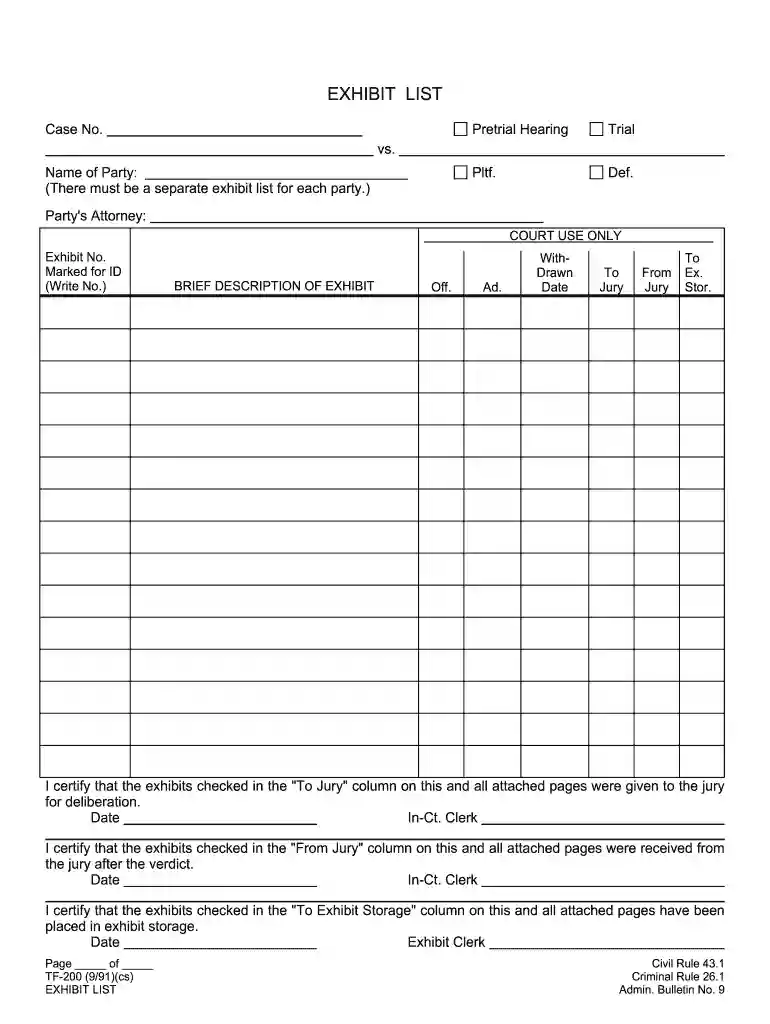
The "TF-200 Exhibit List Trial Prep" refers to a specialized legal document designed to organize and manage exhibits during a trial. This form plays a crucial role in legal proceedings by detailing information such as the identification of parties involved, attorneys associated with the case, and the status of each exhibit. The form typically includes sections for certification statements from court clerks regarding how exhibits are handled during and after the trial.

Purpose and Structure of the Form

  • Identification: Helps in precisely identifying exhibits, parties, and legal representatives.
  • Organization: Provides a systematic method to track the status of exhibits, such as marked for identification or withdrawn.
  • Certification: Ensures authentication by including certification statements from court clerks.

How to Use the TF-200 Exhibit List Trial Prep

Understanding how to effectively use the TF-200 Exhibit List Trial Prep is essential for legal professionals. It acts as a comprehensive tool to streamline the trial preparation process.

Step-by-Step Guidance

  1. Filling Party Details: Enter details about the plaintiff, defendant, and all attorneys involved in the case.
  2. Exhibit Information: List each exhibit with a unique identifier and a brief description.
  3. Status Updates: Regularly update the status of each exhibit to reflect current information.
  4. Certification: Obtain necessary signatures from court clerks to certify the handling of exhibits.

Practical Scenarios

  • Pre-Trial Prep: Used by attorneys to prepare exhibits in advance.
  • Court Use: Allows court clerks to track evidence status efficiently.

Steps to Complete the TF-200 Exhibit List Trial Prep

Completing the TF-200 Exhibit List Trial Prep with precision is vital for its effective use in court. Below is an outline to ensure a smooth and accurate completion process.

Detailed Procedure

  1. Gathering Information: Collect all relevant details about the case and exhibits.
  2. Documenting Exhibits: Clearly number and describe each exhibit's contents.
  3. Cross-Verification: Review entries to prevent errors or omissions.
  4. Court Certification: Ensure court clerks sign off on the form for validation.

Examples of Best Practices

  • Double-Checking Entries: Critical for accuracy, especially in complex cases.
  • Updating Regularly: Adjust the list as new exhibits are introduced or statuses change.

Why Should You Use TF-200 Exhibit List Trial Prep

Utilizing the TF-200 Exhibit List Trial Prep form is essential for maintaining order and clarity in legal environments. It assists legal teams by providing an organized approach to evidence management.

Benefits and Advantages

  • Organized Evidence Presentation: Assures all exhibits are accounted for and correctly categorized.
  • Efficient Court Proceedings: Streamlines communication between legal teams and court personnel.
  • Legal Compliance: Meets requirements for documenting exhibit handling and statuses.

Important Terms Related to TF-200 Exhibit List Trial Prep

Understanding the specific terminology related to the TF-200 Exhibit List Trial Prep is crucial for its correct application.

Key Terms and Their Meanings

  • Exhibit ID: A unique identifier for each piece of evidence.
  • Marked for Identification: Indicates an exhibit is recognized but not yet admitted as evidence.
  • Withdrawn Exhibit: Describes evidence that has been removed from consideration.

Application Examples

  • Legal Jargon: Familiarity with these terms aids in accurate completion of the form without ambiguity.
  • Courtroom Usage: Ensures all parties understand the procedural status of each exhibit.

Legal Use of the TF-200 Exhibit List Trial Prep

The TF-200 Exhibit List Trial Prep form must be used in accordance with legal standards and guidelines to ensure its validity in court.

Legal Considerations

  • Compliance: Adhere to legal standards for evidence submission.
  • Security: Maintain confidentiality and proper handling of sensitive exhibits.
  • Documentation: Proper documentation is necessary for any legal challenges to the exhibit list.

Real-World Implications

  • Court Orders: Must be followed as directed by the presiding judge.
  • Dispute Resolution: Provides a clear record in case of disputes or questions during legal proceedings.

Key Elements of the TF-200 Exhibit List Trial Prep

An understanding of the core elements of the TF-200 Exhibit List Trial Prep form is imperative for effective documentation and preparation for trials.

Constituent Elements

  • Exhibit Details: Detailed description and categorization of each exhibit.
  • Party Identification: Comprehensive list of all parties, including contact information.
  • Certification and Signatures: Required for legal validation within the court system.

Impacts on Legal Proceedings

  • Exhibit Clarity: Every element contributes to a clear presentation of evidence.
  • Court Efficiency: Facilitates smoother proceedings by having all necessary information readily accessible.

Examples of Using the TF-200 Exhibit List Trial Prep

Utilizing case examples can illustrate how the TF-200 Exhibit List Trial Prep supports trial preparation and exhibit management.

Case Study Examples

  • Civil Litigation: A law firm uses the form to prepare for a high-profile civil case, accurately organizing exhibits and ensuring their seamless integration into court proceedings.
  • Criminal Defense: During a criminal trial, defense attorneys rely on this form to manage evidence and track exhibit introduction, ensuring that every piece of evidence is accounted for.

Outcome Benefits

  • Improved Organization: Highlights the efficiency gains from structured evidence management.
  • Legal Relevance: Underlines the critical role of effective exhibit organization in achieving favorable legal outcomes.

See more TF-200 Exhibit List Trial Prep versions

We've got more versions of the TF-200 Exhibit List Trial Prep form. Select the right TF-200 Exhibit List Trial Prep version from the list and start editing it straight away!
Versions Form popularity Fillable & printable
2021 4.4 Satisfied (31 Votes)
2000 4.2 Satisfied (36 Votes)
1991 4.8 Satisfied (62 Votes)
be ready to get more

Complete this form in 5 minutes or less

Get form

Got questions?

We have answers to the most popular questions from our customers. If you can't find an answer to your question, please contact us.
Contact us

Sign in to your DocHub account and import your TF-200 Exhibit List Trial Prep to our editor using one of its upload methods - from your device, cloud storage, secure URL, or your DocHub folders if you have already managed your document before. Open our editor, click the Sign key in the top toolbar, and decide on your signing method. You can upload an image of your handwritten signature, draw it, type in your name, or utilize a QR code instead.

When you edit your TF-200 Exhibit List Trial Prep with DocHub, you will not need to look for other software or services to sign it. An electronic signature is a component of DocHub’s comprehensive editing toolset, which enables you to implement changes in your form without jumping between websites. Simply complete your form, double-check the correctness of your data and put your electronic signature at the end to make it submission-ready within minutes.

Typically, exhibits are sequentially numbered (Exhibit 1, Exhibit 2, etc.) or lettered (Exhibit A, Exhibit B, etc.). Exhibit list: Prepare an exhibit list that includes a description of each exhibit and its corresponding exhibit number or letter.
An exhibit, in a criminal prosecution or a civil trial, is a physical or documentary evidence brought before the jury. The artifact or document itself is presented for the jurys inspection. Examples may include a weapon allegedly used in the crime, an invoice or written contract, a photograph, or a video recording.
Labels - Information on the exhibit label should include: Exhibit number/letter. Witness last name. Court reporters license number and/or name. Date of proceeding. - Label placement: Place labels on the right side of the exhibit, when possible. Take care that nothing on the page is obstructed.

Security and compliance

At DocHub, your data security is our priority. We follow HIPAA, SOC2, GDPR, and other standards, so you can work on your documents with confidence.

Learn more
ccpa2
pci-dss
gdpr-compliance
hipaa
soc-compliance
be ready to get more

Complete this form in 5 minutes or less

Get form