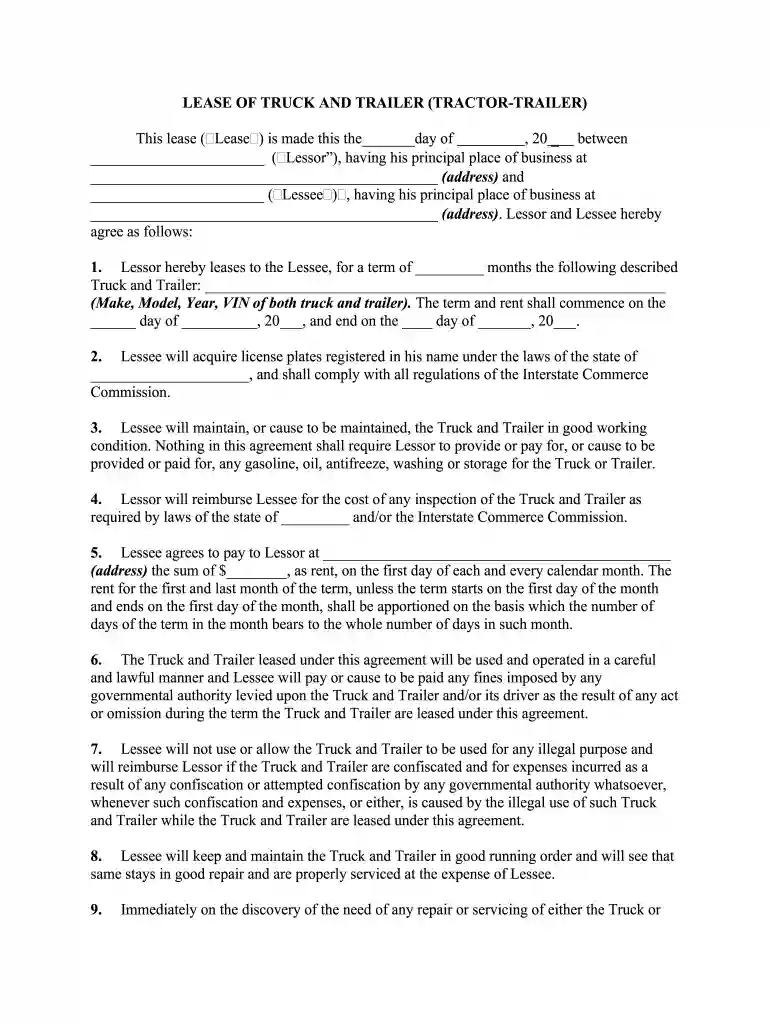
Lease trailer form agreement 2026

Get Form
lease trailer form agreement Preview on Page 1

Here's how it works

01. Edit your form online
Type text, add images, blackout confidential details, add comments, highlights and more.

02. Sign it in a few clicks
Draw your signature, type it, upload its image, or use your mobile device as a signature pad.

03. Share your form with others
Send it via email, link, or fax. You can also download it, export it or print it out.

Definition & Meaning

A lease trailer form agreement is a legally binding contract between a lessor and a lessee, detailing the terms under which the lessee leases a trailer from the lessor. This document specifies the duration of the lease, rental payment amounts, and payment schedules. It also outlines the responsibilities of both parties, including maintenance, insurance, and compliance with applicable laws. This agreement serves to protect both parties by clearly defining expectations and obligations, minimizing potential disputes.

Key Components

  • Lessor and Lessee Information: Full legal names, addresses, and contact details of both parties.
  • Lease Term: Duration of the agreement and conditions for renewal or termination.
  • Payment Terms: Rent amount, due dates, and payment method.
  • Maintenance Responsibilities: Obligations for upkeep and repairs of the trailer.
  • Insurance Requirements: Mandates for insurance coverage and liability.
  • Use of Trailer: Permitted uses and restrictions to ensure compliance with laws and regulations.

How to Use the Lease Trailer Form Agreement

Using a lease trailer form agreement involves several steps, from drafting the document to finalizing and executing it. This agreement should be thoroughly reviewed to ensure that all critical terms are adequately addressed and understood by both parties.

Steps Involved

  1. Initial Drafting: Create an initial version of the lease trailer agreement containing all necessary terms based on the parties' discussions.
  2. Review and Negotiation: Both parties review the document and negotiate terms, as needed, to reach a mutual agreement.
  3. Legal Review: Consider having the document reviewed by a legal professional to ensure it adheres to applicable laws and protects both parties' interests.
  4. Finalization: Once both parties agree on the terms, finalize the document with all necessary signatures.

Considerations

  • Ensure all sections are clearly written and unambiguous.
  • Verify that all legal and regulatory requirements are met.
  • Both parties should keep a signed copy for their records.

Key Elements of the Lease Trailer Form Agreement

The lease trailer form agreement contains several critical elements essential for its legality and enforceability.

Mandatory Clauses

  • Identification of Trailer: Precise description, including make, model, and VIN.
  • Security Deposit: Details regarding the amount, conditions for its retention, and return.
  • Liability and Indemnity: Clauses outlining responsibility for damage or loss.
  • Default Conditions: Explanation of what constitutes a default and the remedies available to the non-defaulting party.

Optional Clauses

  • Option to Purchase: Occasional inclusion of a clause that provides the lessee an option to buy the trailer at the end of the lease term.
  • Early Termination Fees: Terms dictating conditions under which the lease can be terminated early and associated fees.

Important Terms Related to Lease Trailer Form Agreement

The lease trailer form agreement includes several specific terms and definitions essential for its interpretation.

Common Terms

  • Lessor: The party who owns the trailer and is leasing it to another party.
  • Lessee: The party who is renting the trailer from the lessor.
  • Premises: Location where the trailer will be stored or used.
  • Sublease: Allowing the lessee to lease the trailer to another party, subject to lessor approval.

Legal Terminology

  • Force Majeure: A clause that frees both parties from liability or obligation in the case of extraordinary events or circumstances beyond their control.
  • Indemnification: An agreement to compensate for any loss or damage that has occurred or might occur.

Legal Use of the Lease Trailer Form Agreement

This agreement must comply with federal, state, and local laws, ensuring that both parties' rights are protected. Understanding legal stipulations related to leases is crucial for compliance.

State-Specific Variations

  • Regulations regarding deposits, fees, and consumer protection may differ substantially across states.
  • State laws may also dictate specific disclosures or language that must be included in the lease agreement to make it legally enforceable.

Compliance Requirements

  • Compliance with the Uniform Commercial Code (UCC) as it pertains to lease agreements.
  • Adherence to federal laws on lease contracts, ensuring rights and obligations match legal standards.

Examples of Using the Lease Trailer Form Agreement

Examples illustrate how the lease trailer form agreement functions in real-world situations, highlighting how specific terms and clauses are applied.

Case Examples

  • Fleet Leasing: A transportation company leases multiple trailers to expand its fleet temporarily, negotiating terms that include bulk leasing discounts and maintenance agreements.
  • Individual Lease: An independent truck driver leases a trailer for a specific period with a right-to-purchase option at the end of the lease, tailored to fit a long-haul business model.
  • Short-term Use: A film production company leases a trailer for on-location shoots, benefiting from specialized clauses on short-term rentals and insurance.

Required Documents

Submitting a lease trailer form agreement might necessitate accompanying documents to ensure completeness and compliance.

Important Documents

  • Proof of Insurance: Copies of the lessor's and lessee's insurance policies.
  • Vehicle Registration: Proof of trailer registration.
  • Driver's License: Valid driver's license of the lessee.

Verification of Documents

  • Verify that all documentation matches the information in the lease agreement.
  • Both parties should jointly verify the condition of the trailer at the start of the lease term.

Who Typically Uses the Lease Trailer Form Agreement

This agreement is versatile and utilized by various individuals and entities needing formal lease agreements for trailers.


decoration image ratings of Dochub

Common Users

  • Logistics Companies: Regularly lease trailers to accommodate fluctuating shipping needs.
  • Independent Contractors: Use agreements when taking temporary contracts requiring specific types of trailers.
  • Event Coordinators: Lease trailers to transport equipment for events and exhibitions.
decoration image

Benefits for Users

  • Provides legal protection by defining use limitations and responsibilities.
  • Facilitates clear communication and expectations between parties, reducing chances of disputes.
be ready to get more

Complete this form in 5 minutes or less

Get form

Got questions?

We have answers to the most popular questions from our customers. If you can't find an answer to your question, please contact us.
Contact us
. The Lessee to the intent that the obligations may continue throughout the term hereby created doth hereby covenant with the Lessor (s) as follows :- ( i) To pay by Bankers cheque or otherwise as agreed / the said monthly rent hereby reserved on the day and in the manner aforesaid subject to TDS.
Can I write my own lease agreement? Yes, you can write your own Residential Lease Agreement no need for a lawyer. However, whether youre a landlord or a tenant, you can always consult a lawyer to review your contract before signing. Free Residential Lease Rental Agreements (US) | LawDepot LawDepot real-estate residential-lease LawDepot real-estate residential-lease
An equipment lease agreement is a legal contract between a lessor (the equipment owner or provider) and a lessee (the person or business using the equipment) that outlines the terms and conditions for leasing and using the specified equipment.
A gross lease, also known as a full-service lease, is the most common type of commercial lease agreement. In this type of lease, the lessee is responsible for paying the base rent and the lessor generally handles any other building expenses, such as utilities, maintenance costs, taxes, and insurance.
A gross lease, or a full-service lease, is the most common type of lease. A gross lease has a predetermined rent that covers costs associated with owning the property, including things like tax, building insurance, and maintenance. The Different Types of Rental Lease Agreements University of California Riverside resources article University of California Riverside resources article

Security and compliance

At DocHub, your data security is our priority. We follow HIPAA, SOC2, GDPR, and other standards, so you can work on your documents with confidence.

Learn more
ccpa2
pci-dss
gdpr-compliance
hipaa
soc-compliance
be ready to get more

Complete this form in 5 minutes or less

Get form

People also ask

An agreement to lease is a document you sign when negotiating commercial lease terms. It sets out the broad terms of your lease, such as rent and the length of your lease. It may have conditions that need to be met before you can sign a final deed to lease.
This lease for purposes of payment of rent and period of lease shall be deemed to have commenced from. 2. This lease shall be in force for a period of years certain from . The Lessee shall, however, have the option to continue the lease thereafter for a further period upto years. DRAFT LEASE DEED - Jamabandi Jamabandi DeedTemplatesNew English Jamabandi DeedTemplatesNew English

Related links