





Definition and Meaning of IA Motion to Quash
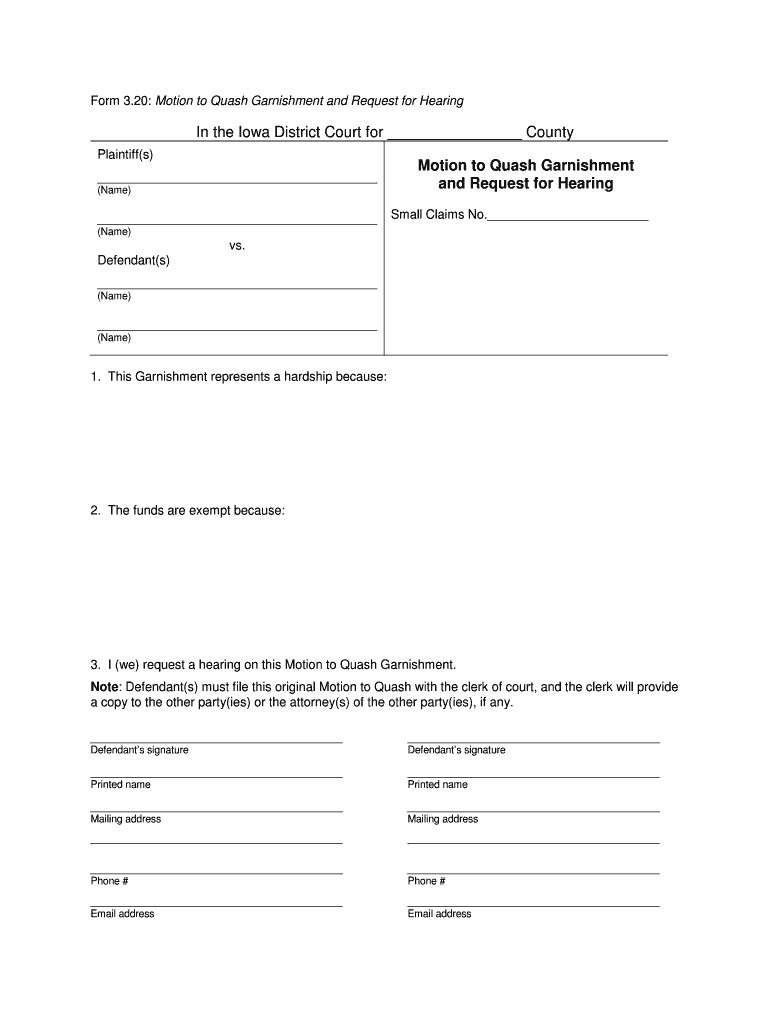
An IA Motion to Quash is a legal document filed in the Iowa District Court with the purpose of contesting a garnishment. Garnishment typically involves the legal process by which a creditor can collect what a debtor owes by setting up a deduction from the debtor’s wages or bank account. Defendants use this motion to highlight any hardships or valid exemptions that justify why the garnishment should not proceed. The document requests a court hearing to present these arguments in a formal setting, providing defendants an opportunity to prevent or halt the garnishment process.
How to Use the IA Motion to Quash
To use the IA Motion to Quash, the defendant must first understand the garnishment process and identify any applicable grounds for objection, such as financial hardships or legal exemptions. Once these are identified, the defendant can complete the motion form, outlining their reasons and supporting them with relevant evidence. This motion must then be filed with the court clerk in the appropriate Iowa district. Following the submission, the court will schedule a hearing, during which the defendant can present their case against the garnishment. It’s crucial to prepare thoroughly for this hearing, gathering all necessary documentation and possibly seeking legal counsel to ensure a well-articulated argument.
Steps to Complete the IA Motion to Quash
- Review the Garnishment Notice: Begin by closely examining the garnishment order, noting crucial details such as case numbers, creditor information, and the amount being garnished.
- Identify Grounds for Quash: Determine what specific exemptions or hardships apply, like claiming the funds are necessary for basic living expenses.
- Complete the Motion Form: Clearly fill out the form, ensuring all sections are addressed, and succinctly state the basis for your motion.
- Gather Supporting Documents: Collect evidence that substantiates your claims, such as financial statements or documentation of exemptions.
- File with Court Clerk: Submit the completed motion along with supporting documents to the court clerk.
- Prepare for Hearing: Use the time between filing and the hearing to prepare your case, considering both your argument and possible counterarguments.
Important Terms Related to IA Motion to Quash
- Garnishment: A legal process where creditors can extract owed money from a debtor's wages or bank account.
- Exemption: A provision allowing a debtor to exclude certain funds or assets from garnishment.
- Hardship: A situation in which the garnishment would cause severe financial difficulty, potentially justifying the motion to quash.
- Court Hearing: The formal session where the court reviews and decides on the motion to quash based on arguments presented.
Key Elements of the IA Motion to Quash
- Case Details: Accurate representation of the involved parties, case number, and garnishment amount.
- Grounds for Quashing: A well-articulated explanation of why the garnishment should not proceed, supported by evidence.
- Requested Action: The specific relief sought, typically the cessation or modification of the garnishment order.
- Declaration: A section affirming that all provided information is truthful and accurate.
State-Specific Rules for the IA Motion to Quash
Iowa may have unique regulations governing the process of filing and contesting garnishments, so understanding these nuances is essential. For instance, there might be specific timelines for filing the motion or particular documentation required to support exemption claims. Ensuring compliance with these state-specific rules is crucial for the success of the motion. Consulting with a legal expert familiar with Iowa’s garnishment laws can offer guidance tailored to the state's procedural and legal standards.
Legal Use of the IA Motion to Quash
The IA Motion to Quash serves as a legal mechanism for protecting an individual’s financial well-being from undue garnishments. Its legal use is essential for fair access to judicial remedial actions, especially for individuals facing unjust or burdensome garnishments. The process ensures that all parties adhere to the legal framework governing debt collection, providing defendants with a voice in contesting garnishments that may violate statutory exemptions or cause undue hardship.
Examples of Using the IA Motion to Quash
Consider a scenario where a debtor's entire bank account is targeted for garnishment. By filing a Motion to Quash, the debtor argues that the funds are social security payments, which are legally exempt from garnishment. Another example involves a debtor experiencing severe financial distress due to wage garnishment, preventing them from covering basic living expenses. Through the motion, the debtor can present comprehensive evidence of their financial situation, seeking court intervention to either stop or reduce the garnishment amount.
Understanding and utilizing the IA Motion to Quash requires careful attention to its components and the procedural intricacies of the Iowa District Court. Properly navigating this process empowers debtors to address unjust financial actions effectively.