




01. Edit your 9a defence online
Type text, add images, blackout confidential details, add comments, highlights and more.

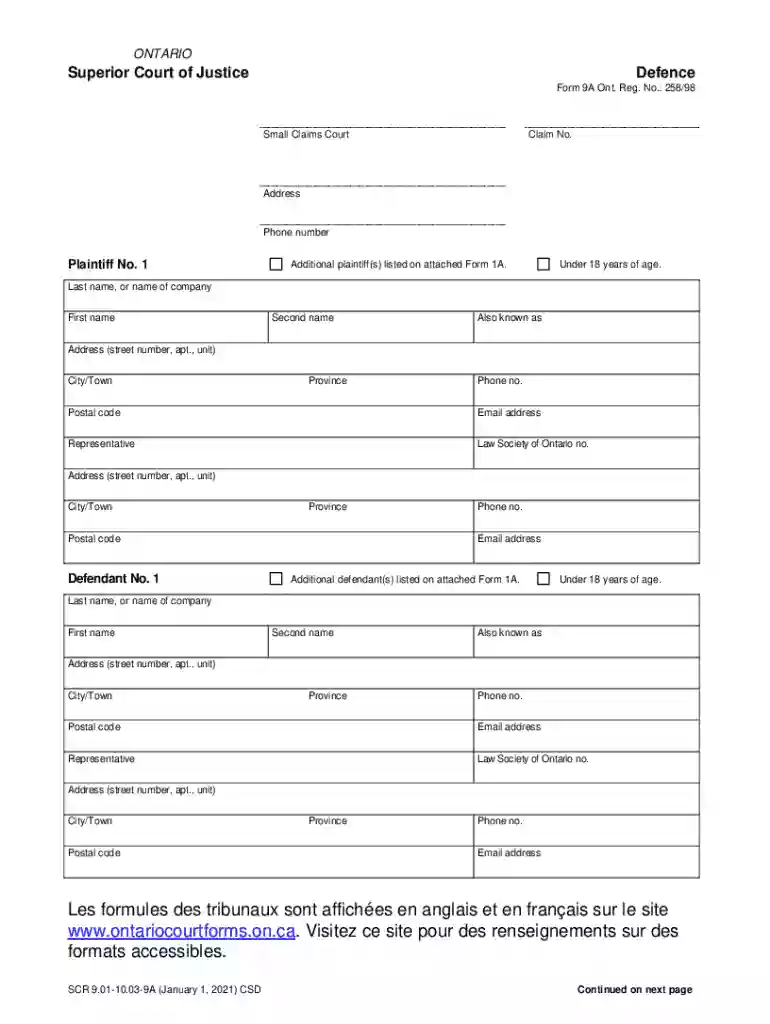
Type text, add images, blackout confidential details, add comments, highlights and more.

Draw your signature, type it, upload its image, or use your mobile device as a signature pad.

Send 9a ontariocourtforms form via email, link, or fax. You can also download it, export it or print it out.
The SCR 9 01-10 03-9A form is a specific document used within a particular legal or administrative context. Its unique identifier reflects a specialized application, indicating its role in a process relevant to individuals, businesses, or legal entities. Though commonly used within its designated field, understanding its definition and implications is crucial for correct application and compliance. This form may serve as a mixed-purpose tool, often associated with documentation requirements that accompany legal proceedings, administrative filings, or detailed reporting requirements.
Gather Necessary Information: Before beginning, collect all pertinent details required by the SCR 9 01-10 03-9A form. This might include personal identification numbers, financial data, business identifiers, or other supporting documents.
Download the Form: Access the required form from verified sources, typically from official government or organizational websites that endorse this document. Ensure you have the correct and current version.
Review the Instructions: Each form comes with a set of guidelines. Read these thoroughly to avoid errors during the completion process.
Fill Out the Form: Use black or blue ink if submitting a physical copy and ensure all fields are legible. For digital submissions, utilize PDF-editing software that allows for accurate completion.
Double-Check Entries: Prior to submission, review all information for accuracy. Double-check figures and personal details to ensure they match supporting documentation.
Submit the Form: Depending on instructions, submit either online, via mail, or in person. Confirm the correct submission method for your jurisdiction.
Keep a Copy: Always retain a copy of the completed form for your records. It may be necessary for future reference or in case additional clarification is needed.
The primary application of the SCR 9 01-10 03-9A form depends on the context in which it is used. Generally, it serves as a structured tool in legal or administrative processes:
Legal Proceedings: It can act as a formal response or claim form in court-related matters, often required to comply with specific procedural requirements.
Administrative Filings: The form may serve to document a series of transactional events, needing precise information to be logged according to defined guidelines.
Information Reporting: Used by organizations or individuals to report significant activities, especially where statutory records need to be maintained or updated.
Identification Section: Typically requires the submitter's name, contact information, and possibly a unique identifier such as a Social Security Number or business tax ID.
Purpose Statement: Clearly indicates the form's intent and should define what is being reported, contested, or declared.
Declarative Statements: These segments require truths to be affirmed, often under penalty of perjury in legal contexts, ensuring the commitment to the accuracy of the provided information.
Supporting Documentation: Various fields might mandate the inclusion of additional evidence or documentation, aligning with the claims or assertions made within the form.
The SCR 9 01-10 03-9A is grounded within a legal framework that governs its correct usage:
Official Submissions: It must be submitted following legal specifications, adhering to submission deadlines and procedural steps pertinent to its jurisdiction.
Court Use: Frequently employed in court cases where specific filings are mandatory, serving as essential paperwork for legal defenses or claims.
Compliance Verification: Regular audits or reviews may be conducted by overseeing authorities to ensure compliance with the stipulated use of the form.
Defending a Claim: Individuals might use it to formally respond to legal claims made against them, outlining their defense strategy in the document.
Filing Administrative Applications: Businesses may use the form to submit detailed applications for licenses, permits, or regulatory compliance documentation.
Financial Reporting: The form might be required as part of a statutory financial disclosure, detailing specific fiscal activities or tax-related information.
Declarant: The individual or organization completing and submitting the form, responsible for the truthfulness of the information.
Jurisdiction: Specifies the legal territory where the form's content is applicable or enforceable.
Compliance: Refers to the adherence to legal or procedural requirements as outlined by the governing authority or institution.
Procedural Guidelines: Rules defining how the form must be completed and submitted to meet legal standards.
Variations in Requirements: Each state may have its nuanced version of the SCR 9 01-10 03-9A, requiring residents to comply with specific adjustments or supplementary information.
Submission Protocols: Some states might mandate electronic submission through a state-operated portal, whereas others accept or require physical forms sent via mail.
Statutory Interpretation: State laws may interpret the requirements or accepted usage of the form differently; knowing these intricacies is essential for compliance.
Legal Repercussions: Failing to submit the form correctly or on time may result in fines, penalties, or legal action.
Suspension of Privileges: Certain rights or privileges, such as a business license, could be revoked if compliance with the form's requirements is not maintained.
Increased Scrutiny: Non-compliance might lead to closer examination or audits by legal entities or regulatory agencies, potentially complicating future filings.
By methodically addressing each of these blocks, users can better understand and navigate the SCR 9 01-10 03-9A, ensuring they use it effectively and remain compliant with all relevant legal and procedural guidelines.
We've got more versions of the 9a defence form. Select the right 9a defence version from the list and start editing it straight away!
Yes, a typed name is recognized as a valid electronic signature when you add it to your paperwork using a compliant solution like DocHub. Simply import your defence form 9a to our editor, click Sign in the top tool pane → Create your signature → Type your name in the proper tab, and choose how it will look on your document.
If you are using Chrome, there are two easy methods to edit your file 9a online. First, go to the DocHub website, add your file, and edit it utilizing our toolbar. You may also set up our Chrome extension and edit any document by dragging and dropping it in your browser tab.
At DocHub, your data security is our priority. We follow HIPAA, SOC2, GDPR, and other standards, so you can work on your documents with confidence.
MADISON, N.J. The University of Scranton womens lacrosse team soundly defeated the Drew University Rangers, 16-5, on Wednesday evening in Madison, N.J..
Dec 3, 2004 This Act may be cited as the Miscellaneous Trade and Tech- nical Corrections Act of 2004. Sec. 1. Short title; table of contents.Read more


