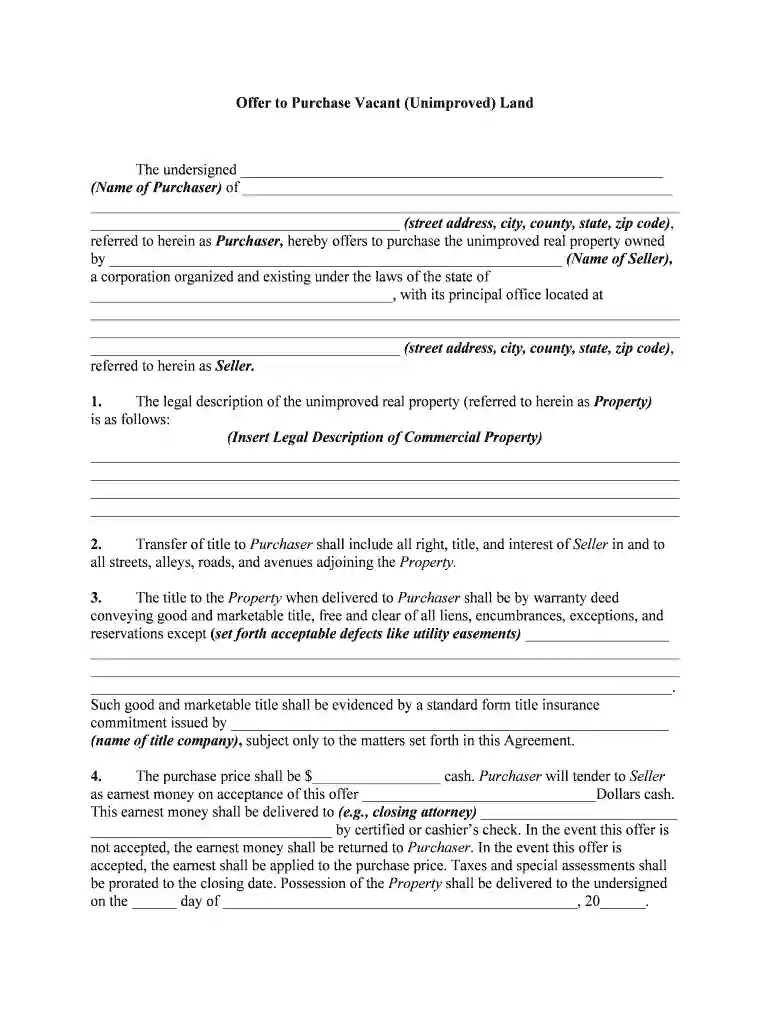
Offer vacant 2026

Get Form
offer vacant Preview on Page 1

Here's how it works

01. Edit your form online
Type text, add images, blackout confidential details, add comments, highlights and more.

02. Sign it in a few clicks
Draw your signature, type it, upload its image, or use your mobile device as a signature pad.

03. Share your form with others
Send it via email, link, or fax. You can also download it, export it or print it out.

Definition and Meaning of Offer to Purchase Vacant Land

The "Offer to Purchase Vacant Land" form is a legally binding document that outlines the specific terms under which a buyer intends to purchase unimproved real estate from a seller. This form is essential in real estate transactions, especially for properties that lack existing structures or improvements. It includes detailed provisions such as the legal description of the land, purchase price, earnest money deposit, and conditions relating to the transfer of title. By providing a clear and comprehensive agreement between parties, this form helps prevent misunderstandings during the purchasing process.

How to Use the Offer to Purchase Vacant Land

  1. Initial Review: Before completing the form, both parties should thoroughly review its content to ensure they understand all terms and conditions.

  2. Filling the Details: The buyer should fill out their personal information, as well as details about the land, including its legal description and the offered purchase price.

  3. Earnest Money Deposit: Specify the amount of earnest money to be deposited as part of the agreement. This serves as a good faith gesture by the buyer.

  4. Signing the Agreement: Once all information is completed, both parties must sign the document. Electronic signatures may be used if permitted.

  5. Submission and Acceptance: Submit the offer to the seller for review. The offer includes a deadline by which the seller must respond.

Steps to Complete the Offer to Purchase Vacant Land

  1. Gather Necessary Information:

    • Legal description of the property
    • Buyer and seller details
    • Offered purchase price
  2. Complete the Form:

    • Fill in all required fields with accurate information.
    • Ensure the legal description matches official records to avoid discrepancies.
  3. Review Terms:

    • Confirm both parties agree on conditional terms like timelines for acceptance and possession.
    • Check requirements for any additional documents or contingencies.
  4. Add Earnest Money Details:

    • Specify the earnest money amount and its handling conditions.
  5. Sign the Document:

    • Ensure that all parties sign the document to formalize the offer.

Key Elements of the Offer to Purchase Vacant Land

  • Legal Description: Accurate identification of the property’s location and boundaries.
  • Purchase Price: Agreed-upon amount the buyer offers for the land.
  • Earnest Money: Deposit amount and conditions on which it's held.
  • Title Conditions: Requirements for a clear title transfer.
  • Acceptance Timelines: Period within which the seller must respond to the offer.
  • Signatures: Necessary endorsements to validate the document legally.

Legal Use of the Offer to Purchase Vacant Land

This form establishes a legal framework for transferring property ownership between a buyer and a seller. It serves to confirm the intentions of both parties and ensures that the seller will not sell the land to another buyer while negotiations are ongoing. By detailing obligations and procedures, the form helps protect the interests of both parties involved.


Important Terms Related to the Offer to Purchase Vacant Land

  • Earnest Money: A deposit made by the buyer showing their commitment to the transaction.
  • Legal Description: A detailed description of a property's location and dimensions.
  • Title: The legal right to own and use property.
  • Contingencies: Conditions that must be met for the sale to proceed.
  • Possession: The date when the buyer is legally allowed to take over the property.

Who Typically Uses the Offer to Purchase Vacant Land

  • Real Estate Investors: Individuals looking to purchase land for development or resale.
  • Homebuilders: Entities acquiring land to build residential homes.
  • Agricultural Buyers: Farmers or corporations intending to use the land for agricultural purposes.
  • Speculators: Buyers looking to hold land as a long-term investment.
decoration image ratings of Dochub

State-Specific Rules for the Offer to Purchase Vacant Land

While the form provides a general framework, specific rules can vary by state. Each state may have unique requirements for real estate transactions, including disclosures, contract language, and contingencies. It's crucial to consult with a local real estate attorney to ensure compliance with state-specific regulations and to incorporate any additional clauses that may be necessary for the legal validity of the offer.

Examples of Using the Offer to Purchase Vacant Land

  • Individual Buyer Scenario: A family interested in building their dream home buys a parcel of land in a suburb. They use the form to specify their offer and any building contingencies.

  • Real Estate Development: A developer seeking to create a new residential community uses the form to make offers on multiple parcels, providing clear terms for each transaction.

  • Agricultural Purchase: A farming corporation uses the form to acquire additional land, specifying use terms aligned with existing operations.

Required Documents for the Offer to Purchase Vacant Land

  • Identification for both parties
  • Legal description of the property
  • Records of earnest money transactions
  • Any contingency addenda or attachments
  • Proof of financial capability (if required)

Maintaining comprehensive documentation helps streamline the closing process and provides a clear record for reference in case of disputes. Always ensure that all required documents are attached and accurately reflect the agreed terms to avoid future issues.

be ready to get more

Complete this form in 5 minutes or less

Get form

Got questions?

We have answers to the most popular questions from our customers. If you can't find an answer to your question, please contact us.
Contact us
Even if the property is furnished and has items within it, if no one is actually living there, it is classed as unoccupied or empty. Insurers will usually state how long a building can remain fully insured while it is unoccupied before the level of is docHubly reduced or stopped.
For example, a renovation project may require the temporary relocation of residents, leaving the building unoccupied until the project is complete. On the other hand, a vacant building is devoid of any occupancy and in a more permanent state of non-use, distinct from the temporary nature of unoccupied status.
Vacant is a term used to describe both (1) empty, unclaimed, and/or unoccupied real property and (2) an abandoned estate, which refers to an estate that has no heirs or claimants. It is often used in property law.
In general, case law defines the term vacant as completely empty meaning a lack of both people and personal property.
Introduce Yourself: Briefly introduce yourself and explain why you are interested in the property. Make Your Offer: Clearly state your offer price and any terms. Mention that you are open to discussion. Provide Contact Information: Include your phone number and email address for them to docHub you easily.

Security and compliance

At DocHub, your data security is our priority. We follow HIPAA, SOC2, GDPR, and other standards, so you can work on your documents with confidence.

Learn more
ccpa2
pci-dss
gdpr-compliance
hipaa
soc-compliance
be ready to get more

Complete this form in 5 minutes or less

Get form

People also ask

Generally, your home is considered vacant if its left empty for 30 to 60 days or more. Most typical homeowner policies wont provide full coverage for the property once its been vacated. Vacant home insurance can be purchased to help.
Statistic: According to research, vacant home insurance can cost about 50% to 60% more than a standard policy for an occupied home. This higher cost reflects the increased risk and potential for more expensive claims.
Generally, your home is considered vacant if its left empty for 30 to 60 days or more. Most typical homeowner policies wont provide full coverage for the property once its been vacated.

Related links