







Definition & Purpose
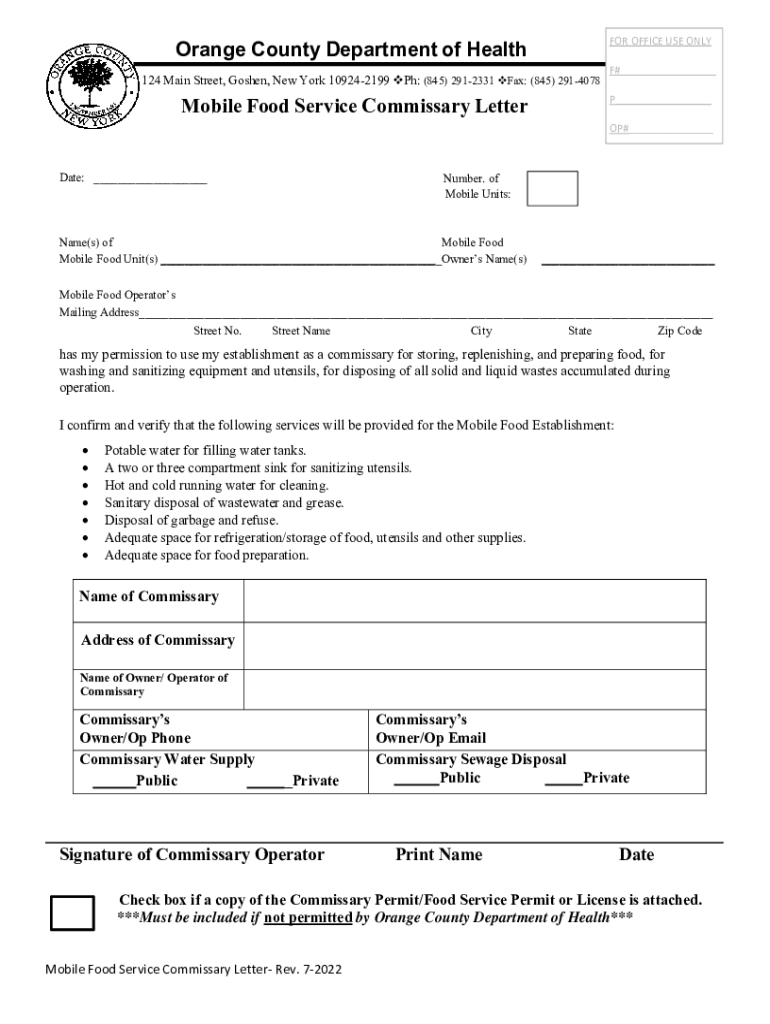
The Orange County Department of Health, located in Goshen, NY, plays a pivotal role in ensuring public health standards are maintained for both individuals and businesses operating within its jurisdiction. This department oversees various health regulations and compliance measures, particularly concerning food safety, sanitation, and community health initiatives. The Mobile Food Service Commissary Letter is a document that grants permission for mobile food units to use specified commissaries for essential activities like food storage, preparation, and proper waste disposal.
Steps to Complete the Mobile Food Service Commissary Letter
-
Identify the Necessary Commissary: Before applying for this letter, mobile food operators need to pinpoint an appropriate commissary that complies with health regulations.
-
Obtain Commissary Owner Consent: Secure written consent from the commissary owner, confirming their agreement to provide facilities for food storage and preparation.
-
Compile Required Information: Collect all relevant details about the mobile food unit, including operator information and specifics of the commissary facilities.
-
Submit Documents: Provide the completed form, along with requisite signatures, to the Orange County Department of Health for review.
-
Await Approval: Once submitted, the application will be reviewed for compliance, and permit issuance depends on meeting all health department criteria.
Key Elements of the Commissary Letter
-
Operator and Commissary Owner Signatures: These are crucial for validating the agreement between the mobile unit and the commissary.
-
Facility Details: Description of services provided by the commissary, including potable water, sanitation, and waste disposal.
-
Compliance Statement: Assurance that the mobile unit will adhere to all public health regulations.
Important Terms Related to Commissary Letter
-
Mobile Food Unit: A vehicle or trailer equipped to sell food on a mobile basis.
-
Commissary: A licensed food establishment that provides the necessary facilities for the mobile unit's operations.
-
Sanitation Facilities: Services ensuring cleanliness and hygiene standards, critical for food safety compliance.
How to Obtain the Commissary Letter
Mobile food operators must contact the Orange County Department of Health in Goshen, NY, to request the Mobile Food Service Commissary Letter. This process typically involves providing detailed information about their mobile unit and intended commissary usage. By ensuring that both facilities and operations meet health department standards, companies can secure the necessary permissions to operate legally and safely.
Legal Use of the Commissary Letter
Possessing a valid Commissary Letter confirms that a mobile food unit meets local health codes for food preparation and storage. This document is critical during inspections and ensures that operators comply with statutory health requirements. It also protects both the operator and consumers by establishing a framework for hygienic food handling.
Penalties for Non-Compliance
Failure to secure or maintain a valid Mobile Food Service Commissary Letter can lead to several penalties:
-
Fines and Citations: Imposed for operating without required documentation.
-
Operational Suspension: Temporary closure until compliance is achieved.
-
Legal Action: In cases of severe violation or repeat offenses.
Adherence to the health department's regulations is critical to prevent these repercussions and ensure seamless business operations.
Real-World Use Cases
Several scenarios highlight the significance of the commissary letter. For instance, a mobile food unit intending to expand its operations across different locations would require this letter to prove compliance to local health departments. Similarly, a new food truck operator entering Orange County would need to ensure that all documentation, including the commissary letter, is in place to commence operations without legal hindrance.
State-Specific Rules in New York
Operators must be aware that New York State has specific health and safety regulations that differ from other regions. This includes the type of facilities that qualify as commissaries and the specific health codes governing mobile food units. Local guidance from the Orange County Department of Health is indispensable in navigating these state-specific requirements and ensuring compliance.
These comprehensive guidelines illustrate the vital role the Orange County Department of Health plays in maintaining food safety and public health standards. Compliance with these regulations helps safeguard consumer health and supports the smooth operation of mobile food units throughout the county.




