Tc 569a 2026

Get Form
utah abandoned vehicle form Preview on Page 1

Here's how it works

01. Edit your utah abandoned vehicle form online
Type text, add images, blackout confidential details, add comments, highlights and more.

02. Sign it in a few clicks
Draw your signature, type it, upload its image, or use your mobile device as a signature pad.

03. Share your form with others
Send abandoned vehicle title utah via email, link, or fax. You can also download it, export it or print it out.

Definition & Meaning of TC 569A

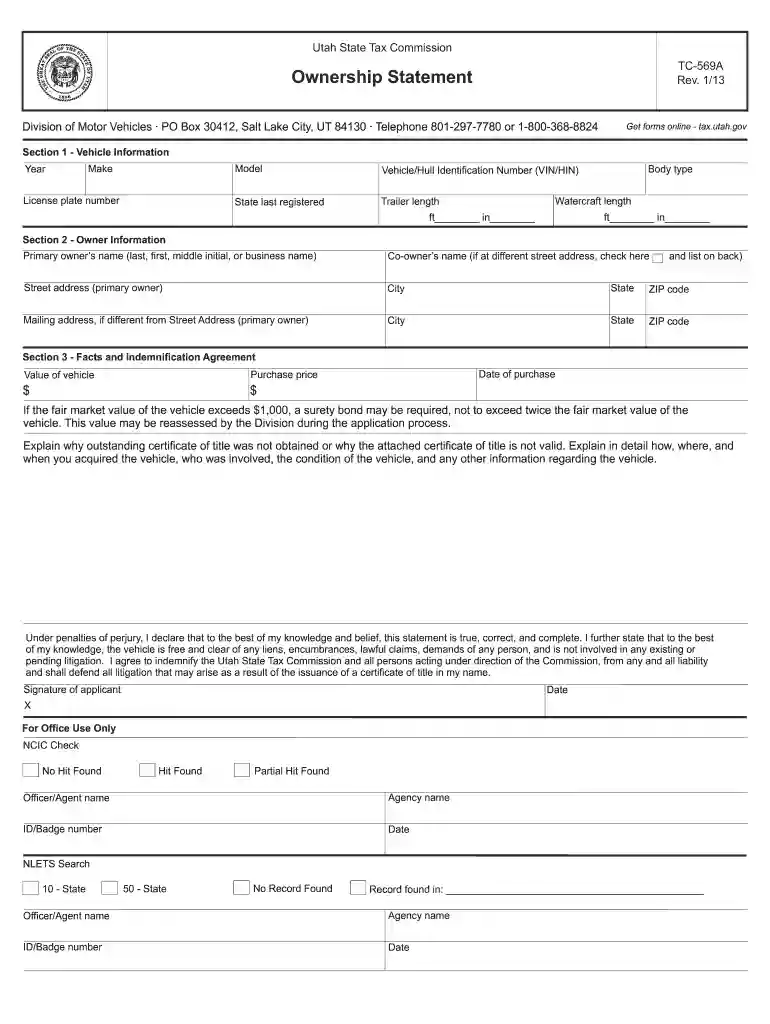
The TC 569A form, also known as the Vehicle Ownership Declaration form, is a document used by the Utah State Tax Commission. It serves primarily to declare ownership of a vehicle when the title is not available. This form is essential in situations where a vehicle may be abandoned or where the owner cannot produce a valid title. The TC 569A helps facilitate the proper transfer of vehicle ownership in compliance with Utah law, ensuring that all necessary legal and ownership details are appropriately documented.

The form includes critical sections that require information about the vehicle, such as make, model, year, Vehicle Identification Number (VIN), and other identifying details. Additionally, it necessitates the inclusion of the owner's information, such as name, address, and the relationship to the vehicle. The form also contains an indemnification agreement in which the signer attests to the truthfulness of the information provided under penalty of perjury. By completing the TC 569A, vehicle owners can initiate the process for obtaining a title or solidifying their ownership claim legally.

How to Use the TC 569A

Using the TC 569A involves several key steps to ensure proper completion and submission. The process typically includes the following:

  1. Obtain the Form: The TC 569A can be downloaded from the Utah State Tax Commission’s website or obtained at local DMV offices.
  2. Complete Vehicle Information: Fill in essential details about the vehicle. This includes the VIN, make, model, year, and any odometer reading if applicable.
  3. Owner Information: Provide the necessary owner information, including full name, address, and contact details.
  4. Indemnification Agreement: Review and complete the indemnification section, assuring that the information is accurate and truthful. This agreement is a legal affirmation that you are responsible for the information provided.
  5. Sign and Date the Form: The form must be signed and dated to be considered valid.
  6. Submission: Submit the completed TC 569A to the appropriate DMV location or the Utah State Tax Commission via mail or in person.

By following these steps, individuals can facilitate the process of declaring vehicle ownership, especially in cases where the title is absent.

Steps to Complete the TC 569A

Completing the TC 569A accurately is essential for successfully declaring ownership of a vehicle. Here are detailed steps to guide you through the process:

  1. Gather Required Information:

    • Collect all necessary details about the vehicle, including the VIN, purchase date, and purchase price.
    • Ensure you have your identification and any supporting documents related to the vehicle ownership.
  2. Fill Out the Form:

    • Begin by entering the vehicle’s details in the corresponding fields.
    • Include all applicable owner information, paying special attention to spelling and accuracy.
  3. Detail Claims for Indemnification:

    • Read through the indemnification agreement carefully. This section asserts that you understand the law and are claiming rightful ownership.
    • Fill in any required acknowledgment or signature lines.
  4. Review Your Entries:

    • Double-check all sections for accuracy and completeness. Ensure that no field is left blank unless specified.
    • Confirm that your signature is included and that you’ve dated the form correctly.
  5. Submit the Completed Form:

    • Determine the submission method: you can send it by mail or deliver it in person.
    • Keep copies of your form for personal records and any correspondence related to its submission.
  6. Follow Up:

    • If submitted by mail, consider following up with the tax commission or DMV after a few weeks to confirm the processing status.

Completing these steps will help ensure that your TC 569A form is processed smoothly.

Important Terms Related to the TC 569A

Understanding the key terms associated with the TC 569A form is crucial for grasping the responsibilities and requirements involved in the vehicle ownership declaration process. Here are some important terms:

  • Indemnification: A legal agreement where one party agrees to protect another from legal liability for actions or claims. In the context of TC 569A, it indicates the signer is taking legal responsibility for the truthfulness of the information provided.
  • Vehicle Identification Number (VIN): A unique code used to identify individual motor vehicles. It is essential for establishing the vehicle’s identity and history.
  • Abandoned Vehicle: A vehicle left unattended on public or private property without consent, often leading to legal ownership claims.
  • Ownership Declaration: A formal statement asserting one’s ownership rights to a vehicle, necessary when traditional ownership documents (like a title) are unavailable.
  • Authority to Sign: The legal right of an individual to assert ownership or make declarations on behalf of another party, relevant in scenarios involving joint ownership or business-related vehicles.

Familiarizing yourself with these terms will enhance your understanding of the entire process surrounding the TC 569A form.

Legal Use of the TC 569A

The TC 569A's legal use hinges significantly on compliance with Utah laws governing vehicle ownership and transfers. This form is specifically crafted to assist individuals in reclaiming ownership of vehicles for which they possess insufficient documentation. The following points illustrate its legal significance:

  • Establishing Vehicle Ownership: The TC 569A acts as an official means to declare vehicle ownership when legal titles are lost or unavailable. It essentially serves as a substitute for the title in light of appropriate evidence.
  • Compliance with State Law: By using the TC 569A, vehicle owners align themselves with the Utah Abandoned Vehicle Law, demonstrating a commitment to following legal protocol in claim ownership of vehicles.
  • Indemnity Clause Enforcement: The indemnification agreement included in the form functions as a safeguard for both the declarant and the state against potential fraudulent claims of vehicle ownership.
  • Reference for Future Transactions: Should any disputes arise regarding ownership, a properly filled TC 569A serves as a legal document referencing the claimant's position at the time.

By understanding these legal implications, users can effectively navigate the vehicle ownership declaration process with confidence and adherence to local laws.

Examples of Using the TC 569A

Utilizing the TC 569A in real-world scenarios provides clarity on its practical application. Here are several examples illustrating its use:

  • Claiming an Abandoned Vehicle: An individual discovers a vehicle on their property that has been left unattended. They can complete the TC 569A to declare ownership, supporting their claim of right to the vehicle by providing evidence of its location and condition.
  • Lost Title Scenario: A vehicle owner misplaces their title and intends to sell the vehicle. By completing the TC 569A, they can legally assert ownership and proceed with the sale, creating a smooth transaction process.
  • Inheritance Situation: If a vehicle is inherited but the title is not readily available, the heir can file the TC 569A as part of the estate settlement process to formalize the ownership transfer.
  • Title Transfer for Business Vehicles: A business may need to declare ownership of a vehicle after acquiring it without a title transfer document. The TC 569A can serve as a means for the business to legally affirm its ownership of the vehicle for tax and registration purposes.

These examples demonstrate the TC 569A's versatility and necessity in various ownership-related scenarios, highlighting its role in facilitating legal vehicle ownership in Utah.

See more tc 569a versions

We've got more versions of the tc 569a form. Select the right tc 569a version from the list and start editing it straight away!
Versions Form popularity Fillable & printable
2022 4.8 Satisfied (59 Votes)
2020 4.9 Satisfied (22 Votes)
2013 4.4 Satisfied (258 Votes)
2011 4.3 Satisfied (44 Votes)
be ready to get more

Complete this form in 5 minutes or less

Get form

Got questions?

We have answers to the most popular questions from our customers. If you can't find an answer to your question, please contact us.
Contact us

Of course, electronically drawing your signature is acceptable, but only if you utilize a tool that complies with industry regulations and policies. Consider DocHub, which ensures eSignature validity under ESIGN and UETA requirements. All you need to eSign your utah abandoned vehicle laws is an account with DocHub and an internet connection. Once you open your document in our editor, click Sign and select the Draw tool.

If you store your paperwork in Google Drive, there is no need to download your how to get a title for an abandoned vehicle in utah on the computer and upload it back to our editor. A much easier way is to install a browser extension created by DocHub to simplify this flow. The extension allows editing PDFs in your web browser. Alternatively, you may integrate your DocHub and Gmail accounts for more efficient editing.

Obtaining Ownership of Abandoned Vehicles and Private Impounds. Towing companies may request a Utah title or dismantling permit for abandoned or privately impounded vehicles when the legal owner has not claimed the vehicle within a reasonable period of time.
You will need to complete Form TC-656, Application for Utah Title with all the appropriate changes reflected. At least one owner whose name was already on the title before changes were made must sign this application. A $6.00 title fee and a $4.00 duplicate registration fee may apply.
If the previous title was from out-of-state, however, the seller is responsible for obtaining a duplicate title from that state. In cases like these, you may take a bill of sale to the DMV, pay your title and registration fees, and obtain a temporary permit so that you may use the vehicle while you wait for the title.

People also ask

No. You do not have to pay sales tax on a gifted car in Utah. Is it better to gift a car or sell it for $1 in Utah? It's a better option to gift a car in Utah rather than selling it for $1.
Registration Only Most recent registration \u2013 You will need to provide a copy of your most recent vehicle registration. Leasing company or lien holder information \u2013 Be prepared to provide the name and address of the leasing company or lien holder that is holding your certificate of title.
To claim the vehicle and title it as your own, you'll need to contact the local law enforcement agency that has jurisdiction in that area, and tell them where the vehicle is located. You also have to fill out an Abandoned Vehicle Form.
Registration Only Most recent registration \u2013 You will need to provide a copy of your most recent vehicle registration. Leasing company or lien holder information \u2013 Be prepared to provide the name and address of the leasing company or lien holder that is holding your certificate of title.
First-time Registration Required documentation may include a vehicle title, bill of sale, previous registration, emission certificate or safety certificate where required. All vehicles in Utah are subject to either an age-based uniform fee or a 1.5 percent uniform property assessment fee.

abandoned vehicle form