




01. Edit your financial advisor client information sheet online
Type text, add images, blackout confidential details, add comments, highlights and more.

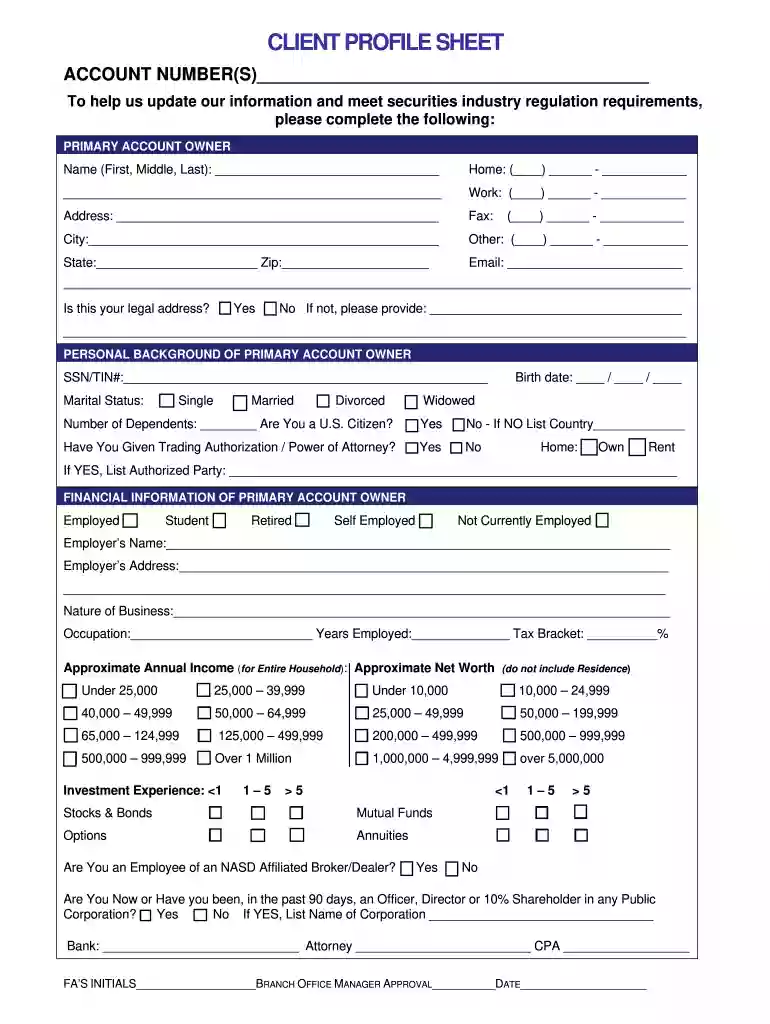
Type text, add images, blackout confidential details, add comments, highlights and more.

Draw your signature, type it, upload its image, or use your mobile device as a signature pad.

Send financial advisor client profile template via email, link, or fax. You can also download it, export it or print it out.
A financial client profile is a comprehensive document that collects vital information regarding an individual's or a couple's financial situation and investment goals. This profile serves as a baseline for financial advisors to understand their clients' unique circumstances and risk tolerance. Primarily, it encompasses personal details, financial assets, liabilities, income sources, and investment objectives.
Key components often included in a financial client profile are:
Having a well-structured financial client profile is paramount for compliance with securities regulations, helping advisors tailor their recommendations to better fit the clients' needs.
A financial client profile should include several critical elements to ensure comprehensive coverage of the client's financial landscape. These key components help lay the groundwork for all financial planning efforts.
Contact Information:
Financial Overview:
Risk Tolerance Assessment:
Investment Objectives:
These elements create a robust financial client profile that acts as a foundation for ongoing financial planning and investment management.
Filling out a financial client profile requires careful attention to detail and systematic steps for accuracy. Here’s a step-by-step guide to facilitate the process:
Gather Basic Information:
Assess Financial Status:
Inventory Financial Assets and Liabilities:
Evaluate Investment Goals:
Review and Finalize:
Following these steps ensures a thorough financial client profile creation, paving the way for informed decision-making by financial advisors.
Practical applications of a financial client profile are essential for maximizing its benefits. By utilizing this document, financial advisors can tailor their services to meet clients' unique needs. Here are a few scenarios that illustrate its usage:
Personal Financial Planning: A young couple preparing for their first home purchase can use the profile to assess their savings, identify monthly expenses, and evaluate what they can afford without undue financial stress.
Retirement Planning: An individual nearing retirement can utilize their financial client profile to review savings and investments, ensuring they have a diversified portfolio that aligns with their risk tolerance and retirement goals.
Tax Planning: A freelance professional can leverage their client profile to track income fluctuations and identify potential deductions, effectively optimizing tax filings and managing cash flow.
These examples underscore how financial client profiles not only guide investments but also facilitate broader financial planning strategies.
Understanding the terminology associated with a financial client profile is crucial for comprehensive financial management. Familiarity with these terms enhances communication between clients and advisors.
Understanding these terms can minimize misunderstandings and ensure that both the client and advisor are aligned in their financial planning efforts.
We've got more versions of the financial advisor client information sheet form. Select the right financial advisor client information sheet version from the list and start editing it straight away!
| Versions | Form popularity | Fillable & printable |
|---|---|---|
| 2003 | 4 Satisfied (46 Votes) |
At DocHub, your data security is our priority. We follow HIPAA, SOC2, GDPR, and other standards, so you can work on your documents with confidence.
The financial statements of the International Civil Aviation Organization for the year ended. 31 December 2005 reflect the results of operations of ICAO and theRead more
Each user should establish a separate Financial Profile (FP) account. There are two types of. FP accounts, which are Report Only and Standard. Once the FPRead more


