




01. Edit your navpers 1616 26 online
Type text, add images, blackout confidential details, add comments, highlights and more.

Type text, add images, blackout confidential details, add comments, highlights and more.

Draw your signature, type it, upload its image, or use your mobile device as a signature pad.

Send navpers 1616 via email, link, or fax. You can also download it, export it or print it out.
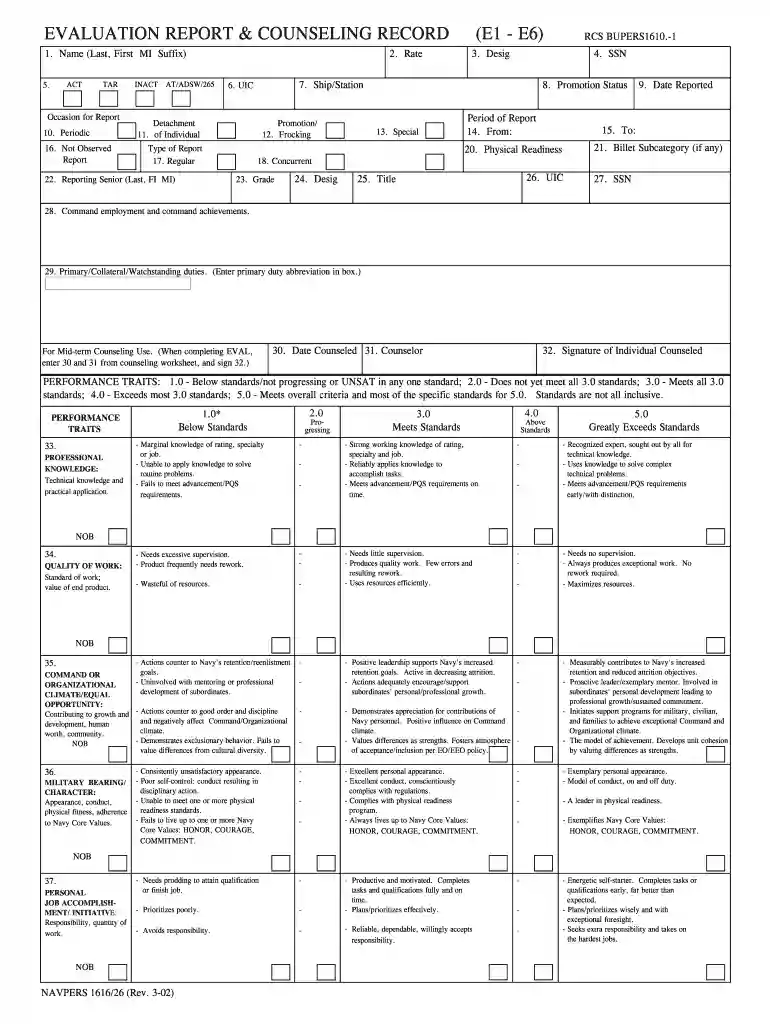
The NAVPERS 1616/26 is a vital evaluation report form used by the United States Navy for documenting the performance of enlisted personnel. It serves to assess various professional traits, such as leadership, teamwork, military bearing, and professional knowledge. This form is designed to provide a comprehensive evaluation that not only highlights an individual's strengths but also identifies areas that require improvement. The NAVPERS 1616/26 is critical for decisions regarding promotions, advancements, and overall career development within the Navy.
Completing the NAVPERS 1616/26 is a structured process that individuals must follow with precision to ensure an accurate representation of performance.
Before beginning the evaluation process, obtain relevant documentation including previous evaluations, performance records, and counseling statements.
Enter identifying details such as the sailor’s name, rank, and reporting period. Accurate personal data is crucial for proper record-keeping.
For each assessed trait, mark the corresponding rating and provide detailed comments. Each comment should justify the assigned rating based on documented examples of behavior and performance during the evaluation period.
Utilize the blank sections to articulate constructive feedback aimed at continued professional growth. This may include recognition of achievements and suggestions for improvement.
Before submission, review the completed evaluation for accuracy. Have a supervisor or, if applicable, another qualified individual verify the information to ensure it meets Navy standards.
Obtaining the NAVPERS 1616/26 form can be accomplished through official Navy channels.
Primarily, the NAVPERS 1616/26 is utilized by:


Several important aspects should be kept in mind when utilizing the NAVPERS 1616/26 form:
During an evaluation period, a First-Class Petty Officer may be assessed based on their leadership capabilities, teamwork involvement, and contributions to mission success. For example, a strong comment might highlight their role in leading a training exercise while fostering engagement among junior sailors, leading to improved operational readiness.
In another case, if a sailor consistently receives low ratings in professionalism, specific, actionable feedback should be documented in the counseling remarks. For instance, noting missed deadlines on projects could lead to targeted recommendations for time management training.
The NAVPERS 1616/26 serves as a critical tool in the continuity and advancement of Navy personnel. By adhering to structured evaluation practices, sailors and their superiors can ensure that performance assessments are meaningful and constructive, ultimately fostering a professional environment focused on growth and accountability.
We've got more versions of the navpers 1616 26 form. Select the right navpers 1616 26 version from the list and start editing it straight away!
At DocHub, your data security is our priority. We follow HIPAA, SOC2, GDPR, and other standards, so you can work on your documents with confidence.




Jul 13, 2018 NAVPERS 1616/24. NAVPERS 237. NAVPERS 2572. NAVPERS 2789. NAVPERS NAVPERS 1616/26. NAVPERS 1616/5. NAVPERS 1616/8. NAVPERS 18658. NAVPERSRead more
Jan 27, 2026 consideration. NAVPERS 1616/26: Evaluation Report and Counseling Record (E1 - E6). Navy form used to evaluate the performance of enlistedRead more
NAVPERS Form 1616/5 is used to report performance evaluations on personnel E4 and below. NAVPERS Form 1616/18 is used to report the performance evaluationRead more


