




01. Edit your form online
Type text, add images, blackout confidential details, add comments, highlights and more.

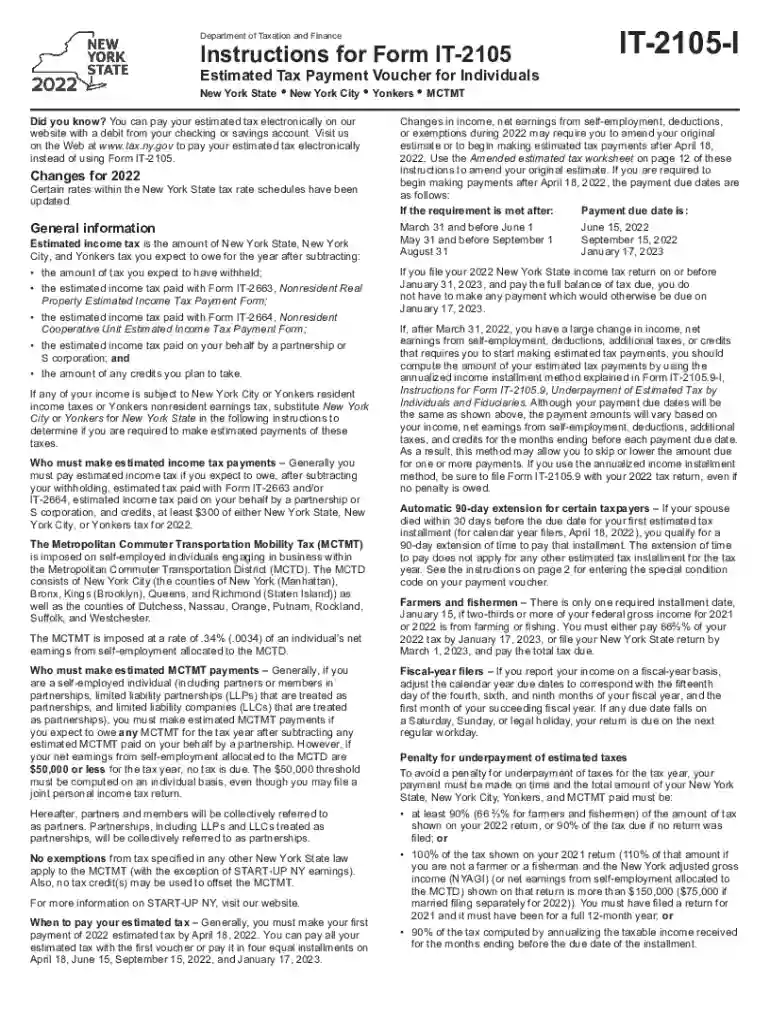
Type text, add images, blackout confidential details, add comments, highlights and more.

Draw your signature, type it, upload its image, or use your mobile device as a signature pad.

Send it via email, link, or fax. You can also download it, export it or print it out.
The Form IT-2105 Estimated Income Tax Payment Voucher is a tool used by residents in New York State to make periodic estimated tax payments for personal income taxes. This form is essential for ensuring taxpayers meet their tax obligations throughout the year and avoid any penalties associated with underpayment. It is particularly relevant for individuals whose income is not subject to automatic withholding, such as self-employed persons, landlords, and investors. It provides a structured way to align tax payments with anticipated tax liabilities, contributing to a more balanced approach to financial planning throughout the tax year.
Using Form IT-2105 involves several steps to ensure accurate and timely estimated tax payments.
Calculate Estimated Tax: Begin by calculating your estimated income tax obligation, taking into account your income, deductions, applicable credits, and any payments already made. This calculation should be based on current year projections and previous year tax returns.
Access the Form: Obtain the Form IT-2105 from the New York State Department of Taxation and Finance website or request a paper form through the mail.
Complete the Form: Fill in your personal information including name, address, and social security number. Enter the calculated estimated tax amount on the provided line.
Submit Payment: Make your payment either by attaching a check or money order with your completed voucher or using electronic payment methods through the department's online system. Ensure that all information is accurate to avoid processing errors.
Completing the Form IT-2105 involves detailed attention to ensure correctness.
Personal Information Section: Enter your full name and social security number. For joint filers, include both spouses' names and SSNs.
Payment Details: Specify the amount of the estimated tax payment. Double-check for accuracy to prevent discrepancies.
Presentation of Additional Information: If applicable, mention any credits from the prior year that can be applied to the current tax year to reduce the estimated amount due.
Final Review: Check all entries for completeness and accuracy before submission. Errors can lead to processing delays.
This form is primarily used by New York State residents who have income streams with no regular tax withholding. Typical users include:
Self-Employed Individuals: Those who own and operate their businesses and do not have taxes withheld from their earnings.
Landlords: Individuals receiving rental income within the state.
Investors: People with dividend, interest, or other investment income that necessitates estimated tax payments.
Freelancers and Contractors: Individuals receiving 1099 income for services rendered.
These groups must be proactive in managing their tax obligations to avoid penalties.


Understanding key terminology is critical for effectively using the Form IT-2105.
Estimated Tax: This is the amount a taxpayer expects to owe in taxes for the year, which should be paid in regular installments.
Withholding: Taxes held back from one's income by employers, whereas those using this form often do not have such withholdings.
Tax Credits: Deductions from the total tax owed, usually based on previous overpayments or specific financial scenarios applicable to the taxpayer.
Staying informed about the filing deadlines is crucial for compliance.
Quarterly Deadlines: Estimated taxes are typically due in quarterly installments throughout the tax year, commonly mid-month in April, June, September, and January of the following year.
Annual Reconciliation: Final tax liabilities and any discrepancies are reported and adjusted during the annual tax filing period, which typically culminates on April 15 of the following year unless an extension is granted.
Ensuring timely payments prevents penalties and interests accruing due to late payments.
Failure to pay estimated taxes on time can lead to significant penalties.
Underpayment Penalties: When taxes paid throughout the year do not meet the minimum required amount, the taxpayer may incur penalties.
Late Payment Penalties: Missing a deadline can result in additional charges and interest on the unpaid amount.
Interest Accumulation: Interest on unpaid taxes adds over time, increasing the total amount owed significantly if left unattended.
These penalties can affect both individuals and businesses negatively, emphasizing the importance of timely compliance.
The Form IT-2105 can be submitted through various methods, offering flexibility to taxpayers.
Online Submission: Utilize the New York State Department of Taxation and Finance's online platform for quick and secure electronic submission, including payment processing.
Mail: Complete the voucher and send it with a check or money order to the specified address on the form. This method requires considering postal delivery times to meet deadlines.
In-Person: While less common, some taxpayers may opt to deliver their form and payment directly to a Department of Taxation office for processing.
Choosing the right method helps ensure tax payments are recorded promptly and accurately.
We've got more versions of the Form IT-2105 Estimated Income Tax Payment Voucher Tax Year form. Select the right Form IT-2105 Estimated Income Tax Payment Voucher Tax Year version from the list and start editing it straight away!
| Versions | Form popularity | Fillable & printable |
|---|---|---|
| 2026 | 4.1 Satisfied (48 Votes) | |
| 2025 | 4.4 Satisfied (53 Votes) | |
| 2024 | 4.2 Satisfied (58 Votes) | |
| 2023 | 4.7 Satisfied (25 Votes) | |
| 2022 | 4.8 Satisfied (36 Votes) | |
| 2021 | 4 Satisfied (48 Votes) | |
| 2020 | 4.4 Satisfied (60 Votes) | |
| 2019 | 4.1 Satisfied (68 Votes) | |
| 2018 | 4.2 Satisfied (42 Votes) | |
| 2017 | 4.3 Satisfied (48 Votes) | |
| 2015 | 4.2 Satisfied (47 Votes) | |
| 2014 | 4 Satisfied (32 Votes) | |
| 2013 | 4.3 Satisfied (48 Votes) | |
| 2012 | 4.7 Satisfied (53 Votes) |
At DocHub, your data security is our priority. We follow HIPAA, SOC2, GDPR, and other standards, so you can work on your documents with confidence.
▫ How to make NYS estimated quarterly tax payments. 1. Mail your payment (check or money order) with payment voucher (NY. Form IT-2105, Voucher). 2. PayRead more
Form IT‐2105, Estimated Tax Payment Voucher for Individuals. Calendar-year filer due dates: April 15, 2026; June 15, 2026; September 15, 2026; and January 15,


