







Definition and Meaning
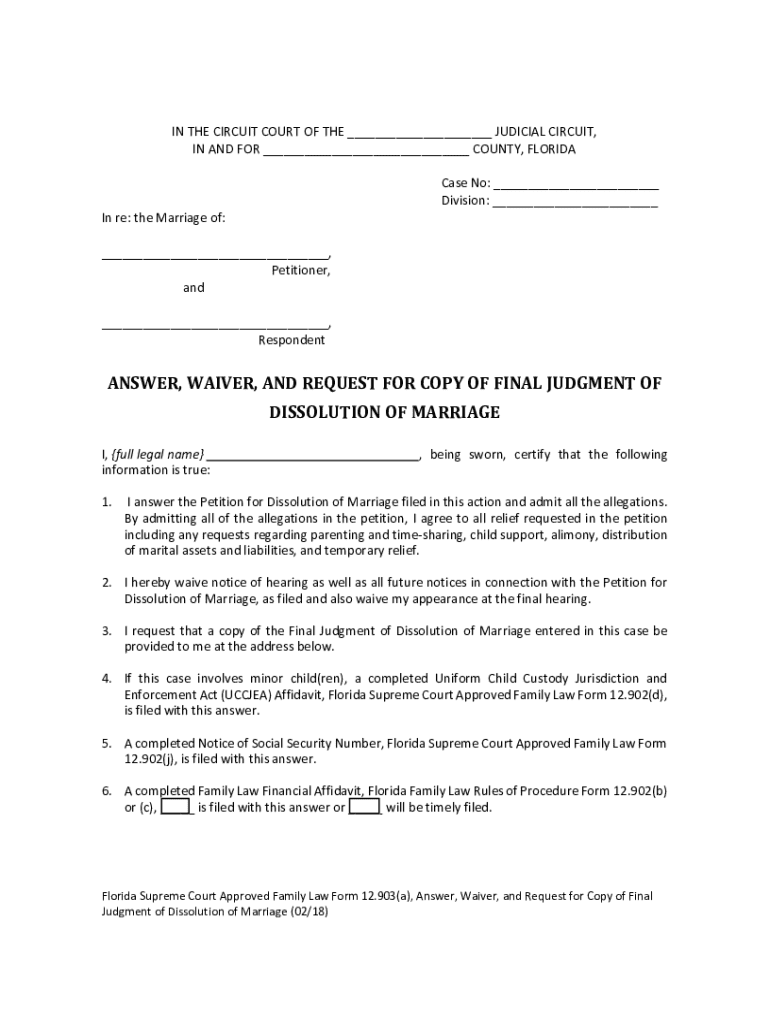
Florida Supreme Court Approved Family Law Form 12.903(a) is a vital legal document for individuals responding to a petition for dissolution of marriage. This form allows the respondent to admit the allegations in the petition, waive their right to further notice in the proceedings, and request a copy of the final judgment once issued. By signing this form, the respondent effectively agrees to the dissolution terms proposed by the petitioner without contesting them. This form streamlines the process and minimizes the need for further court appearances or legal interventions.
How to Use the Form
When you receive a petition for dissolution of marriage and agree with its terms, this form is used to respond officially. It's important to read the petition carefully before completing the form. The form must be filled out legibly, either typed or written in black ink. The document outlines specific sections that require the respondent's input, including identification details and acknowledgment of the petition's specifics. Once completed, you must sign the form in front of a notary to authenticate your response legally.
Obtaining the Form
Obtaining the Florida Supreme Court Approved Family Law Form 12.903(a) is straightforward. You can download the form from the Florida Courts’ website, ensuring that you have the latest version. Alternatively, physical copies may be available at the local courthouse where the petition was filed. It is crucial to use the approved and updated version of the form to avoid potential issues during the submission.
Steps to Complete the Form
- Read the Petition: Ensure you fully understand the dissolution's terms.
- Personal Information: Fill in your personal details, including name and address.
- Admit or Deny: Indicate your agreement with the petition terms.
- Notarization: Sign the form in front of a notary to certify your responses.
- File the Form: Submit the completed form to the circuit court where the dissolution was filed.
Key Elements of the Form
Several critical elements must be included when completing this form:
- Respondent’s Details: Accurate personal and contact information.
- Petition Agreement: A clear statement indicating acknowledgment and agreement with the petition.
- Request for Judgment Copy: A formal request for the final judgment copy, ensuring you remain informed post-resolution.
- Waiver of Notice: Optional section to waive the right to further notifications about hearing dates or additional proceedings.
- Notarization: Proper notarization is mandatory for the form's validity.
Legal Use and Implications
Legally, this form serves as your formal response to a divorce petition. By completing and submitting it, you waive any notice of further hearings and signify that you will not contest the petition. It simplifies the legal process for both parties, enabling a more efficient and faster resolution. It is crucial to fully understand the rights and obligations you forgo by waiving further notices and consenting to the petition.
Important Terms Related to the Form
- Dissolution of Marriage: Another term for divorce.
- Respondent: The individual responding to the divorce petition.
- Petition: The initial document filed by the party initiating the divorce.
- Waiver: The act of voluntarily relinquishing a right in the proceedings.
- Notary Public: An official authorized to certify legal documents and signatures.
State-Specific Rules
Florida has specific rules governing the use of this form. The respondent must ensure notarized submission, and the form should be filed within the timelines stipulated by the court. As Florida operates under no-fault divorce laws, the process centers on mutual consent and equitable distribution of assets. Each form field should be completed following Florida's legal standards to ensure validity.
Filing Deadlines and Important Dates
To maintain compliance and ensure the form is processed, adhere strictly to Florida's filing deadlines. Typically, the form should be submitted within a specific timeframe after receiving the dissolution petition—failure to comply results in legal disadvantages, such as default judgments or additional court costs. Always check with the local court for precise deadlines specific to your case.




