




01. Edit your ite trip generation manual pdf free download online
Type text, add images, blackout confidential details, add comments, highlights and more.

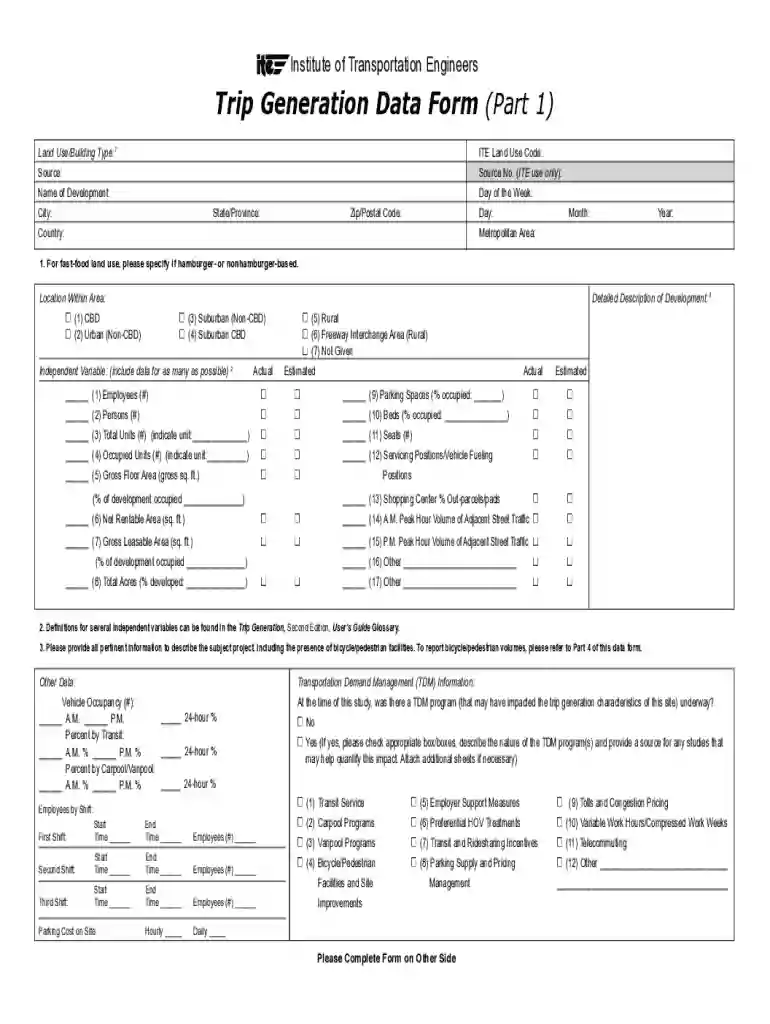
Type text, add images, blackout confidential details, add comments, highlights and more.

Draw your signature, type it, upload its image, or use your mobile device as a signature pad.

Send ite trip generation manual pdf via email, link, or fax. You can also download it, export it or print it out.
The "Trip-Generation Rates for Urban Infill Land Uses in California" is a specialized data set that provides insights into the expected vehicular and pedestrian traffic patterns associated with different types of land use developments in urban infill areas within California. This form is primarily used to estimate the number of trips generated by specific land uses like residential buildings, commercial establishments, or mixed-use developments. Understanding these rates is crucial for urban planners, architects, and engineers to design infrastructures that meet the necessary transportation needs and comply with state regulations.
Utilizing this form effectively requires a detailed understanding of its components and application in urban planning. Here's a step-by-step guide:
A developer planning a new mixed-use building in downtown Los Angeles can use this form to estimate trip counts and adjust building designs or amenities to accommodate anticipated traffic, such as adding additional parking spaces or bicycle facilities.
Completing the form accurately is crucial for acquiring useful insights:
By following these steps, planners can produce consistent and precise estimates.
Comprehending the terminology used within the form is essential for effective utilization:
Familiarity with these terms aids in precise and efficient form completion.
California has unique considerations when applying these trip-generation rates due to its varied geography and urban landscapes.
In San Francisco, environmental scrutiny is stricter, necessitating a more thorough review of estimated trips concerning emissions reductions and sustainable transportation options.
Such examples provide insight into practical application and results:
These examples illustrate the form's utility in actionable planning and strategic decision-making.
Understanding the form's key elements ensures complete and effective utilization:
Legalities around using the form include ensuring transparency and meeting regulatory expectations:
Proper adherence mitigates risks of legal repercussions and supports communities in achieving sustainable development outcomes.
This structure ensures thorough coverage of the Trip-Generation Rates for Urban Infill Land Uses in California by emphasizing comprehensive explanations, examples, and the contextual application of this form in urban planning.
We've got more versions of the ite trip generation manual pdf free download form. Select the right ite trip generation manual pdf free download version from the list and start editing it straight away!
At DocHub, your data security is our priority. We follow HIPAA, SOC2, GDPR, and other standards, so you can work on your documents with confidence.
by KJ Clifton 2015 Cited by 83 This study examines the ways in which urban context affects vehicle trip generation rates across three land uses. Trip Generation Rates for Urban Infill Land
Trip generation rates are used in the development and application of traffic impact fees and are a major determinant in the approval of development projects andRead more
The ASTM Standard. Guide for Greener Cleanups (E2893-13)2 offers a collection of greener cleanup BMPs. Green remediation BMPs focus on the core elements ofRead more


