
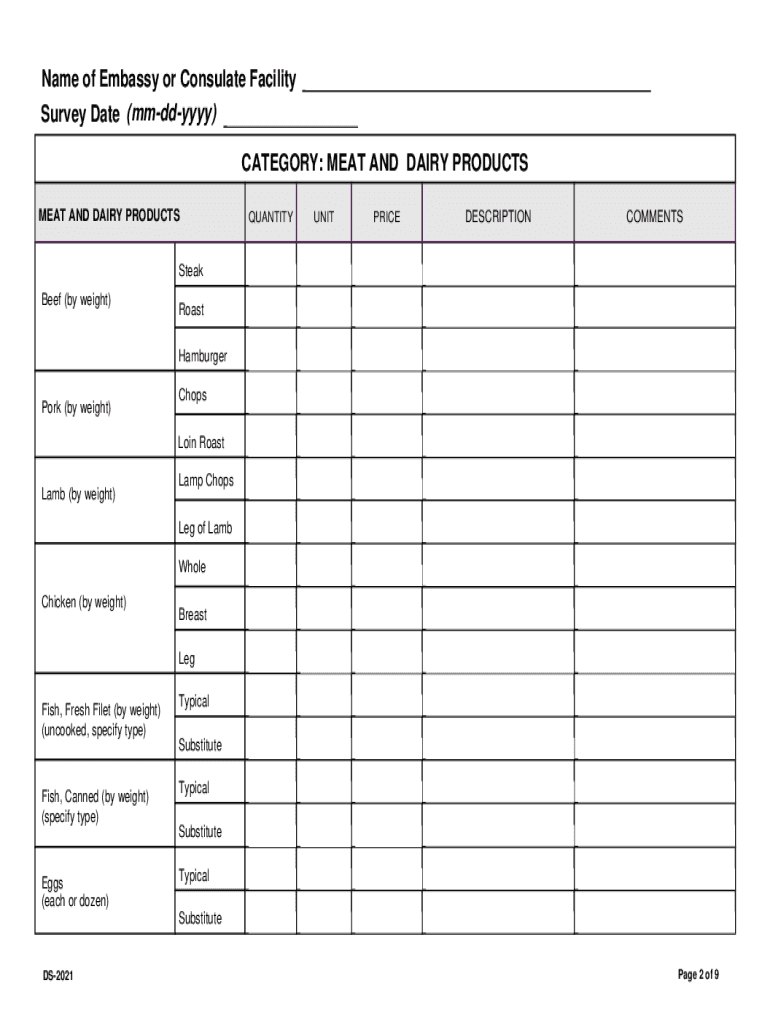







Definition and Meaning of the Retail Price Schedule
A Retail Price Schedule is a structured document used primarily for listing and managing the prices of various products within a retail environment, such as embassies or consulate stores. This form is crucial for both internal inventory management and customer transparency, detailing categories like groceries, alcohol, tobacco, and personal care items. It includes specifics about each product's category, quantity, unit, price, and any related comments. The schedule ensures consistent pricing strategies across locations, promoting fairness and uniformity in product availability and costs.
Steps to Complete the Retail Price Schedule
Completing a Retail Price Schedule involves a systematic approach to ensure all necessary data is accurately represented. Below is a detailed process:
- Gather Product Information: Collect details for each item, including product name, category, and unit of measure.
- Determine Pricing: Calculate the retail price per unit based on factors such as cost, desired profit margin, and local tax regulations.
- Fill Out the Form:
- List each product under the appropriate category.
- Include quantity and unit information.
- Enter the determined price for each item.
- Add Comments: Use the comments section to note any special instructions, discounts, or product-specific conditions.
- Review and Verify: Double-check the accuracy of all entries, and confirm that pricing aligns with organizational policies and regulations.
Key Elements of the Retail Price Schedule
The Retail Price Schedule consists of several critical elements, ensuring effective communication of product pricing:
- Product Categories: Items are grouped into categories like meat and dairy, personal care, and household furnishings, aiding in organized browsing.
- Item Details: Each entry provides product descriptions, including quantity and unit measurements, ensuring clarity.
- Pricing Information: Displays the price per unit, vital for customer understanding and inventory control.
- Comments Section: Allows for additional notes regarding special pricing or product information, enhancing contextual understanding.
Importance of Using the Retail Price Schedule
Utilizing a Retail Price Schedule is essential for businesses in the retail sector for several reasons:
- Consistency Across Outlets: Ensures uniformity in pricing across different locations or stores, preventing customer confusion and disparities.
- Price Monitoring: Facilitates internal oversight and management of pricing strategies, helping identify necessary adjustments based on market changes.
- Regulatory Compliance: Helps meet local and international regulations concerning transparent pricing policies in retail operations.
Who Typically Uses the Retail Price Schedule
The Retail Price Schedule is commonly used by various stakeholders in a retail environment:
- Store Managers: Oversee the completion and maintenance of the schedule to ensure that all prices reflect current market conditions.
- Inventory Controllers: Use the document to track product pricing and quantities, assisting in effective inventory management.
- Financial Analysts: Analyze pricing trends and profitability through often-completed Retail Price Schedules.
- Regulatory Auditors: Review the schedule during compliance checks to ensure adherence to pricing laws.


Software Compatibility and Integration
To maximize efficiency, the Retail Price Schedule needs to be compatible with various software platforms:
- Accounting Software: Integration with software like QuickBooks can streamline financial reporting and track pricing data.
- Inventory Management Systems: Ensuring that pricing data can be fed directly into systems helps maintain up-to-date inventory records.
- Retail Point of Sale (POS) Systems: Direct synchronization can reduce manual entry errors and ensure instant reflection of pricing changes at point-of-sale terminals.
Legal Use and Compliance of the Retail Price Schedule
The legal use of a Retail Price Schedule must adhere to consumer protection laws, ensuring:
- Transparency: Clearly listing prices to prevent consumer deception and ensure fair trading practices.
- Pricing Accuracy: Regularly updating schedules to reflect current market prices and any tax or regulatory changes.
- Documentation: Keeping comprehensive records of price changes as part of an organization's regulatory compliance duties.
Examples of Using a Retail Price Schedule in Practice
Practical examples illustrate how businesses effectively use the Retail Price Schedule:
- Case Study: Embassy Retail Operations: An embassy uses the schedule for pricing goods available in its store, ensuring consistency and regulatory compliance across all international locations.
- Scenario: Seasonal Adjustments: A retail manager updates the schedule for holiday sales, applying discounts and special offers clearly documented for consumer awareness.
- Localization Example: Adapting pricing strategies to align with local economic conditions, ensuring competitive pricing while maintaining profit margins.
Understanding and efficiently using a Retail Price Schedule are paramount for businesses striving for consistency and transparency in their pricing strategies.




