
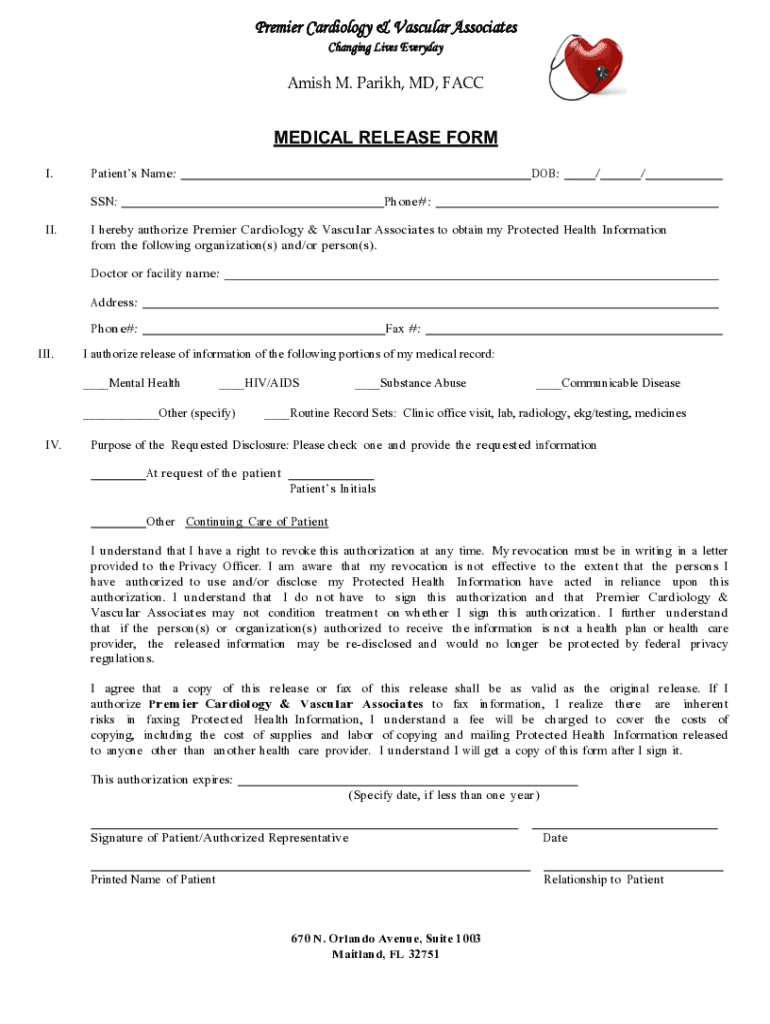







Definition and Purpose of Medical Release Form
A medical release form is a legal document that allows healthcare providers to share a patient’s medical information with specified individuals or organizations. This form plays a critical role in maintaining patient confidentiality while facilitating the necessary flow of information for healthcare management, legal processes, or insurance claims. Under the Health Insurance Portability and Accountability Act (HIPAA), patients have specific rights over their health information, making the medical release form an essential tool to authorize information sharing while complying with legal requirements.
Importance of Medical Release Form
- Privacy Protection: Ensures patient information is shared only with authorized parties.
- Legal Compliance: Supports adherence to regulations such as HIPAA.
- Facilitates Care Coordination: Enables different healthcare providers to coordinate effectively.
- Insurance and Legal Processes: Assists in processing insurance claims and legal matters.
How to Use a Medical Release Form
Using a medical release form requires an understanding of its contents and procedures for completing and submitting it. The form must be filled out accurately to ensure legal compliance and proper processing.
Step-by-Step Instructions
- Identify Information: Specify the information to be disclosed, such as medical history, test results, or treatment plans.
- List Authorized Parties: Clearly state who is authorized to receive the information.
- Duration of Authorization: Define how long the authorization will be valid.
- Sign and Date: The patient must sign and date the form for it to be legally valid.
- Submit the Form: Send the form to the healthcare provider responsible for releasing the information.
Example Scenarios
- When transferring to a new healthcare provider.
- For legal proceedings where medical evidence is required.
- To update insurance companies with recent medical information.
Key Elements of a Medical Release Form
Medical release forms have several critical elements that ensure they are used effectively and comply with legal standards. Understanding these elements helps in filling out the form correctly.
Main Components
- Patient Information: Full name, date of birth, and contact details.
- Purpose of Release: The reason for sharing medical information.
- Specific Information to be Released: Details about the type of medical data to be shared.
- Authorization Expiry: A statement regarding when or under what conditions the authorization expires.
- Patient's Rights: Information on the patient’s right to revoke consent.
Additional Considerations
- Type of Medical Records: Specify if information such as mental health records or substance abuse treatment is included.
- Third-Party Involvement: Specify third parties, if any, who may have access.
Legal Use of the Medical Release Form
Medical release forms are governed by federal and state regulations to protect patient privacy while allowing necessary information sharing.
Legal Guidelines
- HIPAA Compliance: Must meet standards set by HIPAA for privacy and information security.
- State Regulations: Varying state laws may stipulate additional requirements for medical releases.
- Revocation Rights: Patients can revoke the authorization at any time, and the form must include this notice.
Who Typically Uses a Medical Release Form
Medical release forms are used by a variety of individuals and organizations, including:
Common Users
- Patients: To control who accesses their medical information.
- Healthcare Providers: To coordinate care and share necessary information with other providers.
- Insurance Companies: To obtain medical records for claim processing.
- Legal Professionals: To gather evidence for lawsuits or legal matters related to health.


Situational Uses
- School and Sports Physicals: Required for releasing medical information about athletes.
- Senior Care Facilities: To manage elderly patients' health records securely.
Examples of Using the Medical Release Form
Examples help illustrate the practical use and necessity of medical release forms in real-world scenarios.
Real-World Examples
- Transfer of Care: A patient moving to a new city uses a medical release form to send health records to a new primary care physician.
- Specialist Consultation: A primary care doctor uses a medical release to send a patient's records to a specialist for further diagnosis.
- Insurance Claims: An insurance adjuster requests medical records to process a claim after a patient has consented via a medical release form.
State-Specific Rules for the Medical Release Form
Different states may impose their own rules regarding the use and requirements of medical release forms, adding complexity to their completion and submission.
Notable Variations
- Consent Age: Some states have specific age requirements for patient consent.
- Additional Protective Measures: Certain states may require additional consent for sensitive information, such as mental health or HIV status.
Key Terms Related to Medical Release Form
Understanding the jargon associated with medical release forms is essential for accurate completion and processing.
Important Terms
- Protected Health Information (PHI): Any information about health status, provision of healthcare, or healthcare payment that can be linked to an individual.
- Authorization: Consent granted by the patient to release health information.
- Revocation: The act of withdrawing consent previously given.




