




01. Edit your form online
Type text, add images, blackout confidential details, add comments, highlights and more.

Type text, add images, blackout confidential details, add comments, highlights and more.

Draw your signature, type it, upload its image, or use your mobile device as a signature pad.

Send it via email, link, or fax. You can also download it, export it or print it out.
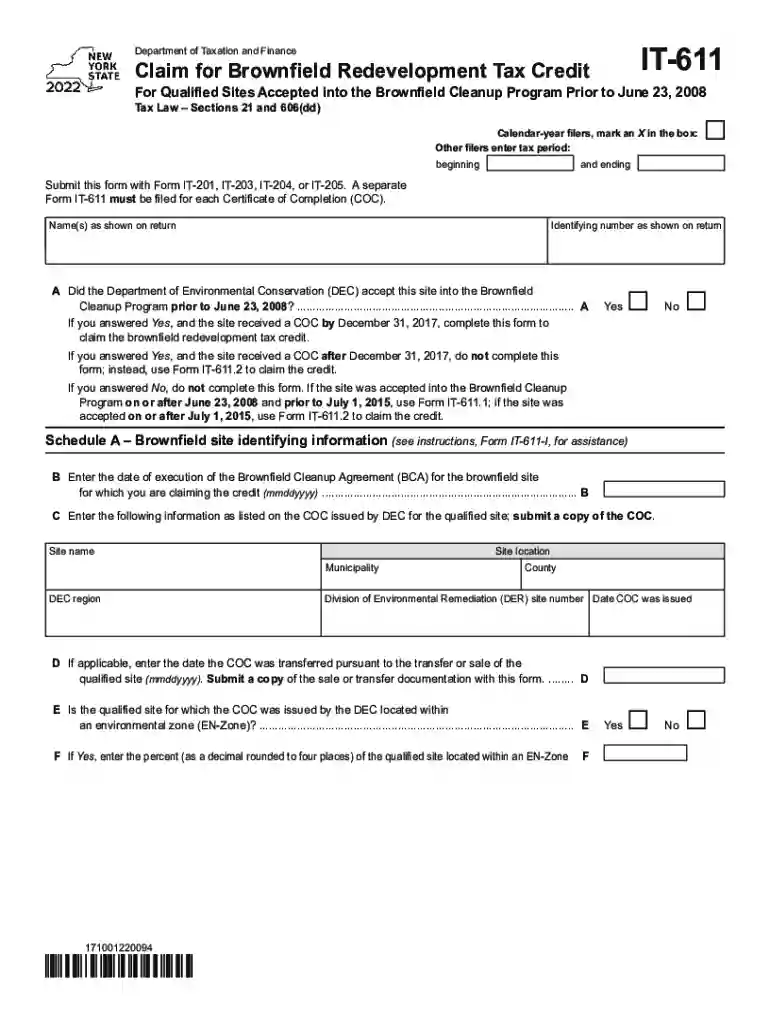
The IT-611 form is critical for taxpayers aiming to claim credits related to the cleanup and redevelopment of brownfield sites in New York State. It applies to tax year 2022 and involves several components, each targeting specific costs and efforts associated with brownfield redevelopment. The Department of Taxation and Finance issues this form, and it focuses on qualified sites accepted into the Brownfield Cleanup Program (BCP) before June 23, 2008.
The IT-611 encompasses several credit components essential for claiming various redevelopment costs:
Site Preparation Costs: This includes expenses related to ground preparation, such as soil testing and environmental consulting fees. It covers efforts necessary to make a site ready for redevelopment.
Tangible Property Costs: This refers to the investment in buildings or other permanent structures on the brownfield site. Eligible expenses are those directly related to the construction or reconstruction of tangible property.
Groundwater Remediation Costs: Cleaning contaminated groundwater is often a complex and costly process. The IT-611 form allows for credit claims against these environmentally necessary activities.
Not every site or project can claim the tax credit. Interested parties must meet specific eligibility criteria:
Qualified Sites: Only sites accepted into New York's BCP before June 23, 2008, are eligible. This legacy inclusion date means that newer entries may not qualify under this form but might under subsequent versions designed for later years or phases.
Certificate of Completion (COC): The issuance date of the COC determines the applicable tax credit calculations and possible restrictions. Ensuring this document is included with your submission can be critical.


Fulfilling the form IT-611 involves several steps and careful attention to detail:
Gather Required Documentation: This includes evidence like site-specific expense records, environmental reports, and your COC.
Complete Each Schedule: Distinct parts of the form need completion to reflect various credit components accurately. Ensure alignment between documented expenses and corresponding credit sections.
Submit Compiled Documentation: Alongside IT-611, relevant tax forms and supporting documents must accompany your submission.
You can access and download the IT-611 form directly from the New York Department of Taxation and Finance's official website. Alternatively, the form is available through various tax preparation software, known for their ability to streamline the process by incorporating these forms into broader income tax computations.
Legal use of IT-611 requires thorough adherence to state regulations associated with the Brownfield Redevelopment Tax Credit.
Filing Timeliness: Taxpayers must observe essential deadlines to avoid penalties. Typically, this aligns with New York State tax return due dates, although extensions may apply.
Disclosure: Full disclosure of remediation work, costs incurred, and resultant site usability improvements are required to ensure compliance.
The IT-611 form is vital for businesses and individuals investing in brownfield sites. The redevelopment of such areas not only mitigates environmental risks but also revitalizes communities and stimulates economic growth.
Businesses Benefit: Corporations investing in redevelopment often experience positive returns through tax credits, facilitating environmentally sustainable projects.
Community Impact: Reduction in local environmental hazards and revitalization can lead to increased property values and improved community well-being.
Consider a manufacturing firm that renovates a former industrial park, transforming it into a mixed-use development. By reclaiming site and water conditions as part of the state's environmental mandate, the firm can offset significant costs through the IT-611 tax credit.
For a more personalized experience or detailed scenarios, taxpayers should consult experienced tax professionals or legal advisors.
The IT-611 form for tax year 2022 is not merely a document but a strategic tool enabling businesses and developers to leverage tax credits for environmental renewal projects. When completed accurately, this form helps foster environmental responsibility and economic growth in line with state priorities.
We've got more versions of the Form IT-611 Claim for Brownfield Redevelopment Tax Credit Tax Year 2022 form. Select the right Form IT-611 Claim for Brownfield Redevelopment Tax Credit Tax Year 2022 version from the list and start editing it straight away!
Sure, you’ll find many different applications for this on the web. However, if you need to eSign your Form IT-611 Claim for Brownfield Redevelopment Tax Credit Tax Year 2022 without installing extra software, DocHub is the best choice you can make. This robust editor works on mobile devices just as on desktops. Open our editor in your preferred internet browser, register or log in to your account, and start managing your paperwork.
You can find the latest and most relevant version of the Form IT-611 Claim for Brownfield Redevelopment Tax Credit Tax Year 2022 in our DocHub forms library. Browse it by categories or use the search field to get the exact template that fits your situation. You may open this form for editing after you find it.
At DocHub, your data security is our priority. We follow HIPAA, SOC2, GDPR, and other standards, so you can work on your documents with confidence.
by R Bell Cited by 2 Instructions: This form must be completed by all masters and doctoral students with a thesis or dissertation requirement.Read more
The brownfield redevelopment tax credit is equal to the sum of three credit components, computed each tax year, for costs incurred in the remediation orRead more


