1019, Notice of Assessment, Taxable Valuation, and Property ...-2026

Get Form
1019 form Preview on Page 1

Here's how it works

01. Edit your 1019 form online
Type text, add images, blackout confidential details, add comments, highlights and more.

02. Sign it in a few clicks
Draw your signature, type it, upload its image, or use your mobile device as a signature pad.

03. Share your form with others
Send form 1019 via email, link, or fax. You can also download it, export it or print it out.

Definition and Importance of the Notice of Assessment

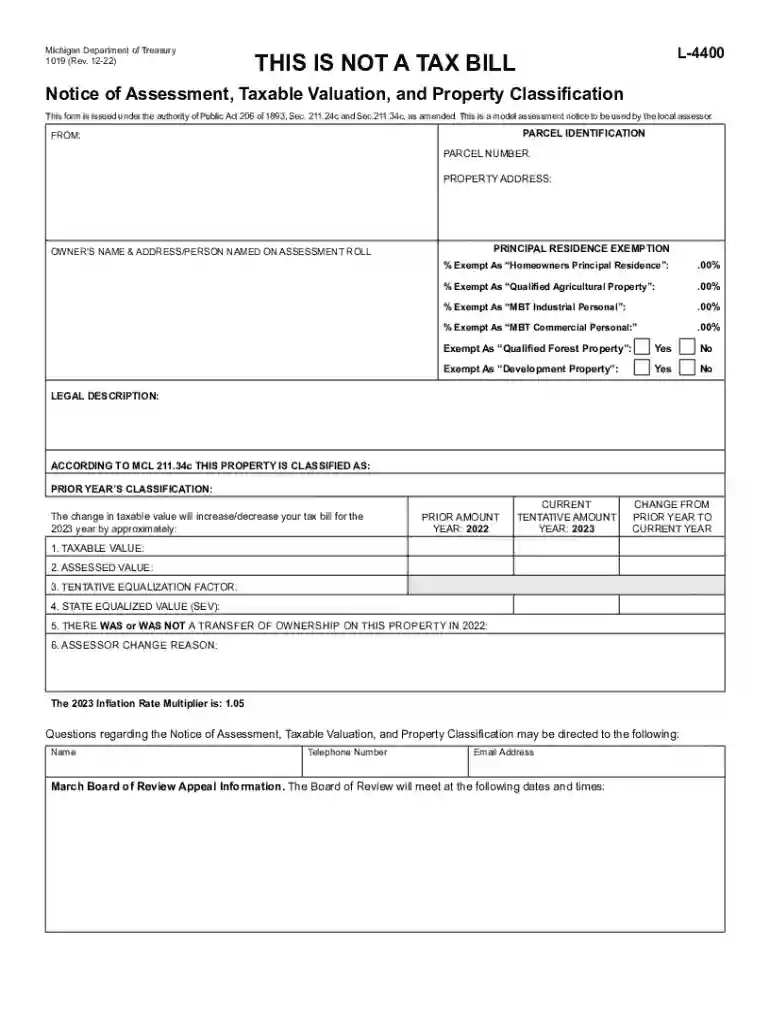
A Notice of Assessment, typically associated with property tax evaluation, is a critical document issued by local government authorities or the state, such as the Michigan Department of Treasury. This notice provides property owners with essential information about their property's taxable value, assessed value, and classification. Understanding these elements is crucial, as they directly impact the property tax obligations of the homeowner. The document also details potential exemptions, adjustments, and processes for contesting valuations, which can affect the financial planning and tax management of the property owner.

How to Use the Notice of Assessment

Using the Notice of Assessment effectively requires owners to review each section carefully. Key steps include:

  1. Review Your Property’s Assessed Value: Compare this with similar properties in your area to ensure accuracy.
  2. Check for Exemptions: Identify any available tax exemptions for which your property might qualify.
  3. Understand the Taxable Value: This is the value upon which your taxes will be calculated, often different from the market value.
  4. Evaluate Your Tax Classification: Confirm your property is classified correctly, as misclassification can affect tax rates.

Steps to Complete the Notice of Assessment

Engaging with the Notice of Assessment typically involves understanding the document rather than completing it, as it is usually prepared by the authorities. However, property owners need to:

  1. Verify All Details: Ensure the document's accuracy regarding property details and values.
  2. Identify Discrepancies: If information seems incorrect, gather supporting documents and data for clarification.
  3. Prepare for Appeals: Should inaccuracies exist, be prepared to appeal by filing the necessary forms and providing evidence to the local tax assessor's office or Board of Review.

Legal Use and Obligations

The Notice of Assessment has legal implications, requiring strict adherence to deadlines and proper procedures for filing protests or appeals. Property owners should:

  • Understand legal rights for contesting assessments.
  • Adhere to specified timelines for appeals, usually outlined in the notice.
  • Seek legal advice if disputes arise that require resolution beyond simple administrative review.

Key Elements of the Notice of Assessment

Understanding the document’s components is essential for property tax comprehension:

  • Property Description: Includes legal identifiers and property location.
  • Assessed Value: Set by the assessor as a percentage of the fair market value.
  • Taxable Value: Often capped by statutory limits but subject to increase due to property improvements or ownership changes.
  • Exemptions and Adjustments: Available reductions or modifications to the taxable amount.
  • Appeals Process: Information on how to challenge the assessment.

State-Specific Rules and Variations

Different states, such as Michigan, may have unique rules regarding property assessments and taxation:

  • Assessment Ratios: These can vary, affecting the conversion from market value to assessed value.
  • Exemption Types: States offer specific homeowner, agricultural, or veteran exemptions.
  • Appeals Procedures: Deadlines and methods for contesting assessments are state-specific.

Obtaining the Notice of Assessment

Property owners can typically obtain their Notice of Assessment by:

  1. Mail Delivery: Most jurisdictions send these annually to property owners.
  2. Online Access: Many states have portals where these notices can be reviewed and downloaded.
  3. Local Assessor’s Office: Visiting the office for in-person queries or document requests.

Examples and Scenarios

Consider a Michigan homeowner who notices an unexpected increase in their property's taxable value:

  • Scenario One: An increase due to recent property improvements, like an addition to the home.
  • Scenario Two: An erroneous rise due to misclassification, leading to a successful appeal after providing evidence of a clerical error.

Required Documents for Appeals

Should discrepancies arise, supporting documents might include:

  • Property Appraisals: Recent reports to compare against the assessed value.
  • Sales Data: Information on sales of comparable properties.
  • Documentation of Exemptions: Proof of eligibility for specific exemptions.

Completing these steps and understanding the nuances of the Notice of Assessment can aid property owners in effectively managing their tax liabilities and ensuring fair taxation practices.

See more 1019, Notice of Assessment, Taxable Valuation, and Property ... versions

We've got more versions of the 1019, Notice of Assessment, Taxable Valuation, and Property ... form. Select the right 1019, Notice of Assessment, Taxable Valuation, and Property ... version from the list and start editing it straight away!
Versions Form popularity Fillable & printable
2023 4.4 Satisfied (21 Votes)
2022 4.1 Satisfied (23 Votes)
2021 4.8 Satisfied (60 Votes)
2020 4.4 Satisfied (90 Votes)
2019 4.3 Satisfied (35 Votes)
2018 4.4 Satisfied (216 Votes)
2013 4.1 Satisfied (54 Votes)
be ready to get more

Complete this form in 5 minutes or less

Get form

Got questions?

We have answers to the most popular questions from our customers. If you can't find an answer to your question, please contact us.
Contact us

Electronic document signing requires a software solution that works in compliance with data security and eSignature laws. DocHub is a perfect tool for that, because it fulfills all the above mentioned requirements. Whatever method you like to sign your 1019 tax form in DocHub, your electronic signature will be legally binding and court-admissible.

You need only a web connection and a browser to fill out your t 1019 rev 03 2021 3 eng on an iOS phone. Open the DocHub website and authenticate. Then, add your file or choose it from the list in your dashboard. Then use our editing tools to fill out your form and save all your changes. You may also send it to a dedicated recipient right away.

Your assessment notice is just that, a notice. It indicates what your property is worth how much of that value is taxable. The local millage rates are applied to your taxable value to calculate your tax bill. Your property taxes are not based on your assessed value.
Assessed value is determined by the local government and is most often used to determine how much you pay in property taxes. Appraised value is done by an independent appraiser and is most often used during the mortgage approval process.
A notice of assessment (NOA) is the summary of the calculated amounts for your income tax and benefit return. The Canada Revenue Agency (CRA) sends you these results after receiving your tax return. The CRA will only send you a notice of reassessment (NOR) if changes are made to your assessed tax return.

Security and compliance

At DocHub, your data security is our priority. We follow HIPAA, SOC2, GDPR, and other standards, so you can work on your documents with confidence.

Learn more
ccpa2
pci-dss
gdpr-compliance
hipaa
soc-compliance
be ready to get more

Complete this form in 5 minutes or less

Get form

People also ask

What does it state on the assessment? What tax is this in regards to? Typically, states would issue a notice of assessment, which is just a fancy way of saying billing for tax due, if you failed to file the return(s) in question or if there were adjustments made to the returns resulting in a tax due.
What is the difference between taxable value and assessed value? Taxable value ( TV ) is the value used to compute your tax bill. State assessed value ( SEV ) is one half the market value, as determined by the assessor. SEV grows as the market rate of property grows.
Its the Appraisal Districts estimate of your propertys value as of January 1st of the current year. This is the value, minus any applicable exemptions, that will be used to calculate your property taxes. Note that the county often uses the terms appraised and assessed synonymously.
Taxable value ( TV ) is the value used to compute your tax bill. State assessed value ( SEV ) is one half the market value, as determined by the assessor. SEV grows as the market rate of property grows. TV increases are capped to inflation rates for the time that you own the property.
Assessed value is defined by state law as 50% of the market value of the property as of December 31st of the preceding year. Taxable value is derived from a formula created by the passage of Proposal A in 1994, designed to limit the taxable value increased annually to the rate of inflation.

t 1019 rev 03 2021 1 eng