
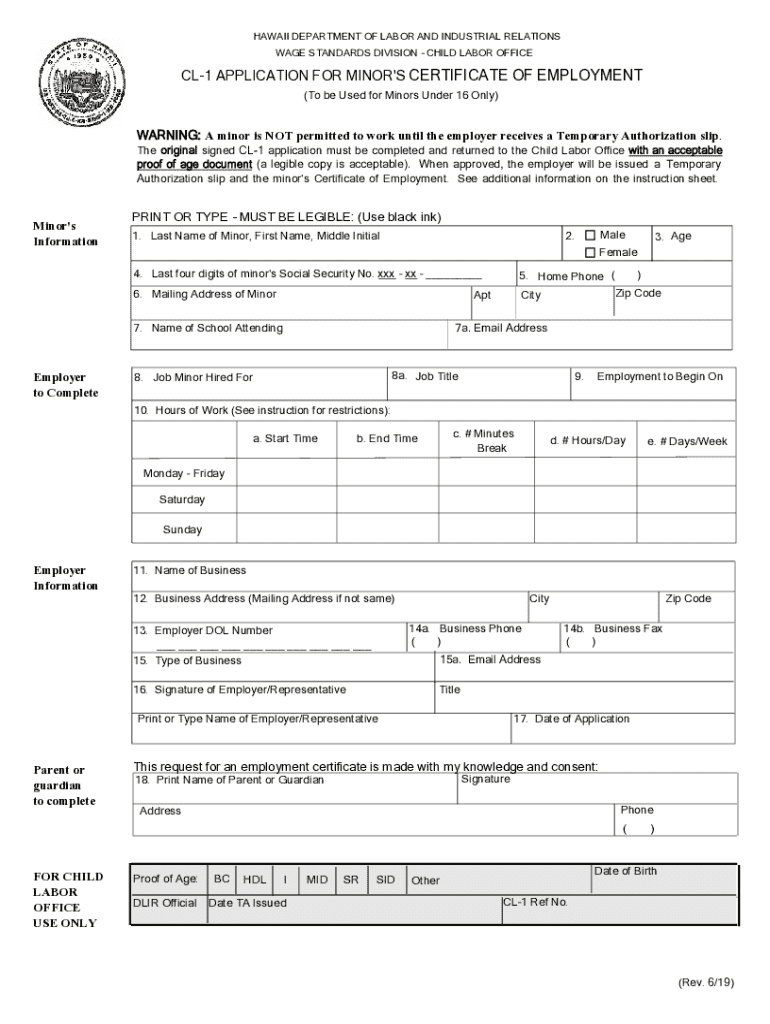







Definition & Meaning of the State of Hawaii Child Labor Law
The State of Hawaii Child Labor Law regulates the employment of minors in various occupations to ensure their safety and welfare. These laws are designed to protect children under the age of eighteen from hazardous working conditions and restrict their working hours. The law outlines specific age requirements, permissible job types, and limits on hours worked, especially for younger minors aged fourteen and fifteen.
Key elements of the law include:
- Age Restrictions: Generally, minors under the age of 16 require a worker's permit to work legally in Hawaii.
- Allowed Occupations: Certain jobs are deemed appropriate for minors, such as retail and administrative roles, while others, like construction, are prohibited.
- Working Hours: There are strict limits on the number of hours minors can work, particularly during school sessions, to ensure they have sufficient time for education.
This law also requires employers to maintain documentation regarding the ages of their minor employees, which can include work permits and proof of age.
How to Use the State of Hawaii Child Labor Law
Understanding and implementing the State of Hawaii Child Labor Law involves several steps, primarily focused on ensuring compliance with legal requirements when hiring minors. Employers must familiarize themselves with the specific provisions related to hiring minors, including obtaining the appropriate labor permits and adhering to wage standards.
Key usage guidelines include:
- Obtain Worker Permits: Employers should ensure that minor employees possess valid worker permits, especially if they are under the age of 16.
- Monitor Working Hours: Keep detailed logs of hours worked by each minor to remain compliant with restrictions, which vary based on age and school schedules.
- Provide Training: Employers must offer training on workplace safety specific to minors, ensuring they understand their rights and responsibilities.
Employers and parents must regularly communicate to ensure that young workers are aware of their rights under the law and the obligations they have in the workplace.
Steps to Complete the Application Process for Workers Permits
The process of applying for a workers permit in Hawaii involves several essential steps that must be followed carefully to ensure compliance with the Child Labor Law.
- Gather Required Documents: Compile necessary identification documents for the minor, including proof of age (e.g., birth certificate or school ID).
- Complete the Application Form: Fill out the workers permit application form, which typically includes details about the minor, the employer, and the job they will be performing.
- Employer Verification: The employer must provide written assurance that the minor is being offered a job and notify of their responsibilities under the law.
- Submit the Application: The completed permit application, along with any required documentation, must be submitted to the appropriate state agency for approval.
- Await Approval: After submission, wait for the necessary approvals, which may take some time depending on the agency's workload.
By following these steps, minor employees can secure their work permits and begin employment legally while ensuring compliance with the State of Hawaii Child Labor Law.
Important Terms Related to the State of Hawaii Child Labor Law
Familiarity with key terms associated with the State of Hawaii Child Labor Law is crucial for both employers and minors. Here are several important concepts:
- Worker Permit: A legal document that allows minors to work in specific jobs as mandated by law.
- Proof of Age: Documentation that verifies a minor's age, necessary for work permit applications.
- Hazardous Occupations: Jobs that are considered unsafe for minors, such as those involving heavy machinery or hazardous materials.
- Restricted Hours: Limits on when and how long minors can work, especially during school periods.
Understanding these terms will help both employers and parents navigate the legal landscape regarding child labor more effectively and ensure compliance with applicable laws.
Penalties for Non-Compliance with the Child Labor Law
Failing to adhere to the provisions of the State of Hawaii Child Labor Law can result in significant penalties for employers. Compliance is crucial not only to protect minors but also to avoid legal repercussions.
Potential penalties include:
- Fines: Violating child labor laws may result in financial penalties, which can vary based on the severity and frequency of the infractions.
- Fines and Damages: In serious cases, employers may face lawsuits or additional financial liabilities if a minor is harmed while working in violation of the law.
- Revocation of Operating Licenses: Persistent non-compliance can lead to losing the privilege to operate within specific industries or business sectors.
Adhering to the Child Labor Law is essential not only for legal protection but also for fostering a safe and supportive work environment for young employees.
State-Specific Rules for the State of Hawaii Child Labor Law
Hawaii has established specific regulations concerning child labor that impact how minors can be employed within the state. These regulations can be stricter than federal guidelines and must be carefully followed.
Notable state-specific rules include:
- Permits Required: Unlike some states, Hawaii mandates that all minors under the age of 16 obtain a worker's permit prior to employment.
- Limited Working Hours: The state also enforces strict limits on hours, such as restricting work during school hours and setting maximum weekly hours during school sessions.
- Prohibited Activities: Specific hazardous jobs are explicitly banned for minors, ranging from construction work to operating hazardous machinery.
Being aware of these rules helps employers ensure compliance while also protecting the rights and safety of young workers.
Examples of Using the State of Hawaii Child Labor Law
Real-world applications of the State of Hawaii Child Labor Law can help clarify how it operates in practice. Here are a few scenarios reflecting its significance:
- Example 1: A fourteen-year-old secures a job as a cashier in a local retail store. The employer ensures they complete the workers permit application and submits it while also monitoring their working hours, aligning with state restrictions.
- Example 2: A sixteen-year-old is hired for a summer position. The employer must confirm that the minor is aware of their rights regarding working conditions and ensure they do not work more than the allowable hours during the school year.
- Example 3: A local bakery wishes to hire minors for part-time positions. They must proactively list which positions are available and verify that none of the job duties fall under the category of hazardous work prohibited for minors.
These examples illustrate how the law is applied in practical settings, highlighting both employer responsibilities and minors' rights.




