




01. Edit your form 8508 online
Type text, add images, blackout confidential details, add comments, highlights and more.

Type text, add images, blackout confidential details, add comments, highlights and more.

Draw your signature, type it, upload its image, or use your mobile device as a signature pad.

Send 8508 form via email, link, or fax. You can also download it, export it or print it out.
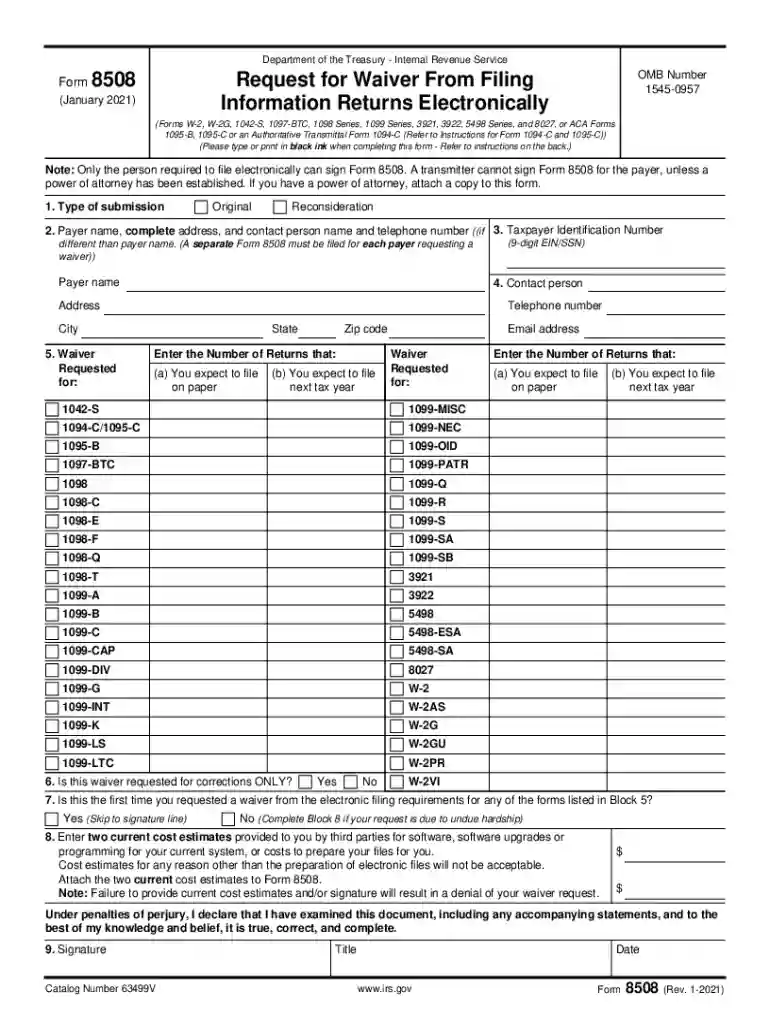
IRS Form 8508 is a critical document used by businesses and individuals to request a waiver from the IRS's requirement to electronically file certain information returns. The form is essential for those who, under exceptional circumstances, cannot comply with the electronic filing mandate for federal tax forms such as the 1099 series or W-2 forms. The waiver is particularly important for entities experiencing significant economic hardships or lacking the technological capacity to e-file, emphasizing the form's utility in ensuring compliance while addressing specific challenges.
Gather Necessary Information:
Complete the Form:
Review IRS Waiver Conditions:
Submit Form:
The IRS provides comprehensive guidance on submitting Form 8508, detailing conditions, exemptions, and procedures. Adherence to these guidelines is crucial for avoiding penalties and ensuring approval. Consult the IRS's official instructions, which include detailed criteria and examples that illustrate eligibility for waivers.
Submitting Form 8508 must align with legal stipulations, ensuring that all provided information is accurate and justifiable. Misstatements or fraudulent submissions may incur significant penalties, highlighting the necessity for accuracy and integrity in completing this legal document.


By thoroughly understanding and adhering to each of these sections, taxpayers and organizations can navigate the waiver process efficiently, ensuring compliance while addressing unique challenges.
We've got more versions of the form 8508 form. Select the right form 8508 version from the list and start editing it straight away!
At DocHub, your data security is our priority. We follow HIPAA, SOC2, GDPR, and other standards, so you can work on your documents with confidence.
Aug 10, 1998 The payer may request a waiver by submitting Form 8508, Request for Waiver From Filing Information Returns on. Magnetic Media, to IRS/MCC. 1998Read more
May 2, 2017 Submit. Form 8508 to the IRS at least 45 days before the due date of Form W-2, or 45 days before you file your first Form. W-2c. See Form 8508Read more
You should file Form 8508 at least 45 days before the due date of the returns for which you are requesting a waiver. Refer to General. Instructions for CertainRead more


