
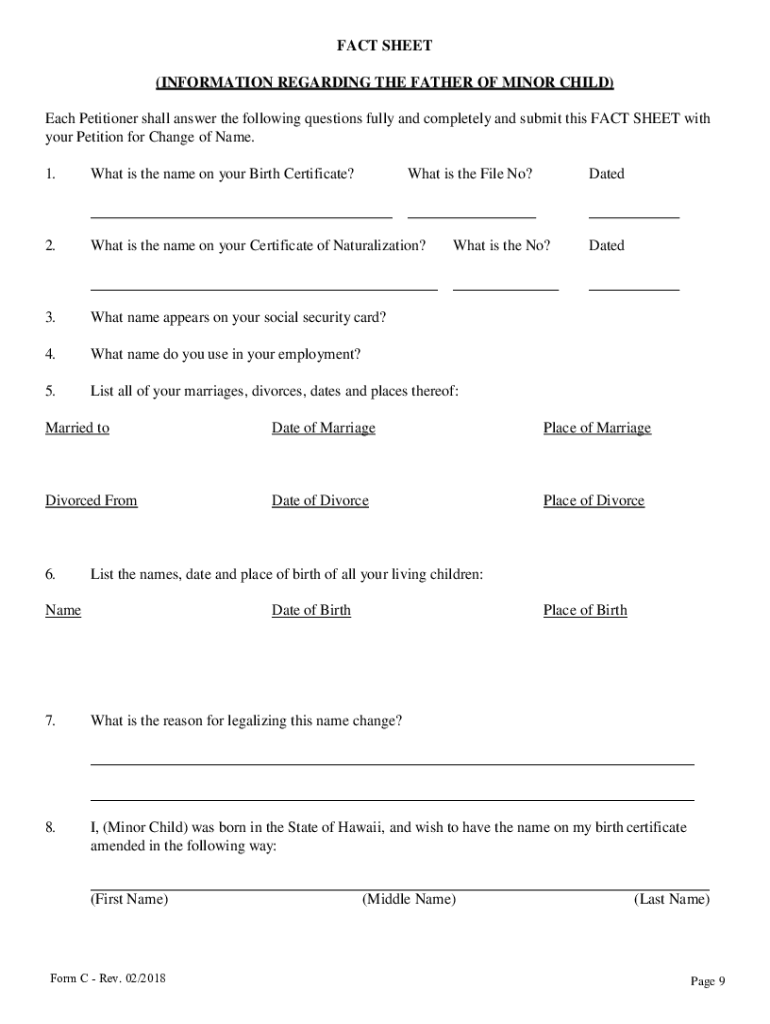







Definition and Purpose of the Information Regarding the Father of Minor Child Form
The "Information Regarding the Father of Minor Child" form plays a significant role in various legal processes, especially in petitions for name changes and other family-related legal actions. Typically, this document is used to collect detailed personal and legal information concerning the father of a minor child. This data is crucial for courts or legal authorities to make informed decisions regarding family law cases and helps in establishing clarity on matters like marital status, paternity, and parental rights. Understanding this form's function allows for accurate and complete submissions, which are essential in facilitating legal processes efficiently.
How to Obtain the Form
The process of obtaining the "Information Regarding the Father of Minor Child" form often varies depending on the jurisdiction. Generally, it can be accessed through local court websites or offices that handle family law cases. In many counties, family law forms, including this one, are available for download in PDF format, ensuring ease of access from any location with internet connectivity. Additionally, some jurisdictions may provide these forms in person at the courthouse or legal aid offices for individuals who prefer a physical copy. Ensuring that you have the latest version of the form is essential to comply with any recent updates or changes in legal requirements.
Steps to Complete the Form
-
Gather Essential Information: Begin by collecting all necessary personal and legal details about the father, such as full name, contact information, and details appearing on official documents.
-
Fill Personal Details: Accurately enter the father's identification details, including dates of birth and Social Security Number, if required.
-
Marital History: Provide a comprehensive overview of marital status, including current and previous marriages, and any associated legal documentation.
-
Children's Information: Record details about any children, including names and birthdates, ensuring accuracy to avoid processing delays.
-
Reason for Submission: Clearly outline the purpose for using the form, such as a legal name change, and provide supporting documentation if needed.
-
Review and Sign: Carefully review all entered information for accuracy and completeness before signing the form, ensuring compliance with submission requirements.
-
Submit the Form: Submit the completed form following the relevant jurisdiction's guidelines, which may include electronic submission or mailing a paper copy.
Key Elements of the Form
- Personal Identification: Full names and detailed information present in legal documents.
- Marital Details: Documentation of marriage history, including divorce decrees or certificates.
- Children’s Details: Listing and verifying information related to children under the father's custody.
- Purpose and Supporting Information: Clearly stated intentions for submitting the form, supported by legal documents wherever applicable.
Importance of Using the Form
The "Information Regarding the Father of Minor Child" form is central in legal contexts where precise parental details are required. Whether for a name change, establishing custody, or clarifying paternity, this form assists legal entities in maintaining accurate records and issuing fair judgments. Completing this form accurately can prevent legal disputes, streamline family law proceedings, and ensure rightful familial associations are legally recognized.
Who Typically Uses this Form
The form is primarily used by legal professionals, family law attorneys, and individuals involved in family court processes. Petitioners seeking a court-mandated name change for their child or resolving custody issues are frequent users of this form. Additionally, guardians or representatives acting on behalf of a minor's interest might utilize this form to clarify parental details in family law cases.
Legal Use and Implications
The legal implications of submitting this form are significant. Accurate completion ensures compliance with family law, mitigating potential disputes regarding parental rights, custody, and identity documentation. Failure to provide complete and truthful information may lead to legal inconveniences, including delayed court proceedings or unfavorable judgments.
State-Specific Rules and Considerations
While the form's core objectives remain consistent, variations in state-specific family laws can affect how the form is processed and what additional documentation might be necessary. Different states may have explicit requirements or additional fields pertinent to their legal standards. It is crucial to be aware of these differences, often detailed in state legislation or court guidelines, and tailor the submission accordingly to align with local protocols.
Examples and Real-World Scenarios
Real-world scenarios often include parents navigating the legal processes for child custody or name changes after a divorce. For example, a petition to change a minor child's last name as part of a custody agreement may require exhaustive details provided by this form. Similarly, in cases where paternity needs to be established legally, this form becomes a foundational document that informs court deliberations and decisions.
Required Documents for Completion
Completing the "Information Regarding the Father of Minor Child" form typically requires supporting documents such as birth certificates, marriage licenses, divorce decrees, and proof of residence. Ensuring all ancillary documents are accurate and match the information on the form is critical for a smooth legal process. Documents should be up-to-date and, where necessary, certified copies may be required to confirm authenticity.
Digital vs. Paper Submission Methods
The form can be submitted either digitally through authorized court portals or in paper format at designated legal offices. Digital submissions may allow faster processing times and provide a user-friendly interface for tracking application status. Conversely, paper submissions might be preferred for traditional filing or in jurisdictions where online options are limited. Regardless of the method chosen, ensuring completeness and accuracy remains paramount for acceptance and processing efficiency.




