




01. Edit your ca d 1 online
Type text, add images, blackout confidential details, add comments, highlights and more.

Type text, add images, blackout confidential details, add comments, highlights and more.

Draw your signature, type it, upload its image, or use your mobile device as a signature pad.

Send ca d 1 form via email, link, or fax. You can also download it, export it or print it out.
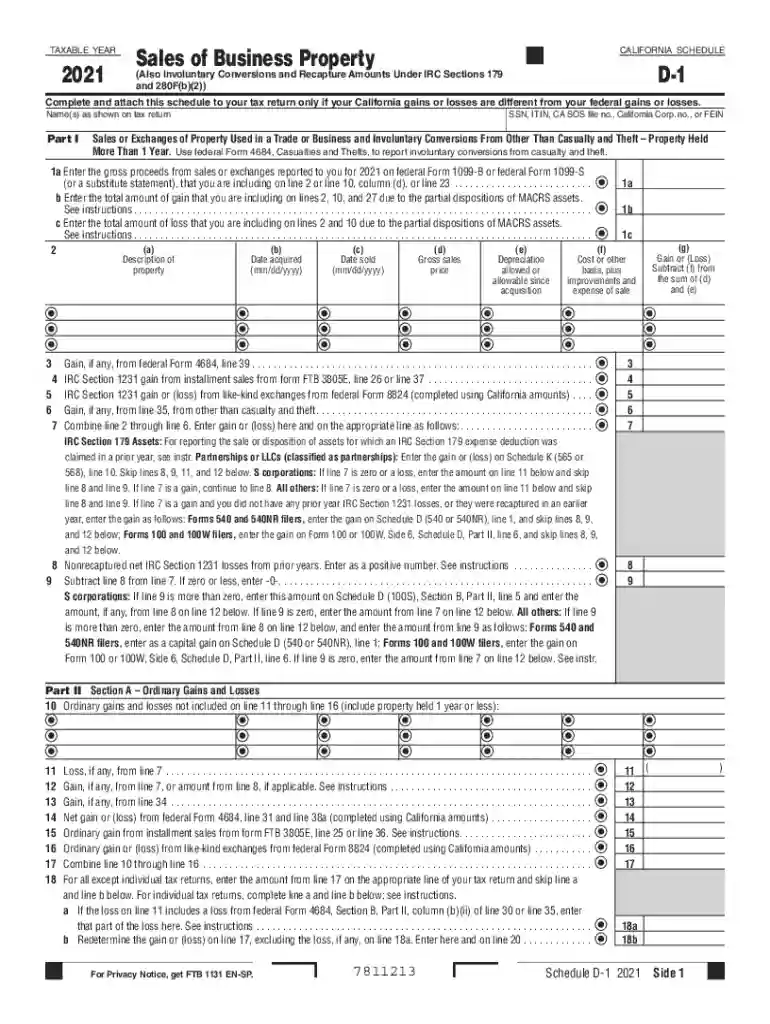
The 2021 Schedule D-1 Sales of Business Property, typically referred to as Schedule D-1, is a tax form used by individuals and businesses to report transactions related to the sale or exchange of business property. This document is crucial for reporting gains or losses arising from selling properties used in trade or business, as well as involuntary conversions and recapture amounts as dictated by specific IRC sections. Schedule D-1 is essential for ensuring compliance with tax regulations by detailing taxable transactions and their financial impacts.
To effectively utilize the 2021 Schedule D-1, individuals and businesses must follow specific steps to complete the form accurately. The process involves:
Completing the 2021 Schedule D-1 involves a series of detailed steps:
Successfully completing the Schedule D-1 requires various supporting documents, including:
Understanding when and how to legally use the Schedule D-1 is crucial:
Adhering to deadlines is critical for the Schedule D-1:
The Internal Revenue Service provides detailed guidelines for the Schedule D-1:
It's vital to understand potential penalties associated with the Schedule D-1:
Accurate completion and a thorough understanding of the 2021 Schedule D-1 Sales of Business Property are essential for meeting tax obligations and avoiding complications.
We've got more versions of the ca d 1 form. Select the right ca d 1 version from the list and start editing it straight away!
Managing your paperwork with DocHub this way is extremely easy once you have downloaded its extension for Google Chrome. Navigate to the Chrome Web Store and set up DocHub - Sign PDF from Gmail to get it. Give our tool access to your Google account, and then open an email containing california d 1 as an attachment and point to the file with your cursor - the DocHub extension button will automatically appear there. Click on it to open your form in our editor. Make any essential modifications, complete the blanks, and click Sign to create your legally-binding eSignature.
If you store your files in Google Drive, there is no need to download your california schedule d 1 on the computer and upload it back to our editor. A significantly simpler way is to set up a browser extension created by DocHub to simplify this flow. The extension allows editing PDFs in your web browser. Alternatively, you may integrate your DocHub and Gmail accounts for more efficient editing.
At DocHub, your data security is our priority. We follow HIPAA, SOC2, GDPR, and other standards, so you can work on your documents with confidence.
Apr 26, 2023 For rental income from debt-financed property, use Schedule D, RTC Section 23701g, Section 23701i, and Section 23701n organizations. SeeRead more
Use Schedule D-1 to report the sale or exchange of business property when the California basis of the asset(s) is different from the federal basis.Read more


