




01. Edit your form online
Type text, add images, blackout confidential details, add comments, highlights and more.

Type text, add images, blackout confidential details, add comments, highlights and more.

Draw your signature, type it, upload its image, or use your mobile device as a signature pad.

Send it via email, link, or fax. You can also download it, export it or print it out.
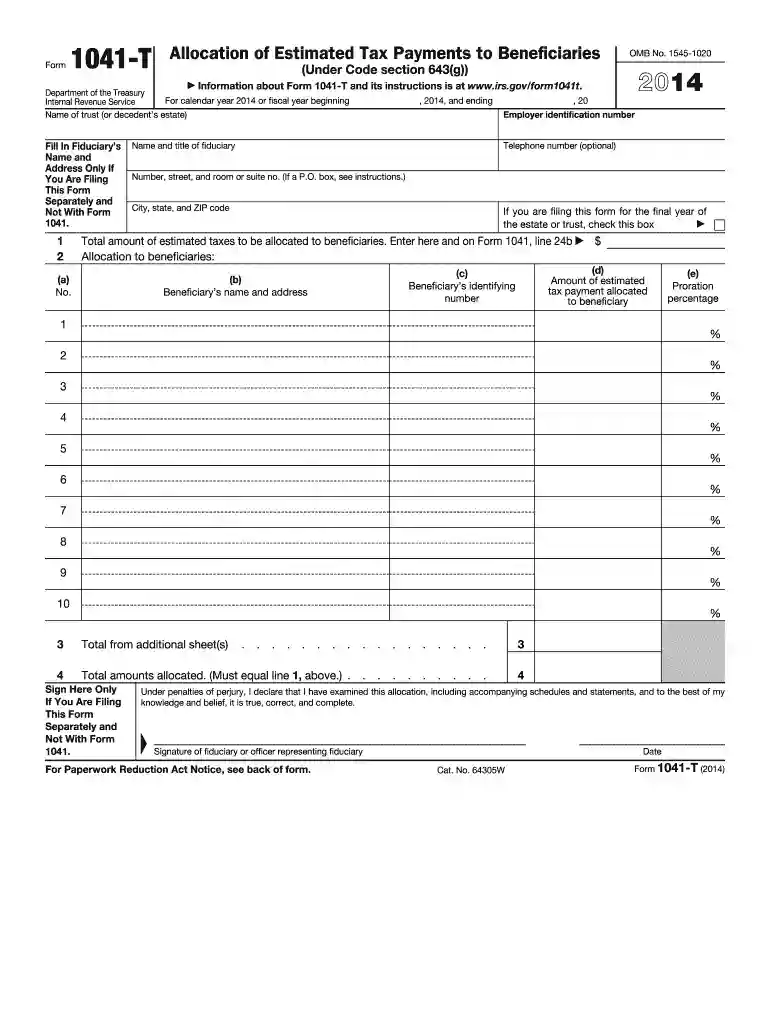
The "Fill In Fiduciarys" form, as interpreted from IRS documentation, is likely associated with form 1041-T. This form is crucial for fiduciaries of trusts or decedent's estates when they need to allocate estimated tax payments to beneficiaries under section 643(g) of the Internal Revenue Code. This allocation enables fiduciaries to elect that estimated tax payments made by the estate or trust be treated as paid by the beneficiaries, which, once elected, is irrevocable. Understanding this form's meaning is vital for proper tax compliance, ensuring that fiduciaries and beneficiaries correctly manage tax payments.
This form is generally used by fiduciaries managing trusts or decedent's estates. They are responsible for allocating tax payments to beneficiaries, ensuring tax obligations are met efficiently. These fiduciaries include:


The IRS provides specific instructions for form 1041-T, offering clarity on how to accurately complete and submit it. Key guidelines include:
Non-compliance with form obligations may result in penalties. The IRS expects adherence to deadlines and accuracy in allocations. Potential penalties include:
Certain states might have individual requirements or variations concerning how fiduciaries report to state tax authorities. Hence, it is critical to:
These sections form a comprehensive overview of the "Fill In Fiduciarys - IRS," ensuring fiduciaries can competently manage their responsibilities and facilitate their correct applications.
We've got more versions of the Fill In Fiduciarys - irs form. Select the right Fill In Fiduciarys - irs version from the list and start editing it straight away!
| Versions | Form popularity | Fillable & printable |
|---|---|---|
| 2025 | 4.8 Satisfied (40 Votes) | |
| 2024 | 4.2 Satisfied (52 Votes) | |
| 2023 | 4.5 Satisfied (36 Votes) | |
| 2022 | 4.7 Satisfied (57 Votes) | |
| 2021 | 4.8 Satisfied (115 Votes) | |
| 2020 | 4 Satisfied (43 Votes) | |
| 2019 | 4.4 Satisfied (46 Votes) | |
| 2018 | 4.1 Satisfied (74 Votes) | |
| 2017 | 4.4 Satisfied (292 Votes) | |
| 2016 | 4.4 Satisfied (77 Votes) | |
| 2012 | 4.3 Satisfied (105 Votes) |
At DocHub, your data security is our priority. We follow HIPAA, SOC2, GDPR, and other standards, so you can work on your documents with confidence.
Every fiduciary, or at least one of joint fiduciaries, must make a return of income on form 1041 (or by use of a composite return pursuant to 1.60125) andRead more
5 days ago Form 56 is used to notify the IRS of the creation or termination of a fiduciary relationship under section 6903 and give notice of qualification under sectionRead more
Apr 15, 1976 Increased section 179 deduction dollar limits. The maximum amount you can elect to deduct for most sec- tion 179 property you placedRead more


