




01. Edit your 1041 t online
Type text, add images, blackout confidential details, add comments, highlights and more.

Type text, add images, blackout confidential details, add comments, highlights and more.

Draw your signature, type it, upload its image, or use your mobile device as a signature pad.

Send form 1041 t via email, link, or fax. You can also download it, export it or print it out.
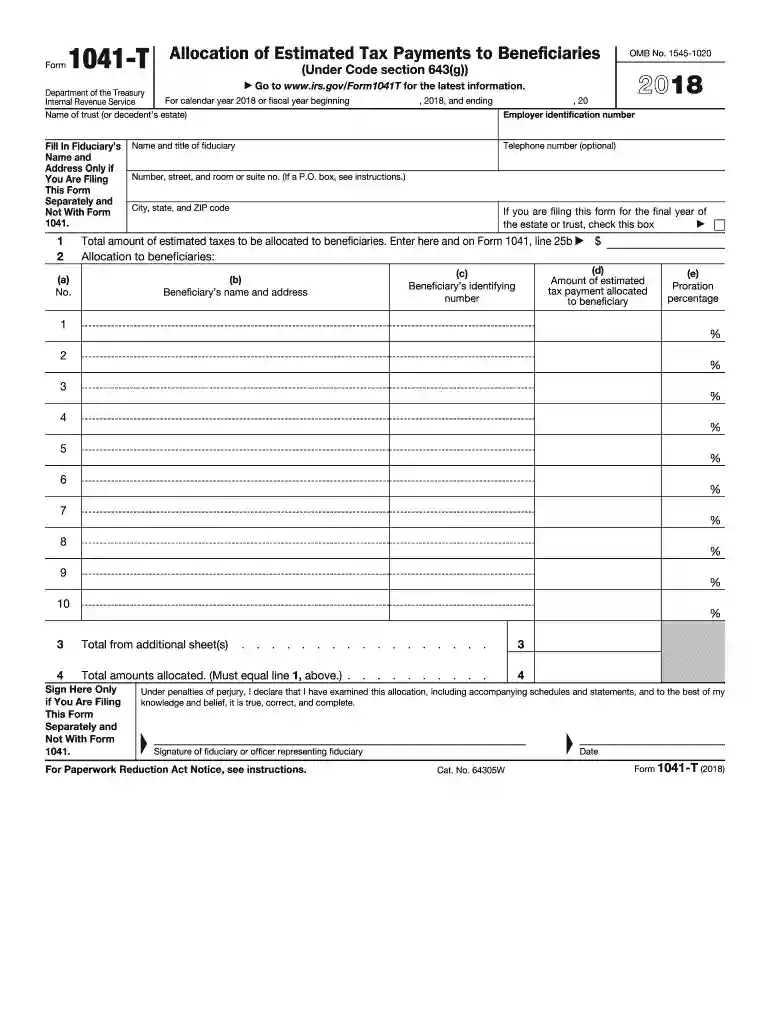
The Tax Form 1041-T, formally known as "Allocation of Estimated Tax Payments to Beneficiaries," is instrumental for fiduciaries managing trusts or decedent's estates. Its primary purpose is to allocate a portion of estimated tax payments to beneficiaries under section 643(g) of the Internal Revenue Code. It provides an avenue for fiduciaries to elect that a part of the tax payments be considered as payments made by the beneficiaries themselves. Understanding this form is crucial for fiduciaries who wish to manage tax implications effectively for both the estate and its beneficiaries.
This form is used primarily by fiduciaries to ensure that beneficiaries receive credit for estimated tax payments applied towards their individual tax returns. Filing the 1041-T allows fiduciaries to manage the tax burdens more strategically, helping beneficiaries align with tax liabilities. By assigning estimated payments to beneficiaries, the fiduciary can better represent the estate's financial activities for tax reporting purposes. Such strategic allocations can optimize tax responsibilities and potentially benefit both the fiduciary and the beneficiaries.
Acquiring the Tax Form 1041-T is straightforward. It can be downloaded directly from the IRS website. Alternatively, it may be available through tax software such as TurboTax or QuickBooks, which often includes the forms necessary for comprehensive tax preparation. Financial institutions or legal professionals specializing in estate planning might also provide this form to their clients. Ensuring the correct version is obtained can prevent misunderstandings during the submission phase.
The crucial filing deadline for the Tax Form 1041-T is the 65th day after the end of the estate or trust’s tax year. This timeline is vital as missing this deadline can lead to complications, including a potential inability to allocate estimated payments to beneficiaries, which could result in higher tax liabilities. Compliance with this deadline ensures that elections made via the form are considered valid for the related tax year, preventing any disruption in beneficiary tax credit allocations.
The form facilitates the legal transfer of tax payment credits from an estate to its beneficiaries and establishes a fiduciary responsibility to report accurately. The legal framework supporting this form under IRS guidelines demands that any allocation of estimated payments be executed with strict adherence to current tax laws. Fiduciaries must act within their legal capacity when utilizing Tax Form 1041-T, ensuring compliance to avoid penalties or legal ramifications.
A typical scenario might involve an estate with multiple beneficiaries, where the fiduciary opts to allocate estimated tax payments directly to those beneficiaries. For instance, in a trust distributing approximately $30,000 in estimated taxes among five beneficiaries, each receiving an equal share, this would translate to $6,000 in estimated payments per beneficiary. This strategic allocation aids beneficiaries in managing their personal tax liabilities efficiently.
By understanding these aspects of Tax Form 1041-T, fiduciaries can strategically allocate estimated tax payments, ensuring compliance and optimizing the tax benefits for the estate and its beneficiaries.
We've got more versions of the 1041 t form. Select the right 1041 t version from the list and start editing it straight away!
| Versions | Form popularity | Fillable & printable |
|---|---|---|
| 2025 | 4.8 Satisfied (40 Votes) | |
| 2024 | 4.2 Satisfied (52 Votes) | |
| 2023 | 4.5 Satisfied (36 Votes) | |
| 2022 | 4.7 Satisfied (57 Votes) | |
| 2021 | 4.8 Satisfied (115 Votes) | |
| 2020 | 4 Satisfied (43 Votes) | |
| 2019 | 4.4 Satisfied (46 Votes) | |
| 2018 | 4.1 Satisfied (74 Votes) | |
| 2017 | 4.4 Satisfied (292 Votes) | |
| 2016 | 4.4 Satisfied (77 Votes) | |
| 2012 | 4.3 Satisfied (105 Votes) |
At DocHub, your data security is our priority. We follow HIPAA, SOC2, GDPR, and other standards, so you can work on your documents with confidence.
Mar 31, 2026 Information about Form 1041-T, Allocation of Estimated Tax Payments to Beneficiaries, including recent updates, related forms and
List the organizations five current highest compensated employees (other than an officer, director, trustee, or key employee) who received reportableRead more
Form 1041-T, al1ocation of estimated tax payments to beneficiaries under code section 643 (g). Journal/Periodical. See availability. Description. Uniform TitleRead more


