




01. Edit your form online
Type text, add images, blackout confidential details, add comments, highlights and more.

Type text, add images, blackout confidential details, add comments, highlights and more.

Draw your signature, type it, upload its image, or use your mobile device as a signature pad.

Send it via email, link, or fax. You can also download it, export it or print it out.
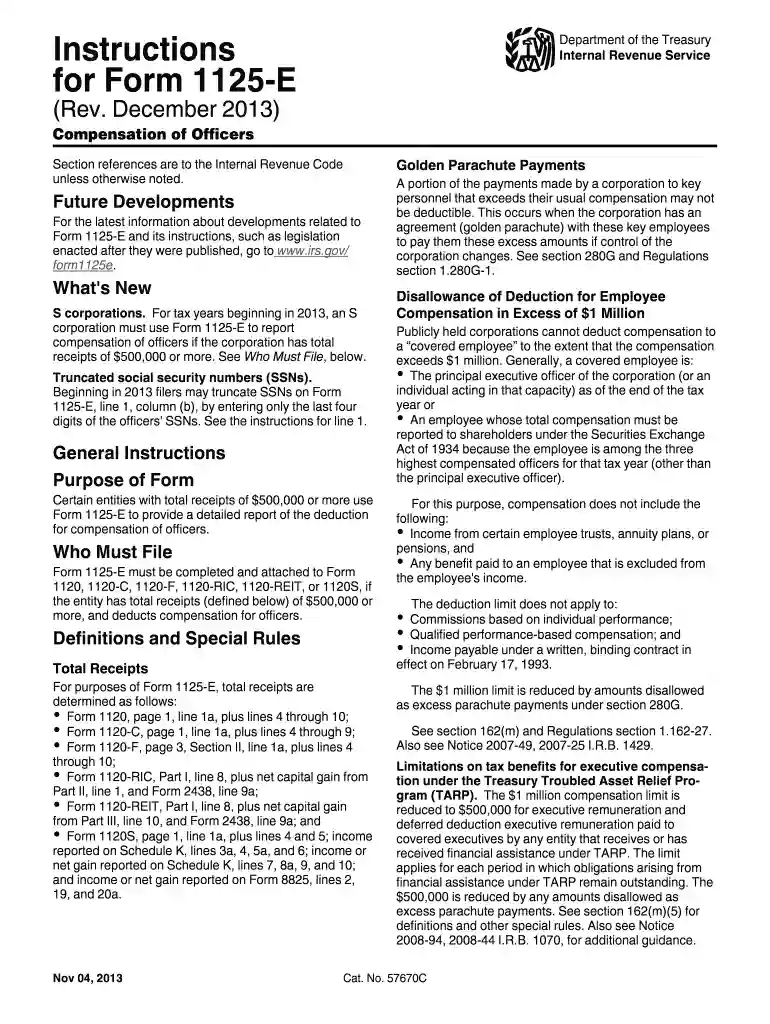
IRS Form 1125-E, essential for S corporations with total receipts of $500,000 or more, is used to report officer compensation for tax purposes. It serves to provide the IRS with information about compensation paid to officers, which is critical in assessing the reasonableness of deductions claimed by the entity. Understanding the function of this form helps businesses ensure compliance with federal tax regulations and avoid penalties due to non-compliance.
Certain thresholds determine which entities need to submit IRS Form 1125-E. Primarily, S corporations with total receipts of $500,000 or more in the tax year must file. It is crucial for these corporations to identify any compensated officers and ensure that their salaries meet the IRS's standards for reasonable compensation. This requirement ensures that corporations do not use excessive officer compensation to unjustly reduce taxable income.


Understanding key concepts related to IRS Form 1125-E is crucial for accurate completion:
Total Receipts: Refers to the gross income amounts recognized for the tax year, encompassing sales of goods, performance of services, and any other business activities.
Officer Compensation: This includes salaries, bonuses, and other forms of payment made to corporate officers that need to be both reasonable and justifiable based on their roles in the corporation.
Golden Parachute Payments: Payments made that can trigger limitations if they exceed a specific threshold, impacting deductibility.
Completing IRS Form 1125-E involves several key steps to ensure accuracy:
Gather Necessary Information: Compile details of all officer compensation for the fiscal year, including any bonuses or additional benefits.
Calculate Total Receipts: Add up all gross income streams to confirm the corporation meets the filing requirements.
Complete the Form: Input officer identifiers, compensation amounts, and roles within the company.
Review Regulations: Verify amounts comply with IRS standards on reasonable compensation to prevent issues during review.
Submit the Form with Tax Return: Attach the completed form to the corporate tax return for the filing year.
The IRS provides specific guidelines regarding officer compensation and deductible limits. It is important for officers’ salaries to reflect their contributions and industry standards. Deductions may be questioned if compensation is deemed unreasonably high. Additionally, guidelines address the treatment of golden parachute payments and stipulate conditions under which they may impact deductibility.
Non-compliance with IRS regulations concerning officer compensation can result in penalties. Misreported or unreasoned compensation can lead to audits and possible fines. Compliance with the guidelines ensures that businesses maintain integrity and financial sustainability without facing legal actions from the IRS.
Digital solutions such as TurboTax and QuickBooks offer compatibility with Form 1125-E, allowing businesses to manage their tax obligations using streamlined software tools. These platforms provide guided filing processes, calculation support, and filing history reports to ensure all documentation complies with federal requirements.
It’s essential to adhere to the filing deadlines associated with corporate tax returns, as Form 1125-E is submitted as part of the overall tax package. Typically, the fiscal year-end dictates the filing period, usually aligning with the March or September deadlines for corporate entities. Preparing the documentation in advance mitigates risks of late fees and compliance issues.
We've got more versions of the irs form compensation 2013 form. Select the right irs form compensation 2013 version from the list and start editing it straight away!
At DocHub, your data security is our priority. We follow HIPAA, SOC2, GDPR, and other standards, so you can work on your documents with confidence.
Sep 16, 2013 These proposed regulations set forth rules for applying this requirement in separate situations depending upon (1) whether the premiumRead more
Complete Form 1125-E only if total receipts are $500,000 or more. See instructions for definition of total receipts. (a) Name of officer. (b) Social securityRead more
FORM 990 - 2013 RETURN OF ORGANIZATION EXEMPT FROM INCOME TAX. NO PAYMENT IS REQUIRED. five current highest compensated employees ・ than $100,000 from the


